QUETTA, Pakistan: Ten laborers were gunned down in southwestern Pakistan on Saturday while working on link roads to connect outlying towns to the country’s $57-billion Chinese “Belt and Road” initiative, security officials confirmed.
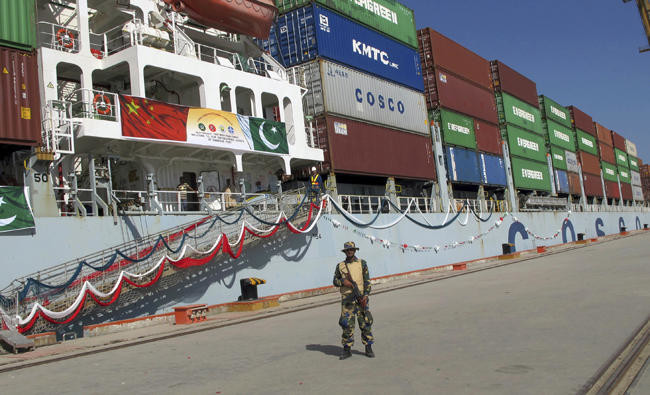
The attack on the Pakistani laborers took place some 20 kilometers from the emerging port city of Gwadar in Baluchistan province that forms the southern hub of the China-Pakistan Economic Corridor (CPEC).
“All the laborers were shot at close range,” said senior levies official Muhammad Zareef, adding that the shooters were traveling on a motorcycle. The levies are a paramilitary force that oversees security in Baluchistan where police jurisdiction is limited to major urban centers.
Gwadar’s deep-water port is the exit point for a planned route from China’s far-western Xinjiang region to the Arabian Sea.
Nadeem Javaid, who advises Prime Minister Nawaz Sharif’s government and works closely on the CPEC program, told Reuters earlier in the week that the Gwadar-Xinjiang corridor should be operational from June next year.
He said Pakistan expects up to 4 percent of global trade to pass through it by 2020.
Baluchistan, however, has long faced security concerns. Separatist militants in the province have waged a campaign against the central government for decades, demanding a greater share of the gas-rich region’s resources.
Security officials have said previously that militants trying to disrupt construction on the “economic corridor” have killed 44 workers since 2014, all of whom were Pakistani.
Pakistan’s military created an army division in 2015, believed to number more than 10,000 troops, specifically to protect CPEC projects and Chinese workers.
The men killed and wounded on Saturday had been working for the provincial government at two separate construction sites on three kilometers apart along the same road. Two laborers wounded in the shootings were taken to hospital where one of them died from his injuries, Zareef said.
The roads the laborers were working on are not specific CPEC-funded projects, but they are part of a network of connecting roads that are part of the corridor.
No group has admitted responsibility for the shootings but past attacks in the region have been carried out by separatists who view construction projects as a means to take over their land.
The shootings come a day after a suicide bomber targetting a Pakistani senator killed 26 people and injured 40, Baluchistan Home Minister Sarfraz Bugti said.
Friday’s attack was claimed by Daesh via its Amaq news agency.


![]()
10 workers gunned down near China 'Belt and Road' projects in Pakistan
10 workers gunned down near China 'Belt and Road' projects in Pakistan



Latest updates


© 2026 SAUDI RESEARCH & PUBLISHING COMPANY, All Rights Reserved And subject to Terms of Use Agreement.