SEOUL: The exhibition “Roads of Arabia: Archaeological Treasures of Saudi Arabia” was inaugurated on Monday at the National Museum of Korea in Seoul.
It is a joint initiative of Saudi Aramco’s King Abdulaziz Center for World Culture, and the Saudi Commission for Tourism and National Heritage (SCTH).
It was inaugurated by SCTH President Prince Sultan bin Salman, Energy Minister and Aramco Chairman Khalid A. Al-Falih, South Korean Deputy Prime Minister Yoo Il-ho and Song Soo-keun, first vice minister of culture, sports and tourism. The exhibition was attended by diplomats, businesspeople and cultural dignitaries.
It was previously on display for three months at the National Museum of China in Beijing, where it attracted more than 170,000 visitors. “Roads of Arabia” is expected to be on display in South Korea for about four months.
At the inauguration ceremony, Al-Falih said: “With ‘Roads of Arabia,’ we bring to Korea a sort of cultural map, artifacts that are priceless not only because of their historic and artistic value, but because they tell the story of the people of the Arabian Peninsula. Across the globe, roads have connected people, ideas, art and culture. In fact, our two nations represent two peninsulas and two peoples, connecting the East and the West.”
He added: “As part of Vision 2030, Saudi Aramco is strengthening its focus of building bridges of trade, commerce and partnerships with the Republic of Korea. And through ‘Roads of Arabia,’ we are also helping pave new roads of culture and people-to-people contacts, all of which are essential for true prosperity.”
Featuring important archaeological relics illustrating the depth and history of Arab civilization, the exhibition features more than 466 pieces selected from the National Museum in Riyadh, the King Saud University Museum and other museums.
The artifacts range from the prehistoric and pre-Islamic periods to the reign of King Abdulaziz, some on display for the first time.
The exhibition was displayed in Saudi Arabia in December 2016 as part of the inauguration of the Dhahran-based King Abdulaziz Center for World Culture, when King Salman launched the Asian tour of the “Archaeological Masterpieces of Saudi Arabia” exhibition.


![]()
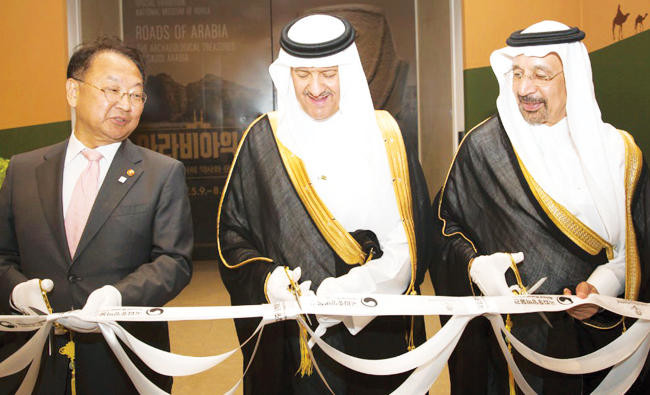
‘Roads of Arabia’ exhibition inaugurated in Seoul
‘Roads of Arabia’ exhibition inaugurated in Seoul
Latest updates


© 2026 SAUDI RESEARCH & PUBLISHING COMPANY, All Rights Reserved And subject to Terms of Use Agreement.