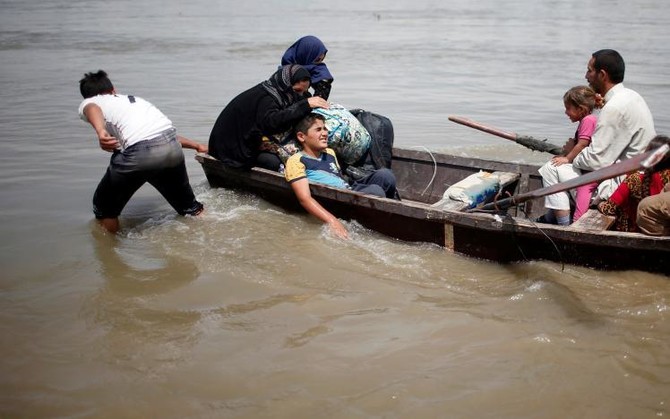
MOSUL: The Iraqi man laid the body of his wife, wrapped in a black shroud, gently on the bow of a small wooden boat and held onto it as a second man rowed slowly to pick up the man’s three children standing a few meters away.
The two teenage girls and young boy climbed in, careful not to disturb the balance, for the crossing taking their mother, killed in an air strike this week, to the east bank of the Tigris River.
This crossing is no ancient rite, however.
It is an extra hardship heaped on the family by the flooding of the Tigris and the disassembly of the last pontoon bridge linking the two sides of Mosul, where US-backed Iraqi forces have been fighting to oust the Daesh militants who seized the city in 2014.
Loading up everything from clothes and food to injured or dead relatives, hundreds of families exhausted by war have been crossing the river on small, rickety fishing boats capable of holding only five or six people.
Many have been leaving the Musherfa district of western Mosul after US-backed Iraqi forces took it from Islamic State on Friday, hoping to reach the relative safety of the eastern banks of the river.
“We suffered Islamic State’s injustice, and now that we are free we were promised five bridges,” said 45-year-old Mushref Mohamed, an ice factory worker from Musherfa. “Where are the bridges? We have been waiting for two days.”
“So many of my neighbors and friends died. We were freed, but we are not happy because we lost the people closest to us.”
The flooding has cut off all crossing points between east and west and forced the military to dismantle the makeshift bridges linking the two sides of Iraq’s second-largest city.
Mothers carrying babies, men in wheelchairs, and families of up to 15 people have been paying 1,000 Iraqi dinars ($0.86) per head to make the short journey, with many needing to make two or three trips.
Even soldiers carrying green army crates full of military documents and cigarettes have had to use the boats. The army initially planned to transport people using steamboats when they took down the pontoons, but now say they have run out of gas.
“We came from the early morning at 7am and have been waiting until now. It is noon. The steamboats do not have gas. This government cannot provide gas?” asked Mohsen, a pensioner from the Wadi Hajar area in west Mosul.
Mosul’s permanent bridges have mostly been destroyed during the seven-month campaign to take the city back from Islamic State.
The army opened a new front in the war with an armored division trying to advance into the city from the north on Thursday and taking back two areas on Friday.
The militants are now besieged in the northwestern corner of Mosul which includes the historic Old City, the medieval Grand Al-Nuri Mosque and its landmark leaning minaret where Islamic State leader Abu Bakr Al-Baghdadi declared a “caliphate” spanning swathes of Syria and Iraq in June 2014.
The Iraqi army said on April 30 that it aimed to complete the retaking of Mosul, the largest city to have fallen under Islamic State control in both Iraq and Syria, this month.

Flooding forces Mosul residents to flee war in rickety boats
UN experts slam Israeli ‘terrorist’ death penalty bill
GENEVA: United Nations experts on Wednesday called on Israel to withdraw a bill proposing the mandatory death penalty for terrorist acts, warning it would violate the right to life and discriminate against Palestinians.
Israel’s parliament last November passed a first reading of a draft amendment to the country’s penal code, demanded by far-right National Security Minister Itamar Ben Gvir.
“Mandatory death sentences are contrary to the right to life,” a dozen independent UN rights experts warned in a statement.
“By removing judicial and prosecutorial discretion, they prevent a court from considering the individual circumstances, including mitigating factors, and from imposing a proportionate sentence that fits the crime,” they said.
While the death penalty exists for a small number of crimes in Israel, it has become a de facto abolitionist country: the last person to be executed was the Nazi Holocaust perpetrator Adolf Eichmann in 1962.
But the amendment, which must pass a second and third reading before becoming law, would change that and would introduce two tracks for the death penalty in Israel, a dozen independent UN rights experts warned in a statement.
In the occupied West Bank, the statement said “the death penalty would be imposed by military courts under military law for terrorist acts causing the death of a person, even if not intended.”
In Israel and occupied East Jerusalem, meanwhile, capital punishment would continue to be applied only under Israeli criminal law and only for the “intentional killing of Israeli citizens or residents.”
‘Vague and overbroad’
The experts’ statement warned that under both tracks, “vague and overbroad definitions of terrorist offenses under Israeli law would apply, which can include conduct that is not genuinely terrorist, and the death penalty would be mandatory.”
The experts, including Francesca Albanese, the special rapporteur for the rights situation in the occupied Palestinian territories, stressed that unintentional killings were not considered among the “most serious” crimes to which the death penalty can be applied under international law.
“Since Israeli military trials of civilians typically do not meet fair trial standards under international human rights law and humanitarian law, any resulting death sentence would further violate the right to life,” said the experts, who also included the special rapporteurs for protecting rights while countering terrorism and for extrajudicial, summary or arbitrary executions.
“Denial of a fair trial is also a war crime,” they stressed.
The independent experts, who are mandated by the UN Human Rights Council but who do not speak on behalf of the United Nations, also warned that “the bill makes matters worse by allowing death sentences to be imposed by a simple majority vote of military judges.”
Hamas said in November that the proposed law “embodies the ugly fascist face of the rogue Zionist occupation and represents a blatant violation of international law.”
The Ramallah-based Palestinian foreign ministry called it a “new form of escalating Israeli extremism and criminality against the Palestinian people.”
Israel’s parliament last November passed a first reading of a draft amendment to the country’s penal code, demanded by far-right National Security Minister Itamar Ben Gvir.
“Mandatory death sentences are contrary to the right to life,” a dozen independent UN rights experts warned in a statement.
“By removing judicial and prosecutorial discretion, they prevent a court from considering the individual circumstances, including mitigating factors, and from imposing a proportionate sentence that fits the crime,” they said.
While the death penalty exists for a small number of crimes in Israel, it has become a de facto abolitionist country: the last person to be executed was the Nazi Holocaust perpetrator Adolf Eichmann in 1962.
But the amendment, which must pass a second and third reading before becoming law, would change that and would introduce two tracks for the death penalty in Israel, a dozen independent UN rights experts warned in a statement.
In the occupied West Bank, the statement said “the death penalty would be imposed by military courts under military law for terrorist acts causing the death of a person, even if not intended.”
In Israel and occupied East Jerusalem, meanwhile, capital punishment would continue to be applied only under Israeli criminal law and only for the “intentional killing of Israeli citizens or residents.”
‘Vague and overbroad’
The experts’ statement warned that under both tracks, “vague and overbroad definitions of terrorist offenses under Israeli law would apply, which can include conduct that is not genuinely terrorist, and the death penalty would be mandatory.”
The experts, including Francesca Albanese, the special rapporteur for the rights situation in the occupied Palestinian territories, stressed that unintentional killings were not considered among the “most serious” crimes to which the death penalty can be applied under international law.
“Since Israeli military trials of civilians typically do not meet fair trial standards under international human rights law and humanitarian law, any resulting death sentence would further violate the right to life,” said the experts, who also included the special rapporteurs for protecting rights while countering terrorism and for extrajudicial, summary or arbitrary executions.
“Denial of a fair trial is also a war crime,” they stressed.
The independent experts, who are mandated by the UN Human Rights Council but who do not speak on behalf of the United Nations, also warned that “the bill makes matters worse by allowing death sentences to be imposed by a simple majority vote of military judges.”
Hamas said in November that the proposed law “embodies the ugly fascist face of the rogue Zionist occupation and represents a blatant violation of international law.”
The Ramallah-based Palestinian foreign ministry called it a “new form of escalating Israeli extremism and criminality against the Palestinian people.”
© 2026 SAUDI RESEARCH & PUBLISHING COMPANY, All Rights Reserved And subject to Terms of Use Agreement.