PARIS: France’s election campaign commission says “a significant amount of data” has been leaked on social networks following a hacking attack allegedly suffered by centrist presidential candidate Emmanuel Macron, 36 hours before the nation votes Sunday in the crucial runoff against Marine Le Pen.
The commission said Saturday that leaked data apparently came from Macron’s “information systems and mail accounts from some of his campaign managers.” In a statement released after a morning meeting, the watchdog said the leaked data had been “fraudulently” obtained and that fake news has probably been mingled with it.
The commission urged French media and citizens “not to relay” the leaked documents “in order not to alter the sincerity of the vote.” French electoral laws impose a blackout Saturday and most of Sunday on any campaigning and media coverage seen as swaying the election.
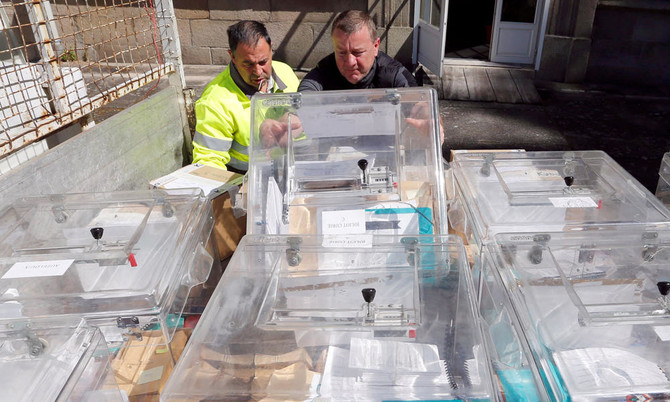
Meanwhile voting for France’s next president started in some overseas territories Saturday.
The first French territory to vote was Saint-Pierre-et-Miquelon, an archipelago located near Newfoundland, where polling stations opened in the morning. Early voting in other French overseas territories and French embassies abroad would begin later.
The 44-hour legal blackout on campaigning began Friday at midnight and is due to last until Sunday at 8 p.m. when the last polling stations close on the mainland and the first pollsters’ projections and official partial results are expected.
Fears of hacking and campaign interference have simmered throughout France’s high-stakes, closely watched campaign — and boiled over Friday night as Macron’s team said it had been the victim of a “massive and coordinated” hack.
His political movement said the unidentified hackers accessed staffers’ personal and professional e-mails and leaked campaign finance material and contracts — as well as fake decoy documents — online.
The perpetrators remain unknown. While the hack is shaking up the already head-spinning campaign, it’s unclear whether the document dump would dent Macron’s large poll lead over Le Pen going into the vote.
After ditching France’s traditional left-right parties in a first-round election, voters are now choosing between Macron’s business-friendly, pro-European vision and Le Pen’s protectionist, closed-borders view that resonates with workers left behind by globalization. The future of the European Union may hinge on the vote, also seen as a test for global populism.
The leak, which began just before the blackout descended at midnight, in theatrical timing befitting the dramatic campaign.
Florian Philippot, the No. 2 in Le Pen’s anti-immigration National Front party, asked in a tweet: “Will the #Macronleaks teach us something that investigative journalism deliberately buried?“
Someone on 4chan — a site known, among other things, for cruel hoaxes and political extremism — posted links to a large set of data which was said to have come from Macron’s campaign. Macron’s campaign swiftly confirmed it had been hacked some weeks ago, and that at least some of the documents were genuine.
Slamming the hack as an effort to “seed doubt and disinformation” and destabilize the vote, Macron’s movement En Marche said it would “take all measures” to shed light on what happened. It recalled similar leaks from Hillary Clinton’s US presidential campaign.
The voting watchdog called on the Interior Ministry late Friday to look into claims by the Le Pen campaign of tampering with ballot papers which it claimed was to benefit Macron. The Le Pen campaign said electoral administrators in several regions who receive ballot papers for both candidates have found the Le Pen ballot “systematically torn up.”
The presidential campaign has been unusually bitter, with voters hurling eggs and flour, protesters clashing with police and the candidates insulting each other on national television — a reflection of the deep divisions and public disaffection with politics.
Le Pen, 48, has brought her far-right National Front party, once a pariah for its racism and anti-Semitism, closer than ever to the French presidency, seizing on working-class voters’ growing frustration with globalization and immigration. Even if she loses, she is likely to be a powerful opposition figure in the upcoming parliamentary election campaign.
“We changed everything,” win or lose, Le Pen said in an interview with The Associated Press on Friday. She claimed an “ideological victory” and said she could still win on Sunday.
The 39-year-old Macron, who has never held elected office, also helped upend France’s traditional political structure with his wild-card campaign outside standard parties.
Many voters, however, don’t like either Le Pen or Macron. They fear her party’s racist past, while worrying that his platform would demolish job protections for workers or be too much like his mentor, the deeply unpopular outgoing President Francois Hollande.

French watchdog: large amount of Macron data leaked
Trump takes unconventional approach to communicating to the public about war in Iran
- The communications strategy opened Trump to criticism that he hadn’t done enough to explain the rationale and objectives of the war
Typical of an unconventional presidency, the Trump administration waited more than 48 hours to make any live, public communication to the American people about why it had decided to go to war with Iran.
President Donald Trump discussed why he launched the attack prior to a White House ceremony honoring military heroes on Monday but took no questions from reporters. Earlier in the day, Defense Secretary Pete Hegseth and Joint Chiefs of Staff Chairman Dan Caine briefed journalists at the Pentagon.
The two days previous, Trump delivered two pretaped statements that were released on Truth Social, the social media site owned by the president’s media company, and granted telephone interviews to more than a dozen journalists — several of which produced fragmented responses that, to some, clouded as much as they cleared up.
The communications strategy opened Trump to criticism that he hadn’t done enough to explain the rationale and objectives of the war, even as the American military suffered its first casualties. By contrast, Israeli Prime Minister Benjamin Netanyahu, who has teamed with the US against Iran, delivered two statements the day the war began and addressed reporters Monday at the site of a missile attack that killed nine people. The Israeli military has held multiple press briefings each day.
“The American people need a commander in chief, and he has been absent in that role,” Rahm Emanuel, White House chief of staff under President Barack Obama, said on CNN Monday. Emanuel, a Democrat, is contemplating a run for the presidency in 2028.
An unconventional strategy leads to criticism
Peter Baker, chief White House correspondent for The New York Times, wrote on social media that “after Trump launched a new war on Iran, he did not rush back to the White House to make an Oval Office address to rally the nation as other presidents have done. He stayed at Mar-a-Lago to attend a glitzy political fundraiser.”
That post provoked a response from Steven Cheung, White House communications director. “Imagine being a reporter so consumed with Trump Derangement Syndrome that he wants President Trump to mimic the failed policies of the past. The truth is that President Trump spent the majority of his time monitoring the situation in a secure facility, in constant contact with world leaders, and made multiple addresses to the nation that garnered hundreds of millions of views. He also took dozens of calls with reporters.”
The calls included one with Baker’s colleague at The Times, Zolan Kanno-Youngs. Trump’s mobile phone number is known to many of the reporters who cover him, and the president often takes their calls for on-the-spot interviews. Besides The Times, he spoke in the aftermath of the attack to journalists for ABC, CBS, NBC, CNN, CNBC, Fox News Channel, The Atlantic, The Washington Post, Axios, Politico and an Israeli television station.
Most of the calls were brief and marginally illuminating; Politico’s Dasha Burns said Trump answered but said he was too busy to talk. The public couldn’t hear what Trump said in the interviews and was dependent upon what the journalists chose to report on the conversations.
“I spoke to President Trump today and he told me that the operation in Iran is going to go very fast,” Libby Alon, a reporter for Channel 14 News in Israel, wrote about her interview on X. “It’s doing very well, and (will) make the people of Israel very happy, and the people of the world very happy.”
The Times reported that in its six-minute chat, Trump “offered several seemingly contradictory visions of how power might be transferred to a new government — or even whether the existing Iranian power structure would run that government or be overthrown.”
In one of his two conversations with Trump, ABC News’ Jonathan Karl said when he asked about the death of Iranian Ayatollah Ali Khamenei, the president said: “I got him before he got me. They tried twice. Well I got him first.” CNN’s Jake Tapper went on the air minutes after his conversation Monday, saying Trump told him “the big one is coming soon,” an apparent reference to a future attack.
Asked for comment, White House spokeswoman Anna Kelly said: “President Trump is the most transparent and accessible president in American history. The American people have never had a more direct and authentic relationship with a president of the United States than they have with President Trump.”
Hegseth briefing concentrates on friendly reporters
Pentagon reporters learned late Sunday about Hegseth’s briefing. Reporters from The Associated Press, Reuters, ABC, CBS, NBC, CNN, Fox News Channel and Stars & Stripes were permitted into the briefing room, but Hegseth did not call on them. Instead, he took questions from NewsNation and Trump-friendly outlets like the Daily Caller, Daily Wire, One America News and the Christian Broadcasting Network. Most mainstream news outlets left their regular stations at the Pentagon last fall rather than agree to Hegseth’s rules restricting their work.
Hegseth denounced the “foolishness” of people wanting to know details of the operation in advance, such as whether Americans would commit to more than air power, and said the operation would continue as long as it took to achieve objections. He initially ignored NBC News’ Courtney Kube when she called out a question: “President Trump put a four-week time limit on it. Are you saying he’s wrong?”
Later, Hegseth denounced Kube for asking “the typical NBC sort of gotcha-type question. President Trump has all the latitude in the world to talk about how long it might take — four weeks, two weeks, six weeks, it could move up, it could move back. We’re going to execute at his command the objectives he set out to achieve.”
Unlike Pentagon briefings in past administrations, reporters were given assigned seats, with the Trump-friendly outlets seated in front. Jennifer Griffin, Hegseth’s former colleague at Fox News Channel who left the Pentagon with other reporters after not accepting his new rules, was seated in the last row.