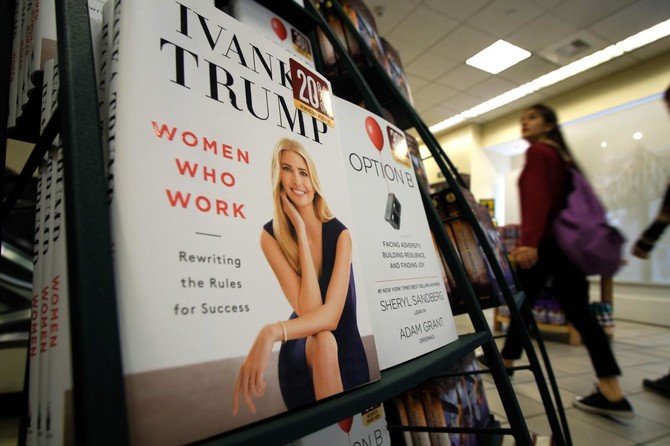
NEW YORK: US First Daughter Ivanka Trump revived ethics concerns Tuesday by publishing a self-help book for working women, which was immediately criticized for offering little help to millions of Americans living outside the moneyed elite.
“Women Who Work: Rewriting the Rules for Success” was released simultaneously in hardback, ebook, 497-minute audio download and CD, Donald Trump’s favorite child sitting on the cover in a dark frock.
The millionaire mother of three, assistant to the president and wife of White House adviser Jared Kushner, says she wrote the tome, published by Penguin business imprint Portfolio, before her father’s shock election.
She took leave from the family real estate business and her eponymous clothing line in January. She is now an unpaid federal employee, with an office in the West Wing, who fulfills duties traditionally carried out by a first lady.
The purpose of the book, she writes, is to empower others with skills she has learned in matters as diverse as starting companies, negotiating, maximizing your influence at work and “helping change the system to make it better for women.”
The text is peppered with quotations from the likes of Mahatma Gandhi, business leaders Jeff Bezos and Sheryl Sandberg, even former secretary of state Colin Powell.
Yet the book spotlights the gulf between the gilded world of a 35-year-old woman thought — with her husband — to still hold investments worth up to $740 million and the struggles facing middle- or working-class working women.
She makes only fleeting reference to a nanny as she details an exhausting schedule for managing her companies, her household and date nights with her husband.
At extremely busy times, such as her father’s presidential campaign, she admits: “I wasn’t treating myself to a massage or making much time for self-care.”
She references her joy at spending weekends “at our country home in New Jersey,” her love of transcendental meditation and shares tips on treating your children to a “spa bath:” run the shower for steam, play rain forest music and lower the lights.
Fatima Goss Graves, incoming president of the National Women’s Law Center that promotes equality for women and families, wrote in US News that the book was “completely out of touch with the obstacles working women face.”
“Millions of women are in no position to follow any of this advice.”
The New York Times, a newspaper repeatedly criticized by the Republican president, called it “not really offensive so much as witlessly derivative.” The “why of her book becomes easy to discern. She’s extending the Trump brand.”
Online booksellers Amazon listed the book with an average of three out of five stars, an instant bestseller in the category of “job hunting and careers.”
Alongside glowing reviews extolling her as a role model with practical advice, irrate comments criticized her as a woman of privilege who never had to work.
Likely galling to many a hard-up student will be the revelation that Anna Wintour, the legendary editor of Vogue, called her in person to offer her a job while she was yet to graduate — a position which she “graciously declined.”
Trump, who uses social media to showcase a carefully curated image, reveals that she shared the first picture of her daughter only after being ambushed by paparazzi.
She justified sharing a photograph of herself digging in the garden with “messy” hair and “dirt on my cheek” thinking it might help “debunk the superwoman myth.”
Trump was pre-paid an advance for the book, but has tried to fend off concerns that she is profiting from public office by promising to donate further profits to charity and announcing that she would not go on a promotional tour.
“In light of government ethics rules, I want to be clear that this book is a personal project. I wrote it at a different time in my life,” she wrote on Facebook.
The book closes with her often-stated desire for the United States to enshrine paid leave and affordable high-quality childcare, but offers no concrete blueprint on how that might be achieved.