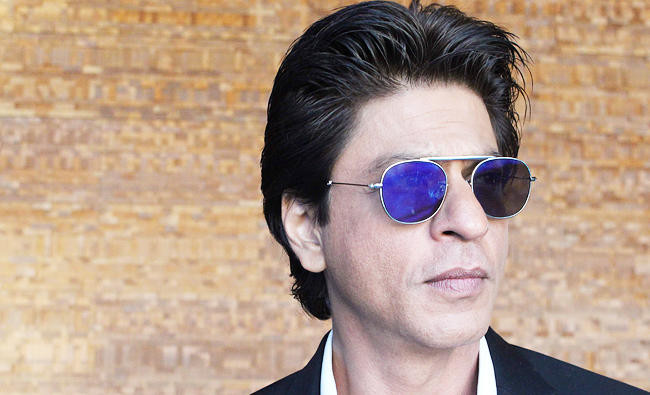
VANCOUVER: Indian superstar Shah Rukh Khan charmed a TED Conference crowd recently, sharing his life and playfully portraying himself as an aging movie star grappling with the changes around him.
Khan’s talk on the TED stage came just months before a version of the big-idea-sharing event makes a television debut in India, where he will play the role of curator Chris Anderson.
In a rare display, scores of fans staked out the convention center where TED was taking place, some of them pressing against windows to watch Khan’s appearance being streamed to television screens.
“For years, I’ve been a huge fan of TED Talks,” Khan said, referring to the conference’s freely shared videos in which brilliant and accomplished people dive concisely into captivating concepts.
“There are so many people in India who would like to come out with their ideas and thoughts, and speak them in Hindi.”
TED curator Anderson described TED Talks India as the organization’s most ambitious television project to date, and expected it to reach tens of millions of people when episodes begin airing later this year. TED collaborated with media giant Star India on the project.
“The country is teeming with imagination and innovation,” Anderson said in a blog post.
“We believe this series will tap into that spirit and bring insight and inspiration to many new minds.”
In a TED video likely to go viral when it is released online, 51-year-old Khan reminisced about growing up in a time when the word “apple” brought to mind fruit, not a world-changing company co-founded by the late Steve Jobs.
He spoke of his career rocketing and the arrival of an Internet age where social media was so rampant that he felt “humanity, like me, was becoming an over-exposed prima donna.”
“I sell dreams and I peddle love to millions of people back home in India who assume that I am the best lover in the world,” Khan said as he opened his talk.
“It has to be you who creates a world that is its own best lover, that should be the future you,” he said in closing, referring to the conference theme.

Shah Rukh Khan taking TED to India TV
For a quarter of a century, Banksy has contributed to many charitable causes
- As his fame has grown, so too have the sums he raises. Reuters could not confirm how much money the artist has donated
Banksy has consistently used his art to fund charitable causes. As his fame has grown, so too have the sums he raises. Reuters could not confirm how much money the artist has donated. In his book “Banksy: The man behind the wall,” author Will Ellsworth-Jones notes that “there is no Banksy Foundation donating money publicly,” making it impossible to “give a complete picture of what he gives away.” Here are some of Banksy’s donations:
2002: Banksy collaborated with Greenpeace to produce artwork for the environmental-action charity’s “Save or Delete” campaign to highlight the dangers of deforestation: It showed characters from Disney’s animated film ‘The Jungle Book,’ tied up and blindfolded in a denuded patch of jungle.
2007: Banksy took his annual “Santa’s Ghetto” pop-up art show and 20 street artists to the West Bank city of Bethlehem, donating proceeds to local youth projects.
2008: Banksy released a series of 299 signed prints of his mural depicting children saluting a Tesco supermarket bag. The sale was conducted as a lottery. According to a published report, Banksy donated the £24,406.61 raised to Sightsavers, an international NGO that provides free eye operations.
2010: Banksy pledged to donate all royalties from 175 prints of his “Choose Your Weapon” mural of a hooded man holding a dog painted in the style of fellow street artist Keith Haring to Russian art collective Voina. Two members of the collective were in a St. Petersburg jail at the time for taking part in an anti-corruption protest. That year, Banksy allowed Moorfields Eye Hospital in London to remove and auction the 2006 “Gangsta Rat” piece he painted on the side of its building. The piece was sold to raise money for the hospital.
2013: In a month-long residency in New York, Banksy bought a beat-up oil painting from a thrift store for $50 and altered the piece by adding a Nazi officer admiring the landscape it depicted. He then covertly returned the doctored work to the charity shop and included a note authenticating it as a Banksy. The charity, Housing Works, sold the piece at auction for $615,000.
2014: A struggling youth club in Bristol, the Broad Plain Boys Club, found a Banksy mural on its doorway. “Mobile Lovers” showed a couple embracing but distracted by their mobile phones. When it became clear it was a Banksy, the local council tried to claim it. Banksy clarified that he intended the piece as a gift to the club, which was facing closure. The club sold the piece for over £400,000 and used the money to stay afloat.
2015: Banksy enlisted dozens of artists to help create his theme park, “Dismaland.” After the park closed, he donated the set pieces and building materials used to create the alternative theme park to “The Jungle,” a camp for migrant refugees in Calais, northern France.
2017: Banksy opened “The Walled Off Hotel” in the West Bank city of Bethlehem. Banksy financed the project independently. The hotel has attracted thousands of visitors and its website notes that any profits will go to local projects.
2019: Banksy created a shop called “Gross Domestic Product” in London. The welcome mats he sold there were produced by women in Greek refugee camps using life vests that washed up on shore. Proceeds were donated to Love Welcomes, a group supporting refugees in the camps.
2020: At the peak of the first wave of COVID-19, Banksy unveiled a piece inside Southampton General Hospital that paid tribute to Britain’s National Health Service workers. It showed a boy who had discarded his Batman and Spiderman dolls in favor of a superhero nurse doll. Banksy donated it to the NHS. A year later, the piece fetched £16.8 million at auction, a Banksy record at that time. The proceeds were used to “support the wellbeing of NHS University Southampton Hospital staff and patients,” according to Christie’s. That summer, Banksy also announced he had funded, equipped, and decorated a former French naval vessel to serve as a migrant rescue boat in the Mediterranean Sea. The ship was rechristened the MV Louise Michel, named after a 19th century French anarchist. According to a website for the boat, it has rescued hundreds of migrants. Conservatively, the vessel costs tens of thousands of dollars to operate each month.
2022: A few weeks after Banksy created seven pieces in Ukraine, the artist put a limited edition of 50 prints on sale, priced at £5,000 each. They were offered via the Legacy of War Foundation’s website. The sale raised £250,000 for the NGO.