In Indian Kashmir, social media becomes a battleground

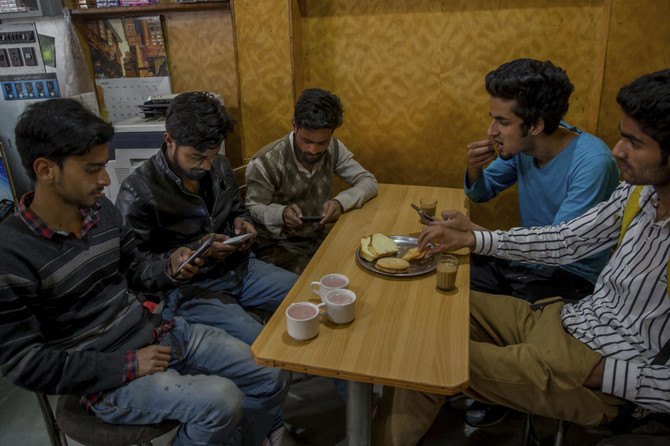
Kashmiri students browse internet on their mobile phones as they sits inside a restaurant in Srinagar, Indian controlled Kashmir, Wednesday, April 26, 2017. On Wednesday, authorities ordered internet service providers to block 16 social media sites, including Facebook and Twitter, and popular online chat applications for one month "in the interest of maintenance of public order." (AP)
Updated 28 April 2017
Follow

In Indian Kashmir, social media becomes a battleground

SRINAGAR: An unprecedented ban on Whatsapp, Facebook and Twitter in Indian Kashmir has highlighted social media’s role in energising an insurgency that has roiled the disputed Himalayan region for decades.
Authorities in the Kashmir valley this week ordered Internet service providers to block 15 social media services for at least one month, saying they were being misused by “anti-national and anti-social elements.”
The move followed an upsurge in violence in the region, where authorities say social media are being used to mobilize stone-throwing protesters behind increasingly frequent civilian attacks on government forces.
Anti-India sentiment runs deep in the predominantly Muslim Kashmir valley, one of the world’s most heavily militarised spots, where most people favor independence or a merger with Pakistan.
One senior police officer said the power of social media to mobilize large groups of civilians was “worrying the security forces much more than the armed militants.”
“Social media is misused to mobilize youth during anti-militant operations,” said the officer, who spoke on condition of anonymity.
Rebel groups have been fighting Indian forces in Indian Kashmir for decades.
But the violent civilian protests, which often mobilize around the anti-militant operations conducted by government forces, are a relatively new phenomenon.
The local government already frequently blocks mobile Internet services in the volatile Kashmir valley, but it is the first time they have banned specific social media services in the interests of public order.
The Kashmir valley has been tense since April 9, when eight people were killed by police and paramilitaries during election day violence.
Since then, students angered by a police attempt to detain suspected protest ringleaders on college grounds have held regular demonstrations, frequently clashing with police.
Kashmir’s tech-savvy young — 70 percent of the population is under 35 — have increasingly turned to social media to express their anger as well as to mobilize demonstrations.
“If they (the government) take away our means of communication and protest we will keep finding new ones,” said Asim, a university student who gave only his first name.
Political scientist Noor Ahmed Baba told AFP the conflict was now “playing out in the social media space.”
“The present government wants to silence the people. The violence of suppression will generate more violence,” said Baba, a political scientist with the University of Kashmir.
Young Kashmiris have also used their mobile phones to record videos of killings and other rights abuses by government forces and upload them on Youtube.
One video circulated online this month depicted a Kashmiri man tied to the front of an army jeep, apparently as a human shield against stone-throwing protesters.
Indian police took the rare step of registering a criminal case after the footage went viral, sparking outrage in India.
But no arrests have yet been made and India’s Attorney General Mukul Rohtagi even appeared to support the use of a human shield, saying “if it has to be done again, it should be done again.”
Another video showed an Indian paramilitary soldier being heckled and slapped by protesters outside a polling station.
But security expert Ajai Shukla said banning social media was “unlikely to control or diffuse the situation.”
“It is at best a temporary solution, but also means shooting the messenger,” he told AFP.
“It indicates poor security management. Politically it is a double disadvantage and from a strategic and technical (military) operations point of view it achieves nothing.”
Kashmir’s armed insurgency in has significantly weakened since its peak in the 1990s.
But dozens of Kashmiri youths have joined its ranks since last July, when security forces killed the popular young leader Burhan Wani.
The death of the charismatic rebel — himself a social media sensation who regularly uploaded video messages — also sparked a wave of popular protest.
More than 100 people died and thousands more were injured in clashes between protesters and government forces last year, the worst violence to hit the Himalayan region since 2010.
One student activist said the ban on social media would remove one of the few remaining outlets for peaceful protest in Kashmir.
“Social media is our media, everyone’s media. We’re in it to show the world what is done to us generation after generation,” said the activist, who asked not to be named.
“Indian politicians and media misrepresent us. This has to end. How else do we protest without being called terrorists?“


Afghanistan says it thwarted Pakistani airstrike on Bagram Air Base as fighting enters fourth day

Updated 01 March 2026
Follow

Afghanistan says it thwarted Pakistani airstrike on Bagram Air Base as fighting enters fourth day

  • The fighting has been the most severe between the neighbors for years
  • Pakistan accuses Taliban government of harboring militant groups that stage attacks against it

KABUL: Afghanistan thwarted attempted airstrikes on Bagram Air Base, the former US military base north of Kabul, authorities said Sunday, while cross-border fighting between Pakistan and Afghanistan stretched into a fourth day.
The fighting has been the most severe between the neighbors for years, with Pakistan declaring that it’s in “open war” with Afghanistan.
The conflict has alarmed the international community, particularly as the area is one where other militant organizations, including Al-Qaeda and the Daesh group, still have a presence and have been trying to resurface.
Pakistan accuses Afghanistan’s Taliban government of harboring militant groups that stage attacks against it and also of allying with its archrival India.
Border clashes in October killed dozens of soldiers, civilians and suspected militants until a Qatari-mediated ceasefire ended the intense fighting. But several rounds of peace talks in Turkiye in November failed to produce a lasting agreement, and the two sides have occasionally traded fire since then.
On Sunday, the police headquarters of Parwan province, where Bagram is located, said in a statement that several Pakistani military jets had entered Afghan airspace “and attempted to bomb Bagram Air Base” at around 5 a.m.
The statement said Afghan forces responded with “anti-aircraft and missile defense systems” and had managed to thwart the attack.
There was no immediate response from Pakistan’s military or government regarding Kabul’s claim of attempted airstrikes on Bagram or the ongoing fighting.
Bagram was the United States’ largest military base in Afghanistan. It was taken over by the Taliban as they swept across the country and took control in the wake of the chaotic US withdrawal from the country in 2021. Last year, US President Donald Trump suggested he wanted to reestablish a US presence at the base.
The current fighting began when Afghanistan launched a broad cross-border attack on Thursday night, saying it was in retaliation for Pakistani airstrikes the previous Sunday.
Pakistan had said its airstrike had targeted the outlawed Pakistani Taliban, also known as Tehreek-e-Taliban Pakistan, or TTP. Afghanistan had said only civilians were killed.
The TTP militant group, which is separate but closely allied with Afghanistan’s ruling Taliban, operates inside Pakistan, where it has been blamed for hundreds of deaths in bombings and other attacks over the years.
Pakistan accuses Afghanistan’s Taliban government of providing a safe haven within Afghanistan for the TTP, an accusation that Afghanistan denies.
After Thursday’s Afghan attack, Pakistani Defense Minister Khawaja Mohammad Asif declared that “our patience has now run out. Now it is open war between us.”
In the ongoing fighting, each side claims to have killed hundreds of the other side’s forces — and both governments put their own casualties at drastically lower numbers.
Two Pakistani security officials said that Pakistani ground forces were still in control on Sunday of a key Afghan post and a 32-square-kilometer area in the southern Zhob sector near Kandahar province, after having seized it during fighting Friday. The captured post and surrounding area remain under Pakistani control, they added. The officials spoke on condition of anonymity, because they weren’t authorized to speak publicly.
In Kabul, the Afghan government rejected Pakistan’s claims. Deputy government spokesman Hamdullah Fitrat called the reports “baseless.”
Afghan officials said that fighting had continued overnight and into Sunday in the border areas.
The police command spokesman for Nangarhar province, Said Tayyeb Hammad, said that anti-aircraft missiles were used from the provincial capital, Jalalabad, and surrounding areas on Pakistani fighter jets flying overhead Sunday morning.
Defense Ministry spokesman Enayatulah Khowarazmi said that Afghan forces had launched counterattacks with snipers across the border from Nangarhar, Paktia, Khost and Kandahar provinces overnight. He said that two Pakistani drones had been shot down and dozens of Pakistani soldiers had been killed.
Fitrat said that Pakistani drone attacks hit civilian homes in Nangarhar province late Saturday, killing a woman and a child, while mortar fire killed another civilian when it hit a home in Paktia province.
There was no immediate response to the claims from Pakistani officials.