Jeddah's Sri Lankan International School (SLISJ) recognizes highest achievers on awards day

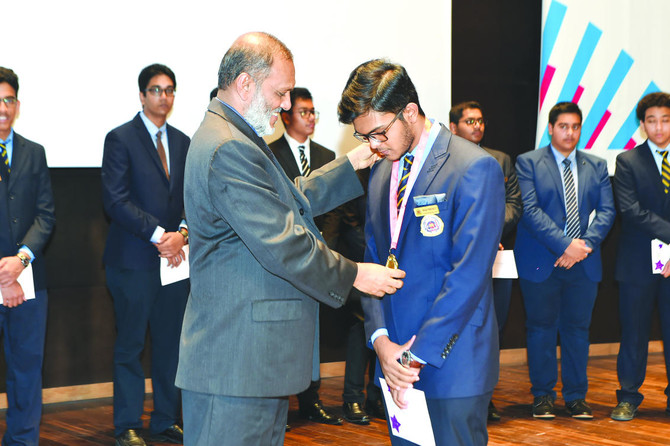
CIE A/S Level highest achiever Shabeer Asath receives a gold medal from Sri Lankan Ambassador Azmi Thassim. (AN photo)
Updated 26 April 2017
Follow

Jeddah's Sri Lankan International School (SLISJ) recognizes highest achievers on awards day

JEDDAH: The Sri Lankan International School in Jeddah (SLISJ) recently held its awards day to recognize its highest achievers at the Waad Academy auditorium.
Five students with exemplary grades in the Cambridge International Examinations (CIE) were awarded gold medals. Ammar Ilyas and Nidhal Rizwan achieved best results at the A Level examinations, while Shabeer Asath and Rahma Rifkie attained high grades in AS Level examinations and Hikma Makshood for her high IGCSE results.
In his address, guest of honor Sri Lankan acting Consul General U.L. Niyas mentioned his satisfaction in the collective teamwork reflected in all school events during his two-month tenure as acting consul general in Jeddah. He commended the dedication and efforts of the parents, teachers and the students for the institution’s success.
Mohamed Ilyas, chairman of the SLISJ board, congratulated all students for their achievements and thanked teachers and parents for their support. As the outgoing board and on behalf of his fellow board members, he expressed his gratitude for the cooperation received from the community during their four years in office.
Ambassador Azmi Thassim, the evening’s chief guest, acknowledged the winners and lauded the efforts of the parents, teachers and community members.
Citing the importance of better education for Sri Lankan students in the Kingdom, he said that negotiations are underway with the Sri Lankan government in this regard. 
Encouraging the community’s cooperation, he said: “Our diplomatic missions in the Kingdom extends our fullest support whenever needed. We have no favoritism, no politics and no religious bias. I call on you all to work together as Sri Lankans to build on the good image of our country.” 
Presenting the school’s annual report, Principal Basheer Risvi encouraged students to strive for excellence. He also mentioned the several accomplishments of the school in the previous year. 
The highest achievers from each class were awarded certificates for subject prizes and general proficiency, while winners of the English Day competitions were also honored at the ceremony.
Other proceedings of the evening included the launching of the school’s annual magazine, felicitation of the staff and performances by primary students of the school. 
The event concluded with the vote of thanks delivered by the school’s head prefect, Shabeer Asasth, followed by the singing of the national anthem.


National program identifies 165 native plants for afforestation efforts in Asir

Updated 29 December 2025
Follow

National program identifies 165 native plants for afforestation efforts in Asir

  • The survey is part of broader plans focused on restoring degraded land, using native vegetation 

JEDDAH: Saudi Arabia’s National Afforestation Program has identified more than 165 species of native plants suitable for afforestation in the Asir region, highlighting the ecological diversity of one of the Kingdom’s most environmentally varied areas, the Saudi Press Agency reported.

The findings form part of broader national efforts to expand vegetation cover, address land degradation, and support sustainability goals linked to the Saudi Green Initiative and Vision 2030.

According to the program, the identified species are distributed across a wide range of natural environments in Asir, including mountainous terrain, highlands, slopes, valleys, plains, rocky landscapes, and coastal areas stretching from the Red Sea to Tihama.

The species belong to numerous plant families, including Fabaceae, Anacardiaceae, Burseraceae, Capparaceae, Ebenaceae, Euphorbiaceae, Malvaceae, Myrtaceae, Oleaceae, and Primulaceae, among others.

Plants suitable for afforestation range from large and small trees to perennial and annual shrubs, herbs, succulents, bulbs, and climbing plants. 

Among the most notable species identified are the grey mangrove, mastic tree, mooring or ben tree, juniper, sycamore fig, wild olive, henna, wild jasmine, hawthorn, and arak.

The Saudi Arabian Botanical Society described the announcement as an important step in protecting plant diversity and strengthening the ecosystem conservation in the Kingdom. 

Munirah bin Hamad Al-Hazani, founder and president of the society, said that prioritizing native species is central to sustainable afforestation.

“Focusing on the cultivation of native plants adapted to diverse environments forms the cornerstone of sustainable afforestation projects, as it plays a pivotal role in enhancing vegetation cover, combating land degradation, and conserving natural and financial resources,” she told Arab News.

Al-Hazani added that long-term success depends on cooperation between government bodies and the nonprofit sector, alongside community involvement and environmental awareness programs.

The National Afforestation Program has increasingly emphasized community participation, working with government agencies, private companies, and nonprofit organizations to support planting initiatives and environmental education. Its approach includes promoting volunteerism and discouraging harmful environmental practices, while focusing on the use of native plants adapted to local conditions.

Parallel efforts are underway in other regions of the Kingdom to support vegetation restoration through research and infrastructure development. In Jouf, often referred to as the Kingdom’s food basket, the King Salman bin Abdulaziz Royal Reserve Development Authority has established a Central Nursery and a Wild Seeds Research and Production Station to address the growing demand for reliable sources of native seeds and seedlings.

The project was launched in 2023 under the directive of Prince Abdulaziz bin Saud bin Naif, the minister of interior and chairman of the authority’s board of directors. 

Since then, the facilities has become a key component of vegetation restoration efforts within the reserve.

The authority has focused on building operational capacity by recruiting and training specialists to manage cultivation and research activities. The research and production station includes 14 mother-seed production fields containing over 400,000 trees and shrubs. 

Planting began in late 2024, with more than 30 native plant species represented, selected for their role in the reserve’s natural ecosystem. 

The facility also includes two seed storage units with a combined capacity of 3,000 kilograms. Seeds are collected annually from multiple sites within the reserve and used for seedling production habitat rehabilitation.

The Central Nursery spans 6,000 square meters and includes 30 greenhouses spanning 1,500 square meters, as well as two shade houses used during summer months. A plant hardening facility, designed to prepare seedlings for natural environmental conditions, covers 10,000 square meters and is divided into seven sections. The nursery’s annual production capacity reaches 1.5 million seedlings, representing more than 15 native plant species. 

Together, these initiatives underscore the growing role of native plant research and propagation in Saudi Arabia’s afforestation strategy, particularly as the Kingdom works to balance environmental restoration with long-term sustainability goals.