MAZAR-I-SHARIF, Afghanistan: Afghan soldier Zabihullah was chatting with an army comrade at their military base in northern Afghanistan when gunfire interrupted their quiet Friday afternoon.
“I asked my friend what was happening, and he said, relax, it must be one of us.”
It was not. It was the Taliban.
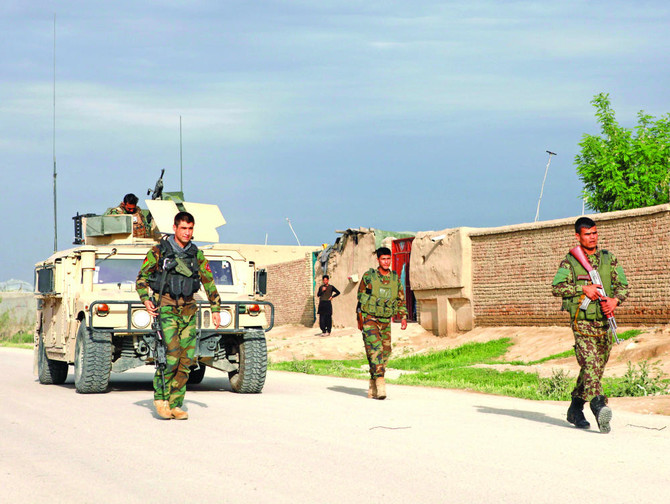
Dressed in army uniforms, at least 10 Taliban attackers had breached the military headquarters in Mazar-i-Sharif, eventually killing more than 140 soldiers, according to the latest estimates by officials.
“When they started hitting other soldiers, we understood that it was a terrorist attack,” Zabihullah said from his hospital bed, wounded by an explosion. “The soldiers were dropping like sparrows hit by a shotgun.”
The attack, which is likely the deadliest yet on an Afghan military base, represents a major blow to the country’s struggling security forces as they prepare for what is expected to be a year of bloody fighting against the Taliban, as well as other smaller militant groups like Daesh.
The base is the headquarters for the Afghan National Army’s (ANA) 209th Corps and also hosts foreign troops from the North Atlantic Treaty Organization (NATO)-led mission to advise and train Afghan forces. No international troops were caught up in the attack, according to coalition officials.
President Ashraf Ghani held an emergency meeting Mazar-i-Sharif with senior security officials and called for a “serious” investigation into the attack. In a statement online, he condemned the attack as “cowardly.”
The incident raised immediate questions over how such a mass killing could occur in a heavily defended headquarters frequented by foreign soldiers.
In the early afternoon on Friday, two army vehicles bearing men in Afghan army uniforms rolled up to the base’s gate, claiming to have wounded soldiers in need of urgent medical care.
Two guards at the first checkpoint waved them through, according to Ahmad Saboor, a soldier who was on guard duty further inside the base that day.
At the second checkpoint, the guards told the men in the trucks they had to leave their weapons behind, as is standard procedure at the bases, Saboor said.
After a brief argument, the attackers shot and killed the two guards and sped toward the third and final checkpoint, which they hit with a rocket-propelled grenade before racing into the base itself.
“The first vehicle had a light machine gun mounted on it and started firing at dozens of soldiers and officers coming out of the mosque,” Saboor recalled. “The second vehicle went toward the dining hall and started shooting.”
Wielding machine guns and rocket-propelled grenade launchers, the attackers sprayed heavy fire into groups of soldiers gathered to eat at a dining hall and leaving afternoon prayers at the mosque. Several other attackers detonated suicide vests packed with explosives.
Photos circulating online showed the inside of the mosque pock-marked with bullet holes and strewn with shattered glass.
“I had just finished my prayers and was outside the mosque when an army pickup sped toward us,” said another wounded officer.
“I stood still and did not know whether to run or stay, then a gunman from the back of the truck opened fire with a machine gun and hit the side of my abdomen and my left leg.”
Other unarmed soldiers were dropping dead and wounded around him.
“One of the attackers blew himself up, and others went and took up positions in a small room next to the mosque,” he said.
The confusion in the base was compounded by the fact that the attackers wore army uniforms.
“At first there was a call on the radio not to shoot because they thought it could have been a misunderstanding,” said the guard Saboor, who reported that some base officials initially thought it might have been a disagreement between soldiers.
Afghan commandos from elsewhere on the base arrived and engaged the attackers, eventually killing or capturing all of them, Zabihullah said.
A Taliban spokesman said at least four of the attackers were longtime members of the army who worked with the insurgent group.
Afghan officials are investigating that claim, but Zabihullah said he had no doubt that the gunmen had inside help.
“Security is so tight that even soldiers without IDs are not allowed to get in,” he said.


![]()
Afghan president calls for ‘serious’ probe into deadly Taliban attack
Afghan president calls for ‘serious’ probe into deadly Taliban attack
Latest updates



© 2026 SAUDI RESEARCH & PUBLISHING COMPANY, All Rights Reserved And subject to Terms of Use Agreement.