TEHRAN: Iran’s Foreign Minister Mohammed Javad Zarif on Thursday criticized “worn-out” US accusations that it was seeking a nuclear weapon to threaten the region and the world.
“Worn-out US accusations can’t mask its admission of Iran’s compliance” with a 2015 nuclear deal, Zarif wrote on Twitter.
Iran says its nuclear program is purely for peaceful purposes but signed a deal with world powers to restrict its fuel enrichment for 10 years in exchange for sanctions relief.
US Secretary of State Rex Tillerson said Wednesday that Tehran has so far met its obligations, but that the deal could only delay Iran’s development of a nuclear weapon.
The deal “fails to achieve the objective of a non-nuclear Iran,” he said, and was a product of “the same failed approach of the past that brought us to the current imminent threat we face from North Korea.”
Zarif said Iran’s compliance had forced the US administration of President Donald Trump “to change course and fulfill its own commitments.”
Trump described the accord as the “worst deal ever negotiated” during his campaign and threatened to tear it up, but analysts say that is increasingly unlikely.
Trump’s spokesman Sean Spicer said a review would be conducted by US government agencies over the next 90 days on whether to stick by the deal.


Iran FM slams ‘worn-out’ US nuclear accusations
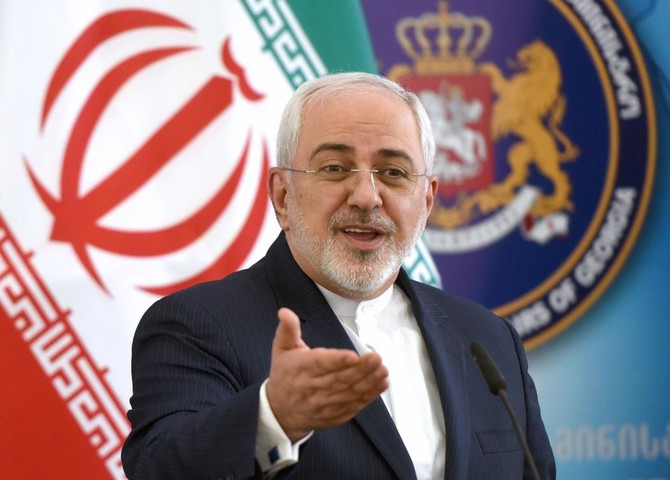
Iran FM slams ‘worn-out’ US nuclear accusations

Trump claims Iran working on missiles that could hit US
- Trump says his preference is diplomacy, but would never allow Tehran to have a nuclear weapon
WASHINGTON: US President Donald Trump on Tuesday claimed Iran is seeking to develop missiles that can strike the United States and accused Tehran of working to rebuild a nuclear program that was targeted by American strikes last year.
The United States and Iran are engaged in high-stakes negotiations over Iran’s atomic program and other issues including missiles, with Trump saying he prefers diplomacy but is willing to use force if talks fail.
“They’ve already developed missiles that can threaten Europe and our bases overseas, and they’re working to build missiles that will soon reach the United States of America,” Trump said during his State of the Union address.
In 2025, the US Defense Intelligence Agency said Iran could potentially develop a militarily viable intercontinental ballistic missile by 2035 “should Tehran decide to pursue the capability,” but did not say if it had made such a decision.
Tehran currently possesses short- and medium-range ballistic missiles with ranges that top out at about 1,850 miles (3,000 kilometers), according to the US Congressional Research Service.
The continental United States is more than 6,000 miles from Iran’s western tip.
Washington and Tehran have concluded two rounds of talks aimed at reaching a deal on Iran’s nuclear program to replace the agreement that Trump tore up during his first term in office.
‘Preference’ is diplomacy
The United States has repeatedly called for zero uranium enrichment by Iran but has also sought to address its ballistic missile program and support for armed groups in the region — demands Iran has rejected.
Iran has also repeatedly rejected that it is pursuing nuclear weapons.
Trump ordered strikes on three Iranian nuclear sites last year, claiming afterward that Tehran’s atomic program was obliterated.
On Tuesday, he said Iran wants “to start all over again,” and that it is “at this moment again pursuing their sinister nuclear ambitions.”
Trump has sent a massive US military force to the Middle East, deploying two aircraft carriers as well as more than a dozen other ships, a large number of warplanes and other assets to the region.
He has repeatedly threatened to strike Iran if negotiations fail to reach a new agreement. Talks with Tehran are currently set to continue on Thursday.
“My preference is to solve this problem through diplomacy but one thing is certain: I will never allow the world’s number one sponsor of terror, which they are by far, to have a nuclear weapon,” Trump said.
The US president’s speech primarily focused on domestic issues, making no mention at all of China — Washington’s primary military and economic rival — and only briefly referring to Russia.
Trump said he was working to end the bloody conflict between Russia and Ukraine, and repeated his inaccurate claim that he had brought eight other wars to an end since returning to office in January 2025.
He also hailed NATO’s decision to spend five percent of gross domestic product on defense — a move made under heavy pressure from Trump and his administration.


