RIYADH: With 70 days to go before the end of the campaign of targeting residency and labor violators, preliminary results are already “positive,” according to officials from the General Directorate of Passports and Ministry of Labor and Social Development.
The campaign is helping violators leave the country without facing fines or penalties for violating regulations. Expats are also exempt from the exit fingerprint requirement, allowing them to return to the Kingdom at a later date legally.
Nineteen government entities are participating in the “A Nation without Violators” campaign, which is seeking to help at least 1 million violators leave the country during the three-month grace period. The campaign, which initially was launched four years ago, has facilitated the departure of more that 5.5 million illegal expats.
Via its Twitter account, the General Directorate of Passports has reached out to violating expats in Urdu, English, Indonesian, Arabic and other languages to inform them in daily tweets about how they can take advantage of the campaign that launched on March 29.
The campaign has resulted in large numbers of violators attending to Passports’ location. Nearly 80 locations received illegal expats across the 13 provinces daily. The locations are distributed between 10 in Riyadh, seven in Quasimodo, 12 in Makkah, two in Al-Baba, three in Asir, four each in Madinah and the Northern Border region, two in Jazan, three in Hail, five in Najran, four in Al-Joudeh, six in Tabuk, and 16 in the Eastern Province.
Ministry of Interior spokesman Maj. Gen. Mansoor Al-Turki said various government agencies are working together to ensure the success of the campaign through joint inspections with security agencies.
Turki Al-Manea, general director of the branch of the ministry of labor and social development in Qassim, said the campaign will likely lead to the exit of at least 1 million violators. He noted that this is the second campaign of its kind carried out in the Kingdom in recent years. The same campaign was first launched in 2013 targeting illegal residents and expats working in jobs different to those they were recruited for. The status of nearly 3 million expats was corrected at the time.
He said the campaign “would revive the economies of companies and establishments and protect small businesses and projects from illegal expats, while also reducing unemployment rates and creating a safe economic and social environment.”
Mohammed Al-Sayegh, director general of Passports in Ar Rass, said on Sunday that the exemption applies to fines and other penalties during the three-month grace period, as well as the fingerprints for deported violators. He said many expats have turned themselves in and departed the kingdom already.
The Labor Ministry, in coordination with public security, held a meeting with recruitment companies in the Saudi market recently to discuss their roles in the campaign.
Adnan Al-Naim, undersecretary of the ministry, said recruitment companies play a very important role in the Saudi market, with the 30 companies having 440 offices distributed throughout the Kingdom. These companies have a 70 percent nationalization rate and very low rates of violations, he said.
Crown Prince Mohammed bin Naif urged violators to “take advantage of the opportunity during the allotted grace period, and for all to cooperate in achieving the campaign’s goals.”
He also instructed “involved parties to facilitate the departure of violators during the period and exempt them of penalties.”


![]()
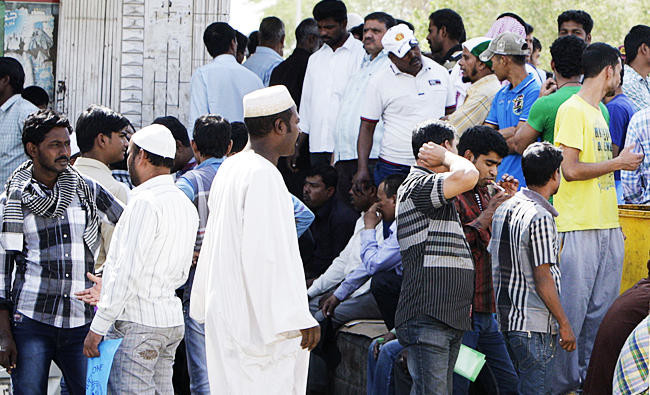
1 million expats expected to leave Saudi Arabia under amnesty plan
1 million expats expected to leave Saudi Arabia under amnesty plan


Latest updates


© 2026 SAUDI RESEARCH & PUBLISHING COMPANY, All Rights Reserved And subject to Terms of Use Agreement.