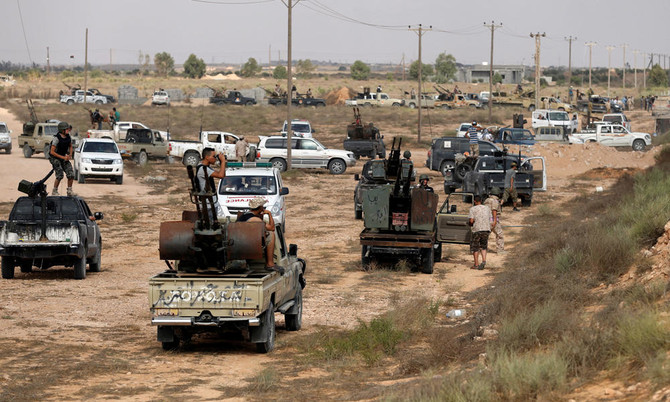
UNITED NATIONS: Secretary-General Antonio Guterres is warning that Libya risks a return to widespread conflict, citing the volatile security situation in Tripoli and fighting in the eastern oil crescent and elsewhere.
The UN chief expressed alarm in a report to the UN Security Council at the renewed military escalation and ongoing political stalemate in the country.
Guterres said the Daesh extremist group no longer controls territory in Libya, but its operatives have been sighted, it has been blamed for a number of attacks in different areas, and the international community in the country remains a target.
He said in the report released Thursday that the potential for an escalating conflict remains due mainly to unaddressed political issues “and the multiplicity of armed actors on the ground with conflicting agendas.”
The overthrow of longtime dictator Muammar Qaddafi in 2011 has spawned chaos in Libya. The power and security vacuum turned the country into a breeding ground for militias and militants, including Daesh extremists and Al-Qaeda affiliates. It has also made Libya a gateway for thousands of migrants from Africa and elsewhere seeking to cross the Mediterranean to Italy.
Since 2014, Libya has been split between rival governments and parliaments based in the western and eastern regions, each backed by different militias, tribes and political factions.
A UN-brokered deal in December 2015 to create a unity government has failed because the UN-backed government now in Tripoli has been unable to win the endorsement of Libya’s internationally recognized Parliament in eastern Tobruk, which is a prerequisite to assume power.
Guterres said the UN-backed Presidency Council and government remain “constrained in their ability to govern effectively and to provide much needed basic services and security to the population.”
He said the 2015 political agreement continues to be supported by the majority of Libyans and interested countries “as the only political framework to lead the country forward.”
An emerging consensus on the need for limited amendments to the agreement “represents an opportunity to overcome the current political stalemate and move the transition forward,” he said.
Guterres urged all parties in Libya to address the key issues blocking implementation of the agreement including the composition of various institutions, especially the executive authority and military command.
The secretary-general said he remains “deeply alarmed” by the human rights situation in the country where violations of international law continue to be perpetrated by all parties to the conflict.
“Armed groups from all sides continued to abduct, torture and kill civilians,” he said. “In addition, ordinary crime was endemic, mainly owing to the state of general lawlessness and the weakness of judicial institutions.”
Between Dec. 1 and Feb. 17, Guterres said the UN political mission in Libya documented 24 deaths and 24 injuries of civilians, mainly by gunfire, airstrikes, explosive remnants of war and improvised explosive devices.
Migrants and refugees in Libya also “continue to suffer horrific abusers and risk death while transiting the country and across the Mediterranean Sea,” he said.
While forces allied to the UN-backed government routed Daesh from its stronghold in Sirte in December, Guterres said remnants are still active “in the hinterland” of the city.
They also maintain a presence in the desert and mountainous areas south of Bani Walid and areas further south and west, and there are reports of Daesh sleeper cells in western coastal areas and the greater Tripoli area, he said.
Guterres also expressed grave concern at the deterioration of the humanitarian situation.
He said 1.3 million people need humanitarian aid, the health care system “is on the brink of collapse” and the UN has received only $9 million of the $151 million it appealed for to help 900,000 people.


![]()
UN chief warns that Libya risks a return to wide conflict
UN chief warns that Libya risks a return to wide conflict

Latest updates


Recommended


© 2026 SAUDI RESEARCH & PUBLISHING COMPANY, All Rights Reserved And subject to Terms of Use Agreement.