

Analysis: Trump and Yellen may not be an odd couple after all

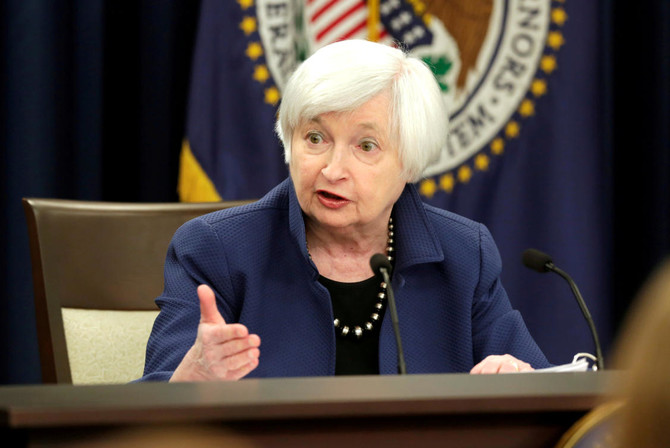
Federal Reserve Chair Janet Yellen. (Reuters)
Updated 14 April 2017
Follow

Analysis: Trump and Yellen may not be an odd couple after all

WASHINGTON: At first glance, US President Donald Trump and Federal Reserve chair Janet Yellen may have little in common.
Yellen is an academic economist and veteran of Democratic administrations who is committed to an open global economy, while Trump is a real estate mogul with an electoral base suspicious of the economic order Yellen helped to create.
Yet the two may have interests in common now that Trump is president and both want to get as many Americans working as possible.
Since her appointment as Fed chair in February 2014, Yellen has kept interest rates low and she currently pledges to raise them only slowly even though unemployment, at 4.5 percent, is at its lowest in nearly ten years.
Meanwhile, Trump’s election campaign promises to cut taxes, spend money on infrastructure and deregulate banking, have helped propel a surge in the US Conference Board’s consumer confidence index to its highest level since the Internet stocks crash 16 years ago.
Former Fed staff and colleagues who know Yellen said Trump’s surprising remarks this week in a Wall Street Journal interview, in which he did not rule out Yellen’s reappointment to a new four year term next year, are not as outlandish as they may appear now that the president has a vested interest in keeping markets and the economy on an even keel.
And the same staff and colleagues say Yellen may well accept reappointment, despite Trump’s criticism of her during last year’s election campaign.
Many in Trump’s Republican party have called for tighter monetary policy and a less activist Fed, but “the president would not really find that useful,” said former Fed vice chair Donald Kohn.
If Trump fills three existing Federal Reserve board vacancies with people Yellen thinks she could work with, “it would be really difficult to turn down” a reappointment when her term as chair expires in February 2018.
“If she continues to do well, he’d be nuts to ditch her for an unknown quantity,” said University of California, Berkeley, economics professor Andrew Rose, a long-time colleague and co-author with Yellen of an oft-cited study of labor markets.
Yellen took over from Ben Bernanke as Fed chair in February 2014 with the US economic recovery from the 2008 financial crisis still on shaky ground, and she has made no secret she puts a priority on growth in jobs and wages and a broad recovery in US household wealth.
In a slow return to more normal monetary policy, Yellen has stopped the purchase of additional financial securities by the Fed and in December 2015 began raising short term interest rates for the first time in 10 years.
So far those policy shifts have been engineered with little apparent impact on job growth, and so mesh with Trump’s core election campaign promises to restore employment and earnings.
The slow rise in interest rates in the past year has also happened while US stock prices have risen to record highs, though Trump has claimed the credit for himself.

Precedent for fed chair to stay on
There is precedent for Trump to stick with a former president’s Fed chair appointment. Paul Volcker, Alan Greenspan and Ben Bernanke, the three previous Fed chairs, served at least two four year terms and were nominated by both Democratic and Republican presidents.
However it may be a more difficult step for Trump.
During last year’s election campaign, Trump accused Yellen of accepting orders from then President Obama to keep interest rates low for political reasons, and he said he would replace her as Fed chair because she is not a Republican party member.
In a particularly biting moment last year, in a campaign video advertisement, he labelled her as among the “global special interests” who had ruined life for middle America.
The Fed on Thursday said it had no response to Trump’s comments published on Wednesday on Yellen and or on whether Yellen would consider a second term.

Much could still go wrong
Some of Trump’s advisers and some Republican lawmakers want a more conservative Fed in which the chair has less power and would see a Yellen reappointment as yet another step away from his promise to “drain the swamp” of the Washington establishment.
There are also three current vacancies on the Fed’s seven member Board of Governors, and unorthodox new members could make it difficult for Yellen to manage policy or accept another four year term.
But if the choice is her consensus style or someone unproven in their ability to manage public and market expectations, “he’d be wise to reappoint her,” said Joseph Gagnon, a former Fed staffer and Berkeley colleague of Yellen’s currently at the Peterson Institute for International Economics.
“I don’t see what is in his interests to appoint someone who is going to jack up interest rates.”


Saudi stocks rebalance after Kingdom opens market to global investors

Updated 57 min 43 sec ago
Follow

Saudi stocks rebalance after Kingdom opens market to global investors

  • Foreign access reforms trigger short-term volatility while underlying market fundamentals hold

RIYADH: Saudi Arabia’s stock market experienced a volatile first week following a landmark decision to fully open the market to foreign investors—a move analysts view as essential to funding the Kingdom’s sweeping economic transformation plans.

The Tadawul All Share Index began the week with a sharp decline, falling 1.89 percent on Feb. 1, the same day new regulations eliminating key restrictions on international investment officially came into force. The index rebounded the following session and remained in positive territory for three consecutive days before slipping once more, ultimately ending the week down 1.34 percent.

Ownership data from Tadawul as of Feb. 1 indicated that foreign non-strategic investors reduced their holdings in nearly half of the companies listed on the TASI. An analysis conducted by Al-Eqtisadiah’s Financial Analysis Unit showed that foreign ownership declined in 120 firms, increased in 97 others, and remained unchanged across the remainder. Despite these shifts, the total number of shares held by foreign investors showed no overall change.

Speaking to Arab News, economist Talat Hafiz addressed the initial volatility in the TASI, explaining: “Stock markets in the Kingdom and globally naturally experience fluctuations driven by profit-taking and price corrections.”

He added that the index’s decline and subsequent recovery “appears to be primarily the result of technical and sentiment-related factors rather than a direct reaction to the opening of the market to foreign investors.”

Hafiz emphasized that this was particularly evident given that foreign participation in the Saudi market is not entirely new, having previously existed under alternative regulatory structures.

The market turbulence coincided with sweeping reforms enacted by the Capital Market Authority and announced in January. These measures included the removal of the restrictive Qualified Foreign Investor framework, which had imposed a $500 million minimum asset requirement, as well as the elimination of swap agreements. The reforms aim to attract billions of dollars in fresh investment while improving overall market liquidity.

Hafiz noted that an initial surge of foreign capital was widely expected to generate short-term volatility as portfolios were rebalanced and liquidity dynamics adjusted. However, the rapid recovery of the index suggests that the market’s underlying fundamentals remained strong and that investor confidence was not significantly undermined.

Earlier in January, experts had told Arab News that the reforms could unlock as much as $10 billion in new foreign inflows. Tony Hallside, CEO of STP Partners, described the move as a pivotal evolution, signaling that the Kingdom is committed to building the most accessible, liquid, and globally integrated financial markets in the region.

Hafiz reinforced this optimistic outlook, stating that broader market access is likely to yield positive effects by boosting liquidity, widening participation, and supporting overall market recovery—ultimately contributing to greater long-term stability once near-term adjustments ease.

He said: “TASI’s swift rebound reflects the market’s constructive response to increased openness and deeper investor participation.”

Hafiz said he does not believe the market opening is primarily intended to function as a conventional financing channel. Instead, he argued that its broader objective lies in the internationalization of the Saudi market, a goal underscored by its inclusion in major global indices.

He explained that attracting foreign capital should be understood less as a short-term funding solution and more as a structural reform aimed at strengthening market depth, efficiency, transparency, and global integration.

The Saudi economist added that while increased foreign participation can indirectly support Vision 2030 by enhancing liquidity and reducing the cost of capital, the opening of the market is “not designed as a direct mechanism to revive or fast-track projects that may have faced funding constraints.”

Rather, it creates a more resilient, globally connected financial ecosystem that can sustainably support long-term development ambitions, according to Hafiz.

As the market continues to stabilize, investors and observers are monitoring which sectors are expected to attract the largest share of investment in the coming weeks and months.

Hafiz told Arab News that foreign investment is expected to initially focus on companies operating in strategically significant, high-growth sectors such as healthcare, transportation, and technology, in addition to mining, energy, and telecommunications.

He added that experienced foreign investors are likely to gravitate toward firms demonstrating strong financial disclosure practices, sound corporate governance, adherence to environmental, social and governance standards, and a track record of consistent dividend payouts.