

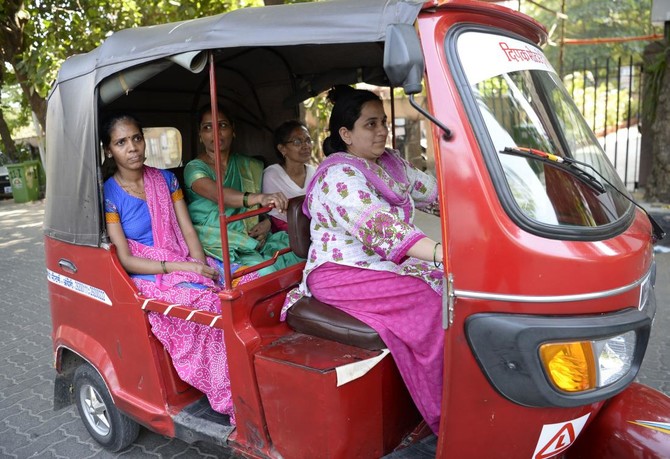
Meet Mumbai’s first women rickshaw drivers

1 / 5
An Indian woman rickshaw driver taking part in a training session in Mumbai. Chaya Mohite slowly turns the accelerator as she carefully edges the salmon-colored rickshaw forward, one of Mumbai’s first female auto drivers to make use of a government scheme aimed at empowering women. (AFP/PUNIT PARANJPE)
2 / 5
An Indian woman rickshaw driver taking part in a training session in Mumbai. Chaya Mohite slowly turns the accelerator as she carefully edges the salmon-colored rickshaw forward, one of Mumbai’s first female auto drivers to make use of a government scheme aimed at empowering women. (AFP/PUNIT PARANJPE)
3 / 5
An Indian woman rickshaw driver taking part in a training session in Mumbai. Chaya Mohite slowly turns the accelerator as she carefully edges the salmon-colored rickshaw forward, one of Mumbai’s first female auto drivers to make use of a government scheme aimed at empowering women. (AFP/PUNIT PARANJPE)
4 / 5
An Indian woman rickshaw driver taking part in a training session in Mumbai. Chaya Mohite slowly turns the accelerator as she carefully edges the salmon-colored rickshaw forward, one of Mumbai’s first female auto drivers to make use of a government scheme aimed at empowering women. (AFP/PUNIT PARANJPE)
5 / 5
An Indian woman rickshaw driver taking part in a training session in Mumbai. Chaya Mohite slowly turns the accelerator as she carefully edges the salmon-colored rickshaw forward, one of Mumbai’s first female auto drivers to make use of a government scheme aimed at empowering women. (AFP/PUNIT PARANJPE)
Updated 13 April 2017
Follow

Meet Mumbai’s first women rickshaw drivers

MUMBAI: Chaya Mohite slowly turns the accelerator as she carefully edges the salmon-colored rickshaw forward, one of Mumbai’s first female auto drivers to make use of a government scheme aimed at empowering women.
The 45-year-old was one of 19 women who recently started jobs ferrying passengers through the notoriously congested streets of India’s financial capital in their new three-wheelers.
“This job is much better than doing household work. I can make more money and it helps us secure our futures,” Mohite told AFP as she got in some last minute practice.
The mother of three has spent the past two months learning how to drive at a training center in Mumbai’s eastern suburbs and is thrilled with her new skills and financial prospects.
“I couldn’t even ride a bicycle but today I can drive an auto rickshaw. I’m independent and it makes me happy,” says Mohite, who hopes to earn 1,000 rupees ($15) a day.
She is benefitting from a scheme introduced by the state government of Maharashtra, of which Mumbai is the capital, that reserves five percent of rickshaw permits for women.
It announced the plan in early 2016, saying that 465 licenses would be made available for women in Mumbai and the neighboring district of Thane.
Unlike similar schemes in New Delhi and Ranchi, where some pink autos are driven by women for women as a safety initiative, the Maharashtra drivers take both male and female passengers.
Services started in Thane last year but Mohite and her new colleagues, who will sport white lab-coat-like uniforms, are the first to ply the streets of India’s most populated metropolis.
“I’ve taught them the A to Z of auto-rickshaw driving. They are now experts and have passed an official RTO (Regional Transport Office) test,” Sudhir Dhoipode, the women’s instructor, told AFP.

WATCH: Mumbai's first female auto rickshaw drivers take to the streets

Dhoipode says he is currently teaching more than 40 women how to drive while around 500 others have expressed an interest in learning despite some community opposition in the conservative country.
“People mocked us for leaving our homes and choosing to drive rickshaws but we hope we can inspire other women to come forward and take advantage of this great initiative,” said driver Anita Kardak.
Rickshaw permits are highly sought after in Mumbai and can be big business, with owners often renting them out for a fee or lending them to others when their shift has finished.
Transport officials say they decided the women should have a different colored rickshaw to the ubiquitous black and yellow ones to stop male relatives from taking them over.
It has led to some fears the women will be at risk because they will stand out, but Mohite isn’t concerned.
“I don’t think there’s going to be any safety issue as we’re capable of looking after ourselves. Driving the rickshaw is a fun feeling and I’m ready to drive anywhere in Mumbai,” she said.


Saja Kilani shines at BAFTAs 2026

Updated 23 February 2026
Follow

Saja Kilani shines at BAFTAs 2026

DUBAI: Palestinian-Jordanian-Canadian actress Saja Kilani, one of the stars of “The Voice of Hind Rajab,” stepped onto the BAFTA Film Awards 2026 red carpet in a sculptural look from Bottega Veneta’s Spring 2026 collection.

Nominated for Best Film Not in the English Language, Kaouther Ben Hania’s “Voice of Hind Rajab” tells the story of Hind Rajab Hamada, who was fleeing the Israeli military in Gaza City with six relatives last year when their car came under fire.

The sole survivor of the Israeli attack, who was then shot and killed, her desperate calls recorded with the Red Crescent rescue service caused international outrage.

Kilani plays Rana Faqih, the real-life Palestine Red Crescent Society volunteer who spoke to Hamada in the final hours of her life as she waited, surrounded by the bodies of her family, for help to come. 

Meanwhile, politically charged thriller “One Battle After Another” won six prizes, including Best Picture, at the British Academy Film Awards on Sunday, building momentum ahead of Hollywood’s Academy Awards next month.

Blues-steeped vampire epic “Sinners” and gothic horror story “Frankenstein” won three awards each, while Shakespearean family tragedy “Hamnet” won two, including Best British Film.

“One Battle After Another,” Paul Thomas Anderson’s explosive film about a group of revolutionaries in chaotic conflict with the state, won awards for directing, adapted screenplay, cinematography and editing, as well as for Sean Penn’s supporting performance as an obsessed military officer.

“This is very overwhelming and wonderful,” Anderson said as he accepted the directing prize. He paid tribute to his longstanding assistant director, Adam Somner, who died of cancer in November 2024, a few weeks into production.

“We have a line from Nina Simone that we used in our film, ‘I know what freedom is: It’s no fear,’” the director said. “Let’s keep making things without fear. It’s a good idea.”

Bookies’ favorite Jessie Buckley won the Best Actress prize for her portrayal of grieving mother Agnes Hathaway, wife of William Shakespeare, in “Hamnet.” Buckley, 36, is the first Irish performer to win the Best Actress prize at the awards.

She dedicated her award “to the women past, present and future who taught me and continue to teach me how to do it differently.”

Horror film “Sinners” took home trophies for director Ryan Coogler’s original screenplay, the film’s musical score and for Wunmi Mosaku’s supporting actress performance as herbalist and healer Annie.

The British-Nigerian actor said that in the role she found “a part of my hopes, my ancestral power and my connection, parts I thought I had lost or tried to dim as an immigrant trying to fit in.”