At 85, Nepali aims to regain title of oldest Everest climber

1 / 2
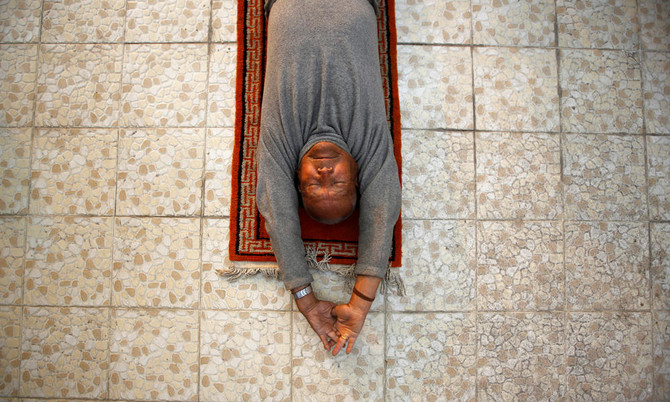
Nepali mountain climber Min Bahadur Sherchan, 85, who will attempt to climb Everest to become the oldest person to conquer the world's highest mountain, performs yoga in Katmandu on Wednesday. (REUTERS/Navesh Chitrakar)
2 / 2
Nepali mountain climber Min Bahadur Sherchan, 85, who will attempt to climb Everest to become the oldest person to conquer the world's highest mountain, performs yoga in Kathmandu, Nepal April 12, 2017. (REUTERS/Navesh Chitrakar)
Updated 12 April 2017
Follow

At 85, Nepali aims to regain title of oldest Everest climber

KATMANDU, Nepal: A Nepali who was once the oldest climber to scale Mount Everest is attempting to regain that title, at age 85, with hopes that the feat will help him spread a message of peace.
Min Bahadur Sherchan plans to climb the 8,850-meter (29,035-foot) peak next month during a window of favorable weather on the summit.
“I want to be the oldest person to scale Everest again to be an inspiration for humankind, a boost for the elderly people and an encouragement for youths,” Sherchan said Wednesday at his home in Katmandu. “It will be a message for everyone that age is no obstacle to achieving their dreams.”
The grandfather of 17 and great-grandfather of six first scaled Everest in May 2008, when he was 76, but his record was broken by then 80-year-old Japanese climber Yuichiro Miura in 2013.
Sherchan’s attempt to climb Everest in 2013 was cut short because of financial problems and delays in getting the climbing permit. Another try in 2015 was canceled because an avalanche triggered by devastating earthquake swept the base camp, killing 19 people just a day before he reached the site.
“I am confident that I will succeed this time. I have no problems that could stop me from climbing Everest and the only problem could be weather,” Sherchan said. He added that he has no respiratory problems and his blood pressure is normal.
Being born in the mountains, he has one big advantage over most climbers: He is used to the altitude. High-altitude sickness can be fatal for people who are not acclimated to the thin air and low oxygen levels. He said he is worried only about the five kilograms (11 pounds) he gained in the last few months.
“I am not scared of climbing, but the only part I fear is the part between base camp and Camp 1, which is very dangerous,” Sherchan said.
That stretch includes the dreaded Khumbu Icefall, where climbers use aluminum ladders and ropes to navigate around deep crevasses amid tall ice blocks.
Sherchan’s love of mountaineering began in 1960 when he was assigned by the Nepalese government as a liaison officer for the Swiss team climbing Mount Dhaulagiri.
He later became an apple farmer and constructed roads and dams before settling down to run hotels in Katmandu.
He and his team of six guides and helpers leave for the mountain Sunday. His team leader, Shiva Bahadur Sapkota, has scaled Everest twice.
He said that if he regains his record, he plans to campaign for world peace by traveling to conflict areas like Syria.
“After I become the oldest Everest climber, people will listen to my campaign for world peace,” he said.


Afghan barbers under pressure as morality police take on short beards

Updated 19 February 2026
Follow

Afghan barbers under pressure as morality police take on short beards

KABUL: Barbers in Afghanistan risk detention for trimming men’s beards too short, they told AFP, as the Taliban authorities enforce their strict interpretation of Islamic law with increasing zeal.
Last month, the Ministry for the Propagation of Virtue and Prevention of Vice said it was now “obligatory” to grow beards longer than a fist, doubling down on an earlier order.
Minister Khalid Hanafi said it was the government’s “responsibility to guide the nation to have an appearance according to sharia,” or Islamic law.
Officials tasked with promoting virtue “are obliged to implement the Islamic system,” he said.
With ministry officials patrolling city streets to ensure the rule is followed, the men interviewed by AFP all spoke on condition of anonymity due to security concerns.
In the southeastern province of Ghazni, a 30-year-old barber said he was detained for three nights after officials found out that one of his employees had given a client a Western-style haircut.
“First, I was held in a cold hall. Later, after I insisted on being released, they transferred me to a cold (shipping) container,” he said.
He was eventually released without charge and continues to work, but usually hides with his clients when the patrols pass by.
“The thing is that no one can argue or question” the ministry officials, the barber said.
“Everyone fears them.”

 This photograph taken on February 11, 2026 shows an Afghan barber trimming a customer's hair along a sidewalk in Kabul. (AFP)

He added that in some cases where both a barber and clients were detained, “the clients have been let out, but they kept the barber” in custody.
Last year, three barbers in Kunar province were jailed for three to five months for breaching the ministry’s rules, according to a UN report.

‘Personal space’

Alongside the uptick in enforcement, the religious affairs ministry has also issued stricter orders.
In an eight-page guide to imams issued in November, prayer leaders were told to describe shaving beards as a “major sin” in their sermons.
The religious affairs ministry’s arguments against trimming state that by shaving their beards, men were “trying to look like women.”
The orders have also reached universities — where only men study because women have been banned.
A 22-year-old Kabul University student said lecturers “have warned us... that if we don’t have a proper Islamic appearance, which includes beards and head covering, they will deduct our marks.”

 This photograph taken on February 11, 2026 shows an Afghan barber trimming a customer's hair along a sidewalk in Kabul. (AFP)

In the capital Kabul, a 25-year-old barber lamented that “there are a lot of restrictions” which go against his young clients’ preference for closer shaves.
“Barbers are private businesses, beards and heads are something personal, they should be able to cut the way they want,” he said.
Hanafi, the virtue propagation minister, has dismissed such arguments, saying last month that telling men “to grow a beard according to sharia” cannot be considered “invading the personal space.”

Business slump

In Afghanistan, the majority are practicing Muslims, but before the Taliban authorities returned to power in 2021, residents of major cities could choose their own appearance.
In areas where Taliban fighters were battling US-backed forces, men would grow beards either out of fear or by choice.
As fewer and fewer men opt for a close shave, the 25-year-old Kabul barber said he was already losing business.
Many civil servants, for example, “used to sort their hair a couple of times a week, but now, most of them have grown beards, they don’t show up even in a month,” he said.
A 50-year-old barber in Kabul said morality patrols “visit and check every day.”
In one incident this month, the barber said that an officer came into the shop and asked: “Why did you cut the hair like this?“
“After trying to explain that he is a child, he told us: ‘No, do Islamic hair, not English hair’.”