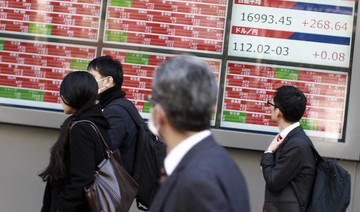
HONG KONG: Asian markets moved cautiously Wednesday as global geopolitical risks continued to gnaw at investor sentiment following last week’s US missile strike on Syria and soaring tensions on the Korean peninsula.
Dealers remain on edge over a brewing crisis following the attack that has damaged ties between the US and Russia over Moscow’s backing for Syrian President Bashar Assad.
US Secretary of State Rex Tillerson began talks with his Russian counterpart Sergei Lavrov in Moscow Wednesday following a war of words between the two sides over the US strike that Washington said was in retaliation for a Syrian chemical attack.
Risks are also rising on the Korean peninsula, with US President Donald Trump warning Washington was prepared to “solve the problem” of North Korea on its own if Pyongyang’s sole major ally China refused to help rein in its neighbor’s nuclear ambitions.
Chinese President Xi Jinping urged Trump to peacefully resolve mounting tensions as a US naval strike group headed toward the region, a show of force that prompted the North to declare it was “ready to react to any mode of war desired by the US.”
The rising uncertainty has seen a surge in safe-haven investments, with the yen climbing to five-month highs against the dollar.
Tokyo ended the morning 1.0 percent lower, while Shanghai closed 0.4 percent lower.
But Hong Kong stocks reversed earlier losses, gaining 0.9 percent, while Sydney added less than 0.1 percent. Singapore and Seoul gained 0.2 percent.
In early European trade London was flat, while Paris and Frankfurt added 0.3 percent.
Tokyo stocks were down across the board, with a stronger yen hitting exporters as Panasonic dropped 1.61 percent and Toyota traded down 1.89 percent.
Toshiba declined 1.02 percent after it reported an unaudited loss of $4.8 billion in long-overdue financial results for the nine months to December 2016.
The company also warned that its financial situation would likely worsen and said its survival was at risk.
“The reality is there is a sense of risk aversion rising in markets,” said Greg McKenna, chief market strategist at CFD and FX provider, AxiTrader.
“The worry is the rhetoric is heating up between the US and North Korea,” he said.
On oil markets both main contracts saw further gains following Friday’s US strike in Syria, which raised speculation about the impact on exports from the crude-rich Middle East.
The successful implementation of a landmark OPEC agreement to reduce a worldwide glut in oil that had depressed prices also contributed to gains.
At the end of November, the Organization of the Petroleum Exporting Countries agreed to cut output by 1.2 million barrels per day from January 1, initially for a period of six months.
Despite speculation that the reduction would be extended further, concern is growing that a boost in US shale output will undercut the decrease.
“Extending production cuts beyond June is gathering momentum,” Jonathan Barratt, chief investment officer at Ayers Alliance Securities in Sydney, told Bloomberg News.
“The problem is, as prices climb higher, US shale producers will pump more. The top for West Texas is probably about $55 a barrel.”


![]()

Asian markets cautious in face of geopolitical risks
Asian markets cautious in face of geopolitical risks

Latest updates


© 2026 SAUDI RESEARCH & PUBLISHING COMPANY, All Rights Reserved And subject to Terms of Use Agreement.