LOS ANGELES: US cable network Showtime said on Sunday it is to release “Risk,” a documentary from Oscar-winning filmmaker Laura Poitras about controversial WikiLeaks founder Julian Assange.
The network announced in a statement it would partner with distributor Neon on a theatrical release before premiering the movie on television in a few months.
Filmed over six years and taking in the 2016 US presidential election, “Risk” claims to take viewers closer than any previous film crew into Assange’s inner circle.
“With unprecedented access, Poitras gives us the WikiLeaks story from the inside, allowing viewers to understand our current era of massive leaks, headline-grabbing news, and the revolutionary impact of the Internet on global politics,” Showtime said in a statement.
“‘Risk’ is a portrait of power, principles, betrayal, and sacrifice when the stakes could not be any higher. It is a first-person geopolitical thriller told from the perspective of a filmmaker immersed in the worlds of state surveillance and the cypherpunk movement.”
Assange, 45, has been at the Ecuadoran Embassy in London since 2012, having taken refuge to avoid being sent to Sweden, where he faces a rape allegation.
He fears Sweden would extradite him to the US over his website’s leaking of diplomatic cables and other classified documents.
The Australian was questioned at the embassy on Nov. 14 and 15 on the rape allegation which dates back to August 2010.
Poitras’s profile of Assange, who denies any wrongdoing, is a follow-up to her Academy Award-winning “Citizenfour” (2014), about fugitive leaker Edward Snowden and the NSA spying scandal.
“It is an exciting time to be working with Showtime and Neon,” the 53-year-old said. “Both organizations are thinking outside the box about how to bring complex stories to a wide audience. I am thrilled to team up with them on ‘RisK’.”
An unfinished version of “Risk” screened to critical acclaim at the 2016 Cannes Film Festival.
Separately on Tuesday, Ecuador’s President-elect Lenin Moreno warned Assange not to meddle in the country’s politics, after the he taunted a rival candidate following his loss.
Moreno’s election victory was a relief for Assange.
The socialist president-elect’s conservative rival, Guillermo Lasso, had vowed to kick Assange out of the embassy.
But Moreno had some stern words after Assange took to Twitter to celebrate Lasso’s loss.
“Mr Julian Assange must respect the condition (of asylum) he is in and not meddle in Ecuadoran politics,” he said at a news conference.
As results showed Lasso losing on election night, Assange had exuberantly turned around the right-wing candidate’s threat to expel him within 30 days.
“I cordially invite Lasso to leave Ecuador within 30 days (with or without his tax haven millions),” he tweeted — a reference to allegations the ex-banker has money stashed in offshore accounts. Outgoing President Rafael Correa, a fiery critic of the US, granted Assange asylum, and Moreno has vowed to uphold it.
Assange’s case has returned to the spotlight since WikiLeaks was accused of meddling in the US election last year by releasing a damaging trove of hacked e-mails from presidential candidate Hillary Clinton’s campaign and her Democratic party.
That created an awkward situation for the Ecuadoran government, which responded by temporarily restricting his Internet access.


![]()
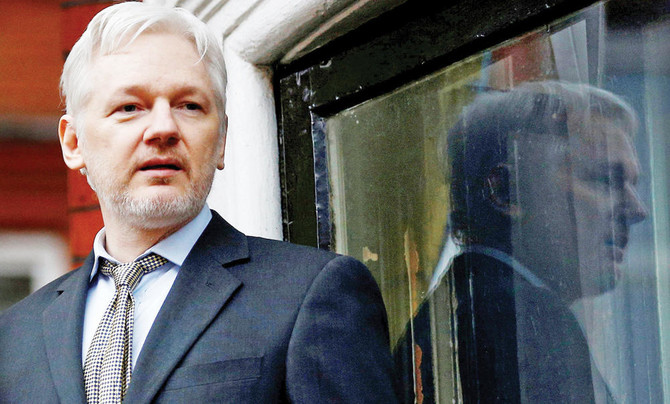
Showtime to air documentary on WikiLeaks founder Assange
Showtime to air documentary on WikiLeaks founder Assange
Latest updates



Recommended


© 2026 SAUDI RESEARCH & PUBLISHING COMPANY, All Rights Reserved And subject to Terms of Use Agreement.