BELGRADE, Serbia: Blowing whistles or horns and banging pots, more than 10,000 people protested on Saturday against Serbia’s powerful Prime Minister Aleksandar Vucic and his election as the country’s new president.
The protests in Belgrade and other Serbian cities marked the sixth day in a row of demonstrations against Vucic’s election triumph last weekend.
The noisy crowds first gathered Saturday outside the Serbian government headquarters in central Belgrade, joining hundreds of policemen and soldiers who were holding a separate rally over low wages and poor living standards.
Chanting “Vucic, thief, you stole the vote!,” the demonstrators then marched toward the police headquarters.
The protests by mostly young people have been held every day since Sunday’s election when Vucic polled 55 percent of the votes and avoided a runoff election. Opposition groups have alleged irregularities, including muzzling of the media during the campaign, voter intimidation and bribes.
Student groups have demanded replacement of the state election commission, the state TV editors and the parliament speaker.
Vucic brushed the claims aside.
“I am thankful to the citizens for the massive support that only encourages me to work more,” he said. “It is important that the protests are peaceful and democratic and all will be fine.”
Government officials claim the demonstrations are organized by opposition leaders, who have denied doing so.
“We have tried to induce change within the system and we have failed,” said protester Djordje Djolovic.
“All that’s left for the people is to fight outside of the system, on the streets, with no violence, but with determination, and to the end,” he said.


Thousands rally against leader Aleksandar Vucic in Belgrade
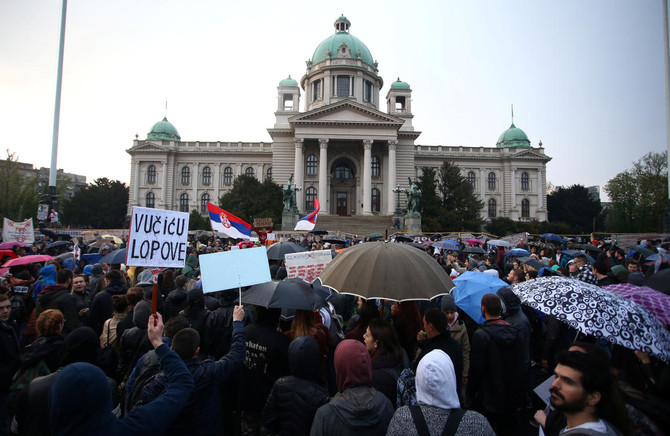
Thousands rally against leader Aleksandar Vucic in Belgrade

Pakistani fighter jet crashes in Jalalabad, pilot captured: Afghan military, police
- Fighting between Pakistan and Afghanistan’s Taliban military entered its third day on Saturday
- Pakistan’s strikes on Friday hit Taliban military installations and posts, including in Kabul and Kandahar
JALALABAD: A Pakistani jet has crashed in Jalalabad city and the pilot captured alive, the Afghan military and police said Saturday, with residents telling AFP the man parachuted from the plane before being detained.
"A Pakistani fighter jet was shot down in the sixth district of Jalalabad city, and its pilot was captured alive," police spokesman Tayeb Hammad said.
Wahidullah Mohammadi, spokesman for the military in eastern Afghanistan, confirmed the Pakistani jet was downed by Afghan forces "and the pilot was captured alive".
The AFP journalist heard a jet overhead before blasts from the direction of the airport in Jalalabad, the capital of Nangarhar province, which sits on the road between Kabul and the Pakistani border.
Fighting between Pakistan and Afghanistan’s Taliban military entered its third day on Saturday, following overnight clashes as the international community expressed increasing concern about the conflict and called for urgent talks.
Pakistan’s strikes on Friday hit Taliban military installations and posts, including in Kabul and Kandahar, in one of the deepest Pakistani incursions into its western neighbor in years, officials said.
Islamabad accuses the Taliban of harboring Tehreek-e-Taliban Pakistan (TTP) militants, who it claims are waging an insurgency inside Pakistan, a charge the Taliban denies.
Pakistan described its actions as a response to cross-border assaults, while Kabul denounced them as a breach of its sovereignty, saying it remained open to dialogue but warned any wider conflict would result in serious consequences.
The fighting has raised the risk of a protracted conflict along the rugged 2,600-kilometer frontier.
Diplomatic efforts gathered pace late on Friday as Afghanistan said its foreign minister, Amir Khan Muttaqi, spoke by telephone with Saudi Arabia’s Prince Faisal bin Farhan about reducing tensions and keeping diplomatic channels open.
The European Union called for both sides to de-escalate and engage in dialogue, while the United Nations urged an immediate end to hostilities.
Russia urged both sides to halt the clashes and return to talks, while China said it was deeply concerned and ready to help ease tensions.
The United States supports Pakistan’s right to defend itself against attacks by the Taliban, a State Department spokesperson said.
Border fighting continues
Exchanges of fire continued along the border overnight.
Pakistani security sources said an operation dubbed “Ghazab Lil Haq” was ongoing and that Pakistani forces had destroyed multiple Taliban posts and camps in several sectors. Reuters could not independently verify the claims.
Both sides have reported heavy losses with conflicting tolls that Reuters could not verify. Pakistan said 12 of its soldiers and 274 Taliban were killed while the Taliban said 13 of its fighters and 55 Pakistani soldiers died.
Taliban deputy spokesman Hamdullah Fitrat said 19 civilians were killed and 26 wounded in Khost and Paktika. Reuters could not verify the claim.
Pakistan’s Defense Minister Khawaja Muhammad Asif said “our cup of patience has overflowed” and described the fighting as “open war,” warning that Pakistan would respond to further attacks.
Taliban Interior Minister Sirajuddin Haqqani said in a speech in Khost province that the conflict “will be very costly,” and that Afghan forces had not deployed broadly beyond those already engaged.
He said the Taliban had defeated “the world, not through technology, but through unity and solidarity,” and through “great patience and perseverance,” rather than superior military power.
Pakistan’s military capabilities far exceed those of Afghanistan, with a standing army of hundreds of thousands and a modern air force.
In stark contrast, the Taliban lacks a conventional air force and relies largely on light weaponry and ground forces.
However, the Islamist group is battle-hardened after two decades of insurgency against US-led forces before returning to power in 2021.


