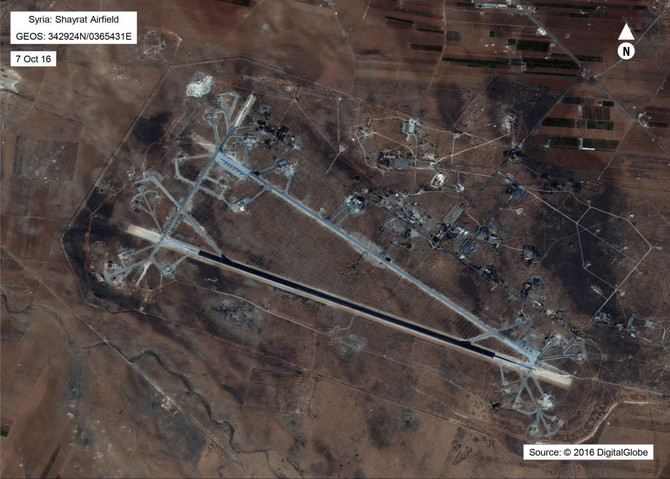
BEIRUT: The US missile attack caused heavy damage to one of Syria’s biggest and most strategic air bases, used to launch warplanes to strike opposition-held areas throughout Syria.
Videos from inside the Shayrat air base showed fighter jets and hangars destroyed and runways pocked with holes after the strike in the pre-dawn hours Friday. Still, the impact on President Bashar Assad’s military capabilities is limited: His air force has more than a dozen other bases from which to operate.
In fact, just hours after 59 US Tomahawk missiles hit the base southeast of the city of Homs, Syrian warplanes struck opposition targets in the north and south of the country, including one near the town of Khan Sheikhoun, where a chemical weapons attack Tuesday triggered the US missile strike.
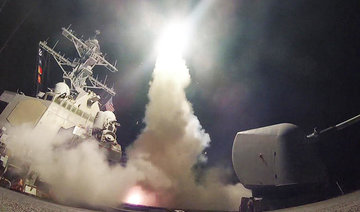
The missiles — launched from the USS Ross and USS Porter warships deployed in the Mediterranean — targeted the base’s two airstrips, hangars, control tower and ammunition depots, US officials said. Russian Defense Ministry spokesman Maj. Gen. Igor Konashenkov said they destroyed six Syrian air force MiG-23 fighter jets that were undergoing repairs, but didn’t damage other warplanes at the base.
The Kremlin maintained only 23 of the 59 cruise missiles reached the base, leaving the runways intact. However, a US official said all but one of the 59 missiles struck their targets, hitting multiple aircraft and air shelters, and destroying the fuel area. The official, who was not authorized to discuss initial reports, spoke on condition of anonymity.
“Although the strike will further weaken the overall air defense and ground attack capabilities of the (Syrian air force), it will not significantly diminish the ability of the Assad regime to conduct further chemical weapons attacks,” wrote analyst Reed Foster of the defense and intelligence publication Jane’s.
Col. Hassan Hamade, a Syrian pilot who defected in June 2012 when he landed his MiG-21 in Jordan, agreed.
“The bombardment of Shayrat will not have a major effect on military operations of the regime,” said Hamade, speaking to The Associated Press by telephone from Turkey. He said if only the tarmac was destroyed it can be fixed within hours, but if the communications system and the control tower were heavily damaged it will take weeks if not months.
No matter how extensive the damage at Shayrat, Assad has other options, Hamade said. There are 25 air bases in Syria, including 20 under government control. He said Shayrat is the second-most active when it comes to take offs and landings, superseded only by the Hemeimeem base operated by the Russian military in the coastal province of Latakia. He said he expects the country’s third-most active, Saqqal air base, which is also located in central Syria, will fill the vacuum created by the destruction at Shayrat.
Hamade said Iranian military advisers were active at the base, though it was not possible to independently confirm the claim. The Russian Defense Ministry made no mention of any Russian presence at the base before, during or after the attack, and Russian Foreign Minister Sergey Lavrov said there were no Russian casualties.
Opposition activists in the area reported extensive damage. “Shayrat air base in Homs that killed and displaced innocent people is out of order after the American military strikes,” said activist Mohammed Al-Sibai, who is based in Homs province.
“The air base is almost nearly destroyed, including aircraft and air defense bases,” said Rami Abdurrahman, head of the Britain-based Observatory for Human Rights, which operates a network of activists on the ground in Syria. Still, he said the strike on the base, Syria’s second-largest, with a fleet of Sukhoi-22, Sukhoi-24 and MiG-23 warplanes, is more a moral blow than a military one.
Syrian government officials said the base has played an instrumental role in the fight against the Daesh group, which until recently controlled the historic town of Palmyra in Homs province.
“This very airport that was attacked by the United States has been fighting against terrorists for the last six years,” Assad adviser Buthaina Shaaban told the AP in Damascus.
“If the United States is serious about fighting terrorism, why not direct its missiles on Daesh and Al-Nusra,” she said, using an Arabic acronym for IS and referring to Al-Qaeda’s branch in Syria.
Hours after the bombardment, opposition activists reported several Syrian warplanes took off from Shayrat. The Observatory said they attacked a position of the Daesh group, while Osama Abu Zeid of the Homs Media Center said they landed at the nearby T4 air base, but did not carry out any attacks.
Opposition activist Bebars Al-Talawy, who is from Homs province, said the base is surrounded by villages that are loyal to Assad and many of their residents work there. Syria’s state news agency SANA said two missiles hit nearby villages, killing four people and wounding seven.
Al-Talawy said that after the bombing dozens of ambulances rushed to the area to evacuate the wounded adding that people living nearby saw balls of fire that lit through the sky when the missiles hit the base.
A video posted on Syrian state TV showed some of the hangars received direct hits, while photos posted online by a Russian journalist who visited the base showed that at least one warplane was totally destroyed inside the hangar.


![]()
US strike on Syrian air base has limited impact on Assad
US strike on Syrian air base has limited impact on Assad


Latest updates


Recommended


© 2026 SAUDI RESEARCH & PUBLISHING COMPANY, All Rights Reserved And subject to Terms of Use Agreement.