

Arab League: Syria chemical attack a 'major crime'; UK says all evidence point to Assad

Updated 07 April 2017
Follow

Arab League: Syria chemical attack a 'major crime'; UK says all evidence point to Assad

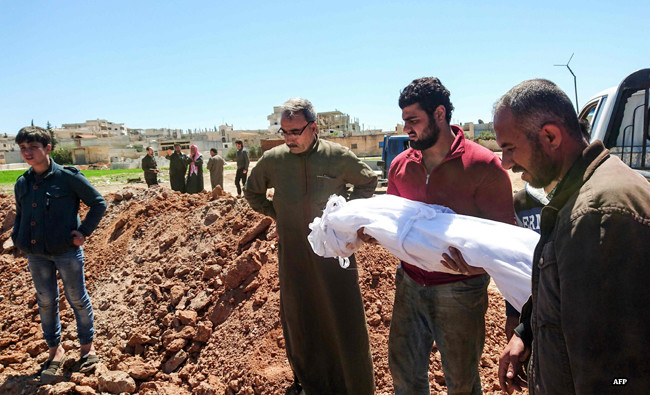
CAIRO/VATICAN/BEIRUT: International outcry grew louder on Wednesday against a suspected chemical weapons attack in Syria, with Pope Francis describing it as an “unacceptable massacre” and the Arab League calling it a “major crime”.
NATO and UN Secretary-General Antonio Guterres also weighed in, calling for an investigation to hold to account those responsible for the attack that left more than 70 dead in Syria’s Idlib province on Tuesday.
Lebanese Prime Minister Saad Hariri said the international community is itself to blame for allowing such acts to happen.
“The world should not be shocked because it’s letting such a regime do what it is doing. What should shock us is the increase of children dying and that the whole world is watching,” he told reporters at a Syria donor conference in Belgium.
Hariri also said that Lebanon has been overwhelmed by the arrival of some 1.5 million Syrian refugees and “cannot sustain this issue anymore. The international community has to do something.”
At his midweek public audience in St. Peter’s Square in Vatican City, Pope Francis said: “I completely deplore the unacceptable massacre that took place in Idlib province yesterday, where dozens of defenseless people, including many children, were killed.”
The 80-year-old pontiff spoke out as Russia and Western powers disputed what happened at Khan Sheikhun, where at least 20 children were among those who have died.
The Syrian Observatory for Human Rights said Tuesday’s air strike on the opposition-held town of Khan Sheikhun in Idlib province was likely carried out by regime warplanes, a charge the regime denied.
Turkey’s health minister says some 30 Syrians have been brought to the Turkish city of Gaziantep, bordering Syria, for treatment following the suspected chemical weapons attack in Syria.
Recep Akdag said Wednesday that initial symptoms and findings confirm that the wounded were the victims of a chemical attack. His comments were reported by the Haber Turk news channel.

‘Evidence point to Assad’
Russia, which has provided military and diplomatic backing for Syrian President Bashar Assad in his fight against the opposition fighters, said the deaths occurred after regime forces bombarded a “terrorist warehouse” containing “toxic substances.”
British Foreign Secretary Boris Johnson, however, insisted that “all the evidence” pointed to Assad’s regime “using illegal weapons on their own people.”
Johnson also says that he does “not see how a government like that can continue to have any kind of legitimate administration over the people of Syria.”
He added that he “would like to see those culpable pay a price for this.”
In Cairo, Arab League chief Ahmed Aboul Gheit said “targeting and killing civilians with these prohibited methods is considered a major crime and a barbaric act.” A
“Whoever carried it out will not escape from justice, and must be punished by the international community according to international law and international humanitarian law,” hesaid, without specifying who he held responsible.
The Arab League suspended Syria’s membership at the end of 2011 following months of brutal repression of anti-regime demonstrations and an opposition movement supported by Gulf monarchies.

Investigation pushed
UN’s Guterres said the global body would seek to establish who was to blame for a deadly episode, which he said had “demonstrated that war crimes are going on in Syria.”
Guterres told reporters at a Syria donor conference in Brussels on Wednesday that he hopes “this moment will be able to mobilize the capacity of all those that have responsibilities in this situation.”
He said “the horrific events of yesterday demonstrate that unfortunately war crimes are going on in Syria, that international humanitarian law remains being violated frequently.”
He added he is “confident that the Security Council will live up to its responsibilities,” with major powers set to convene there later in the day.
NATO Secretary-General Jens Stoltenberg said in a statement Wednesday that “this is the third report of the use of these barbaric weapons in the last month alone.”
He said Syria “is responsible to ensure its full compliance with these obligations.”
German Foreign Minister Sigmar Gabriel has called on Russia to endorse a planned United Nations Security Council resolution condemning a suspected chemical weapons attack in Syria.
Gabriel said Wednesday in Brussels before the opening of the international conference on the Syria conflict that, “We appeal to Russia to approve this resolution, to investigate this case and to bring to justice those who are responsible.”
The UN Security Council is to convene for an emergency meeting over a suspected deadly chemical attack in a town in northern Syria earlier this week, where at least 72 people were reported killed, including 11 children.
Nearly 400,000 people have been killed and half of Syria’s population has been displaced by the six-year conflict.
Ramadan brings a season of grief after an Israeli strike wiped out most of a Gaza family

Updated 4 sec ago
Follow

Ramadan brings a season of grief after an Israeli strike wiped out most of a Gaza family

  • In the Gaza Strip, Ramadan has become a season when wartime losses hit especially deep for the many families grieving loved ones killed by Israeli forces
GAZA CITY, Gaza Strip: As the sun sets, Saddam Al-Yazji, his wife and their daughter sip a noodle soup, breaking their daily Ramadan fast in Gaza City. They sit around a folding table set up in the dirt at the foot of a towering pile of rubble, twisted metal and concrete slabs that was once their home.
Buried under the debris are the bodies of much of their family.
The three are virtually the family’s only survivors. Al-Yazji’s parents, his three brothers and his sister, along with most of their children, and his wife’s parents and siblings — 40 relatives in total — were all killed in a single strike when Israeli forces bombed the house in December 2023.
The Islamic holy month of Ramadan is traditionally a time for family, with large, festive gatherings for iftar, the sunset meal that ends the daily fast. In the Gaza Strip, it has become a season when wartime losses hit especially deep for the many families grieving loved ones killed by Israeli forces, which have been fighting Hamas for more than two years.
“I look at photos of our gatherings in Ramadan and cry,” the 35-year-old Al-Yazji said. “Where is my family? All are wiped out.”
“It’s the third Ramadan without them.”
Family once had large Ramadan meals
During Ramadans before the war, Al-Yazji’s father, Kamel Al-Yazji, brought all his children and grandchildren together for iftar around a large table piled with meat and rice and other dishes, recalled Saddam’s wife, Heba Al-Yazji.
Ramadan, when Muslims fast from dawn to dusk, is a month dedicated to religious reflection and worship. It also builds community, with the giving of charity.
The elder Al-Yazji was a former judge with the Palestinian Authority and a well-known sports figure in Gaza, serving as chairman of the Palestinian Athletics Federation. Saddam Al-Yazji earned a living running a supermarket on the ground floor of the four-story family home in Gaza City’s Rimal neighborhood.
The airstrike came only a few months into the ferocious Israeli bombardment that was launched after the Hamas-led attack on southern Israel in October 2023. The house was leveled on top of everyone inside.
“We were in the same house, in other part of the house,” Saddam Al-Yazji said. “We survived miraculously.”
The only other survivors were the daughter and the pregnant wife of one of his brothers. Among the dead were 22 children.
Some of the bodies were retrieved at the time. One of Al-Yazji’s brothers is buried in a grave marked with sticks at the foot of the destroyed house. Around 20 relatives remain buried under the rubble.
After the strike, the couple and their daughter, 11-year-old Maryam, lived in a tent elsewhere in Gaza City for much of the war. During the previous two Ramadans, they tried as much as possible to come visit the rubble of their home and have iftar there.
When a ceasefire deal came into effect in October, the three moved to a tent next to their old home.
“Life is empty,” Heba Al-Yazji said. “The war took everything from me. We wish we had died with them rather than remain alone.”
Most families feel a loss
Throughout the war, Israel has struck homes and tent camps sheltering Palestinians, often killing large numbers of families at once. Israel says it targets Hamas militants, though it rarely says who were the specific targets.
Israel’s campaign has killed more than 72,000 people, nearly half of them women and children, according to the Gaza Health Ministry. The ministry, which is part of the Hamas-led government, maintains detailed casualty records seen as generally reliable by UN agencies and independent experts, though it does not give a breakdown of civilians and militants.
Around 8,000 more are still buried under the rubble of destroyed homes, according to the ministry. Retrieving most of those bodies was out of the question when airstrikes and ground assaults were raging. Under the ceasefire, recovery efforts have increased, though they are still hampered by a lack of heavy equipment.
The Israeli campaign was triggered by the Hamas attack that killed some 1,200 people in Israel and took more than 250 others hostage. The hostages have been released, mostly as part of ceasefire agreements.
Almost everyone in Gaza has lost at least extended family members. Nearly the entire population of 2.1 million is homeless, with most living in vast tent camps. More than 80 percent of the strip’s buildings have been damaged or destroyed.
A landscape of rubble that was once the Rimal district extended all around the small Ramadan table where the three surviving Al-Yazjis ate their meal.
Saddam Al-Yazji recalled the “great dining table” of his family’s past Ramadan gatherings and how they all looked forward to it every year.
“I feel like I have betrayed them by being alive,” he said.