MOGADISHU, Somalia: President Donald Trump’s approval of greater US military authority to pursue Al-Qaeda-linked extremists in Somalia will put civilians further at risk, experts say, especially as drought displaces thousands of people in areas that now will be considered a war zone.
Trump has approved a Pentagon request to allow more aggressive airstrikes against extremist group Al-Shabab as parts of southern Somalia will be considered areas of active hostilities. US special operations forces can move closer to the fight and call in offensive airstrikes more quickly while increasing assistance to the Somali National Army.
Some in long-chaotic Somalia, where access to independent information is extremely challenging, could see this as a chance to spread misinformation, said Laetitia Bader, a Somalia researcher for Human Rights Watch. “At a time when thousands of civilians are currently on the move ... the US should be cautious in relying on information about whether civilians are present before deciding to strike,” she said.
Somalia’s fragile central government, which struggles to assert itself beyond the capital and other limited areas, has not yet commented on Trump’s decision. The country also was one of the seven predominantly Muslim countries included in Trump’s recent travel ban that has been suspended by federal courts.
Somalia’s government has declared the growing drought a national disaster, with the UN saying roughly half of the country’s 12 million people are at risk. A cholera outbreak also spreads. More than a quarter-million people have been displaced in recent months, the UN refugee agency says, as drought-stricken families try to reach points where aid agencies are distributing food.
““I had no other option but to leave,” one man, Aydrus Salah, told The Associated Press this week after a trek with his three children during which his wife died of hunger.
Aid agencies cannot distribute in areas under the control of Al-Shabab, which dominates remote towns and villages across the south and central parts of the country. The extremist group has promoted its own drought relief efforts, but they are seen as attempts to keep civilians from leaving areas under their control.
“In the environment in Somalia, it’s extremely difficult to distinguish combatants from civilians,” said Joel Charny, director of the Norwegian Refugee Council’s office in Washington. Trump’s decision on Somalia follows what humanitarian experts have witnessed in Iraq, Syria and Yemen, where civilians have been killed amid US-backed efforts to go after extremists or rebels, he said.
“There appears to be a move by the Trump administration to loosen the rules, allow for more discretion at the local level, back campaigns that may be pushing the edge,” Charny said. “The theme seems to be more aggressive, and the consequences seem to be a spike in civilian casualties. It’s very worrying, especially if you transfer to the Somalia context in the midst of severe food difficulties and the worst drought in 20 years.”
With its frequent suicide bombings and assaults on hotels and military targets in Somalia’s capital and elsewhere, security experts say Al-Shabab has proved more resilient than the US expected. And now a new threat has emerged, with fighters pledging alliance to the Daesh group in the semi-autonomous northern part of the country.
About 50 US commandos currently rotate in and out of Somalia to advise and assist local troops. The commandos have accompanied Somali forces in several raids against Al-Shabab in which dozens of extremists were killed, according to Somali intelligence officials, who insisted on anonymity because they were not authorized to speak to the press.
The US already has military bases in Somalia, although it has not publicly acknowledged them. They are often used for drone attacks. In the past year the US launched 14 airstrikes — nearly all drone strikes — killing some top Al-Shabab leaders, according to a Somali intelligence official who coordinated with the US on some of them.
It is not clear how many Somali civilians have been killed in the US fight against Al-Shabab. A US intelligence report in January said as many as 117 civilians had been killed in drone and other counterterror attacks in Somalia, Yemen and elsewhere during former President Barack Obama’s presidency. Human rights and other groups have said the administration undercounted civilian casualties.
The new US military expansion of airstrikes will do little to degrade Al-Shabab, said Rashid Abdi, a Horn of Africa analyst with the International Crisis Group.
“They are a hard target, unlike ISIS. It’s very unlikely there will be Al-Shabab assets out there to hit except some training camps that are themselves hard to find. They relocate from place to the other and are highly mobile,” Abdi said.
“Those airstrikes will face more challenges, and civilian casualties will be counterproductive.”


![]()
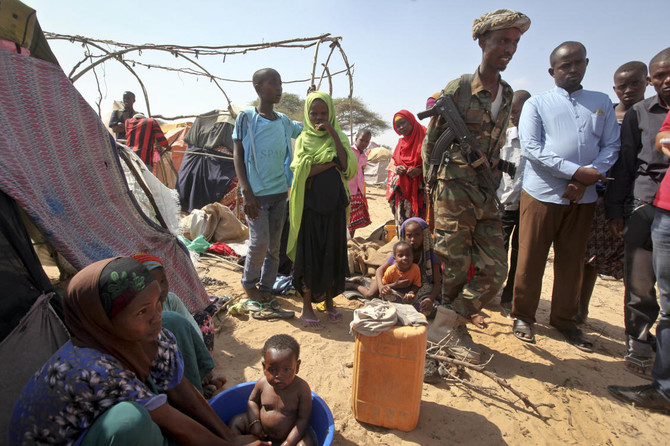

More aggressive US strikes in Somalia said to risk civilians
More aggressive US strikes in Somalia said to risk civilians
Explosion outside Moscow railway station kills two, police say
- Two other police officers were injured in the explosion
MOSCOW: An explosion outside a Moscow railway station killed two people early on Tuesday, including a police officer and a suspect believed to have planted an explosive device, Russian news agencies quoted police as saying.
Police, quoted by agencies, said investigators reviewed video footage showing a suspect approached a police car outside the Savyolovsky station in central Moscow and placed a device there.
Two other police officers were injured in the explosion. Police provided no explanation or motivation for the incident.


Latest updates


© 2026 SAUDI RESEARCH & PUBLISHING COMPANY, All Rights Reserved And subject to Terms of Use Agreement.