Hasan Sham Camp, Iraq: The children proudly wield donated plastic water bottles like freshly dug nuggets of treasure, smiling despite the fear and death and destruction they have faced in their ruined city.
With the impetuousness that only children can muster, they forget for a moment the hell they’ve endured in Mosul.
“We had a big house, but Daesh bombed and burned it,” says 10-year-old Nora, her undersized frame draped in a hand-me-down dress with a black, Peter Pan collar.
“They destroyed us.”
She is among thousands of children whose young lives have been torn apart by a vast military operation to recapture Iraq’s second city of Mosul from the Daesh group, known locally by the Arabic acronym “Daesh.”
She sits in a tent with other displaced children at a refugee camp 30 kilometers (20 miles) east of Mosul, quietly scrawling a pencil drawing of a bright pink heart.
That’s far enough to finally silence the constant thud of shelling and the crack of rifle fire that they’ve heard for weeks.
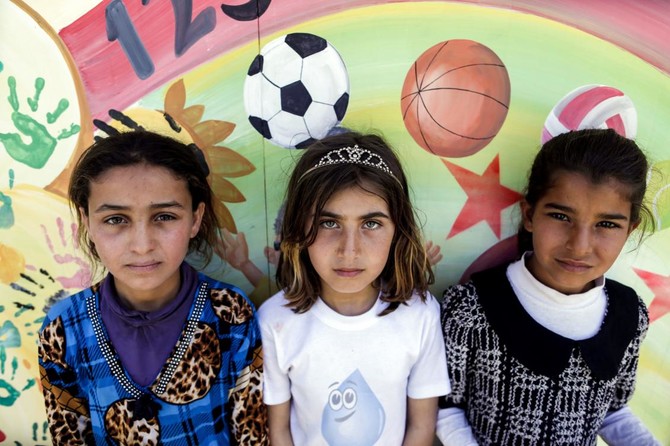
The facilities are fine but basic: a few linoleum tables, plastic chairs, crayons, pencils and paper. The tent exteriors are daubed with bright murals of fields of flowers, technicolor handprints and SpongeBob SquarePants.
A small astroturf volleyball court fades in the clear March sunshine.
For Maulid Warfa, a local official with the United Nation’s children’s fund UNICEF, this “Child Friendly Space” has a crucial function.
“Here is where children feel like children again,” she says.
Iraqi authorities say more than 200,000 people have fled west Mosul since an operation to oust Daesh from their former stronghold began last month after security forces had earlier captured eastern neighborhoods.
The battle has taken a deadly toll on civilians, sparking calls for greater efforts to protect them.
When in the tent or in the play area, Nora and her friends could almost be mistaken for happy, carefree children anywhere.
But those fleeing Mosul have their tells: fatigue darkening the eyes, sallow cheeks, shadows cast a little too thinly.
“It’s because of Daesh that we are here,” says nine-year-old Abdulrahman, sitting next to Nora at the black table strewn with crayon sketches.
“There,” he says of Mosul, “there is fear.”
He talks against a soundtrack of children laughing and singing as they chase each other through the area.
But each child here bears hidden scars.
“When they were in Mosul, they went through very, very difficult experiences,” says Warfa.
“They have seen things that they should not have, many of them have seen people that have been killed. They have seen dead bodies.”
The Child Friendly Space, run in conjunction with French charity Terre des Hommes, can help the children express themselves creatively.
But despite the psychological “first aid” they receive when arriving at the camp, many display understandable signs of the trauma they’ve witnessed.
“Some are aggressive and they run away from adults. There are those who hit their friends, others who don’t want to share anything,” says one social worker, who declined to give his name.
Warfa adds: “Even though they look normal... they are burning inside.”
Their drawings depict both innocence and pain. In among the cheery scenes of sunshine, homes and animals, some images speak of more harrowing recent experiences in Mosul.
One, starkly traced in black pencil, shows a terrified child, alone in a city consumed by flames.


![]()
Ghosts of Mosul stalk Iraq’s fleeing children
Ghosts of Mosul stalk Iraq’s fleeing children
Latest updates


© 2026 SAUDI RESEARCH & PUBLISHING COMPANY, All Rights Reserved And subject to Terms of Use Agreement.