JEDDAH: The third annual Toastmasters Division-K contest (District 79) was held recently at the Trident Hotel where speakers kept the audience engaged with motivational speeches. The theme of the competition was “Educate, Engage, Empower.”
The chief guest and keynote speaker at the event was Saudi media and political analyst Khaled Almaeena.
He congratulated the Toastmasters for their efforts in empowering the community, and termed the non-profit organization a mini UN with its diverse participants.
He said that only through education and learning will individuals be able to accept our diversity, and also advised the audience to spend quality time with their loved ones.
Almaeena praised the contribution of expatriates to the development of the Kingdom.
Lemuel Lopez, Philippine vice consul, in his address advised the audience to empower themselves to face any challenge.
Contest Chair Aqeel Jamil Khan welcomed the Toastmasters along with other guests.
He said every interaction with a person is an opportunity to have a positive impact on them; it leads to an exchange of ideas and brings people closer.
Division-K Director Osman Omer said the Toastmaster club is a place for transformation where people have the opportunity to take part in interactive educational programs and share real-life experiences.
Twenty-three speakers from areas 16, 28 and 35 participated in four different categories in the contest: Humorous Speech, Table Topics Speech, Speech Evaluation and International Speech.
All participants had moved into division level after winning contests conducted earlier in their respective areas and clubs.
In the Humorous Speech category, contestants entertained the audience with spontaneity and humor. Zainab Mulji bagged first position, Bobby Ensomo second and Syed Nasir Khursheed third.
In the Table Topics Speech category, which requires the speakers to deliver impromptu speeches, Zainab Mulji stood first, Omer Aqeel Khan second and Yousef Mario Germino third.
In the Speech Evaluation category, speakers revealed their effective listening skills and gave feedback on the speech delivered by test speaker Mohammed Abdullah. Zainab Mulji secured first place, Omer Aqeel Khan second and Yousef Mario Germin third.
In the International Speech category, which was more about synchronized gestures and voice modulation, Yousaf Abba came in first, Zainab Mulji second and Yousef Mario Germino third.
All first-place winners will participate in the District 79 Annual Conference set to take place in Riyadh on May 18-20.
Former District-79 Director Joey Villanueva presented the Pathways Program.
Program Quality Director District-79 Marwan Dashash and IPQD Rashid Ali District-79 also spoke at the occasion.
Seasoned Toastmaster Vennie Legaspy was assisted by four contest masters; Samia Aqeel Khan, Robert Parez, Riyaz Sarang and Assain Illical.
Omar Fattah, Denilo Abenis, Joey Villanueva and Abdullah Filimban were the chief judges.
Chief sergeant of the contest was Glen Sibag.
Contest chair thanked all organizing committees for their efforts in making the event successful. He also thanked Trident Hotel for their hospitality and service.


Learning is key to success, Toastmasters told
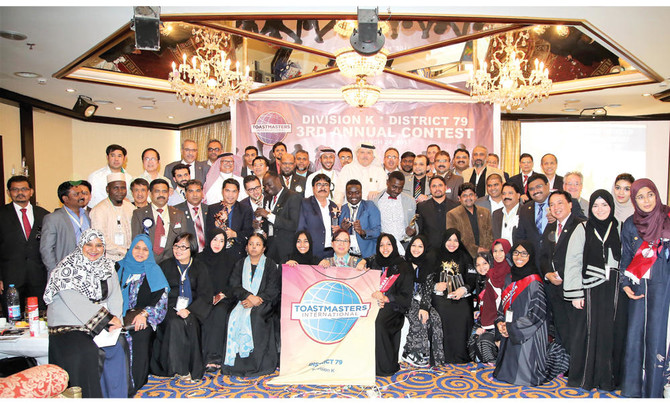
Learning is key to success, Toastmasters told

Motherhood during Ramadan
- Planning ahead, flexibility, and family support helps mothers make it through the holy month
JEDDAH: For mothers — new, working or stay-at-home, Ramadan comes with its own set of demands as they strive to balance work, house, and children of different age groups, all while fasting.
As routines shift and energy levels fluctuate, Arab News spoke to mothers on how they manage to keep their world together.
Elaf Trabulsi, founder and creative at Ctrl C Agency and a full-time employee, is a mother to an 18-month-old daughter. For Trabulsi, Ramadan is “controlled chaos, honestly. It’s my favorite month but it’s also the one that tests every system I’ve built — work, home, health, sleep. There’s something about fasting while managing a full schedule that forces you to be very deliberate about where your energy goes. I’ve come to appreciate that pressure.”
Planning is a vital strategy during Ramadan, mothers said, because without a clear structure in place, the household ends up in a state of disarray. A lot of decisions have to be made professionally and domestically to hold the house together.
“I juggle a full-time job alongside the agency, so Ramadan is really about protecting the hours that matter most and being honest about what can wait,” Trabulsi said.
Baraa Hifni, a physical education teacher at Jeddah Campus International School, echoed similar sentiments. “I rely on planning ahead, distributing household responsibilities, and organizing my children’s time. I also make sure to take some time for myself so that I can stay in a good mood throughout the day. Balance requires calmness and clear priorities,” the mother of two young daughters said.
Even with a schedule planned, juggling motherhood and work can often be challenging because newborns and toddlers function on their own timeline, and it is the sleep schedule that takes a hit.
“Ramadan flips your schedule naturally — late gatherings, suhoor, staying up — and then you have a toddler operating on her own timeline regardless. That gap between when you slept and when she’s ready to start her day is where it gets hard. You learn to function on less and find energy where you can,” Trabulsi told Arab News.
Finding pockets of peace or solitude during Ramadan for worship is also quite difficult for mothers because they cannot set or follow a rigid schedule.
For Hifni, it is usually after the chaos around iftar settles after maghrib prayer “even if it’s just a few minutes to regain my calmness and draw closer to God.”
For Trabulsi it is “whenever and wherever I can find it … sometimes it’s the quiet after she sleeps, sometimes it’s during the drive home from a gathering.”
Hana Barakat, an occupational therapist and mompreneur productivity coach, shares similar thoughts.
“Allow worship to be brief and spread throughout the day. Measure productivity by consistency, not quantity. Accept fluctuating energy from day to day. Recognize that a quieter Ramadan can still be deeply spiritual,” she said.
“Achieving balance — or harmony, as I prefer — does not mean pushing the body to match spiritual intentions but adjusting expectations and practices so that the body supports the experience rather than resists it,” she said. “Realism supports well-being and allows space to experience the month with calm.”
She advises new mothers to reset their expectations by prioritizing recovery and infant care over productivity. For a new mother, this shift can feel especially intense because she is already adapting to life after childbirth — “caring for an infant whose needs are unpredictable.”
Fasting can also influence emotional regulation, particularly when combined with sleep deprivation.
“When hunger combines with lack of sleep and fatigue, the nervous system becomes more sensitive; the crying baby may make mothers feel more overwhelmed than usual,” Barakat said.
“Emotional reactions may occur more quickly, and the mother needs extra effort to calm herself. These are normal physiological responses, not a sign of being an impatient or inadequate mother.”
Barakat outlined several strategies to help new mothers navigate the month with greater ease. Reducing nonessential tasks is not neglect, it preserves the strength needed to move steadily through the month, she said.
Choosing one meaningful task per day prevents energy from being drained by trying to accomplish everything. Waiting for an uninterrupted stretch may lead to frustration. Brief quiet moments can become restorative spiritual pauses, she added.
Even a few minutes of true rest can help regulate the nervous system, improving patience and emotional balance. Less complexity in meals, social obligations, and routines leaves more room for spiritual presence.
Meaningful support, Barakat said, must be practical rather than merely verbal, for all mothers.
Spouses and family members should help by taking responsibility for specific daily tasks, giving mothers uninterrupted time to rest, reducing social expectations placed upon her, and understanding fluctuations in her energy and mood.
“When responsibility is shared, the mother can experience Ramadan with greater calm, ease, and presence,” she said.


