Arabs to back Mideast talks if Palestine state guaranteed

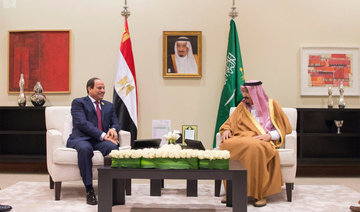
Saudi Arabia's King Salman bin Abdulaziz Al-Saud attends talks of the Arab League summit in the Jordanian Dead Sea resort of Sweimeh on Wednesday. (AFP)
Updated 30 March 2017
Follow

Arabs to back Mideast talks if Palestine state guaranteed

THE DEAD SEA, Jordan: Arab leaders on Wednesday adopted the Amman Declaration, issued at the conclusion of the Arab Summit in Jordan, reiterating their readiness to have a historic reconciliation with Israel in return for its withdrawal from land it has occupied since the 1967 war.
The declaration, read by Arab League Secretary-General Ahmed Aboul Gheit, said Arab states would back Palestinian-Israeli talks to end the decades-old conflict if it guaranteed the creation of a Palestinian state alongside Israel.
The Arab Summit — attended by 21 leaders — urged countries not to move embassies to Jerusalem and to reject unilateral Israeli moves that undermine the city’s identity. President Donald Trump has said he would move the US Embassy in Israel to Jerusalem.
The Amman Declaration says “peace is a strategic option” for the Arab world, based on a two-state solution.
It also calls for a settlement to the Syrian crisis that secures the aspirations of the Syrian people and the country’s unity and sovereignty, and removes the presence of all terrorist groups there, in accordance with the Geneva I communique and relevant UN resolutions, particularly 2254.
The declaration added that the crisis can only be solved via a political settlement with the approval of all Syrian components. It also underlined the need to support countries hosting millions of refugees.
The declaration said Arab leaders support Yemen’s legitimate government and a political settlement to the conflict on the basis of UN Resolution 2216, the Gulf Cooperation Council (GCC) initiative and the outcomes of the Yemeni National Dialogue.
It also expressed support for Arab Coalition efforts to support Yemen’s legitimate government.
The declaration said Arab leaders support the unity and stability of Iraq. It hailed the Iraqi government’s fight against terrorists, and its efforts to achieve national reconciliation that safeguards all components of society. It said Iraq’s stability is part of regional and international stability.
The declaration supports all efforts to reach a political settlement in Libya that includes all parties in a national dialogue, leading to solution that maintains the country’s unity, security and stability, and which serves the interests and hopes of the Libyan people.
Arab leaders vowed to take all measures to fight terrorism and extract it from its roots via a comprehensive strategy that entrenches democratic values and human dignity, and counters ignorance and exclusion.
Arab leaders also said they welcome good neighborliness with other countries based on mutual respect that boosts bilateral cooperation and rejects interference in the internal affairs of Arab countries, attempts to destabilize them, and sectarianism and sedition.
The declaration called on Iran to end its occupation of Emirati islands, and expressed support for the UAE’s efforts to reclaim the islands via all legal and political means. 


Israel confirms ban on 37 NGOs in Gaza

A Palestinian woman carries wood for fire in the Nuseirat refugee camp in the central Gaza Strip on December 31, 2025. (AFP)
Updated 3 sec ago
Follow

Israel confirms ban on 37 NGOs in Gaza

JERUSALEM: Israel on Thursday said 37 humanitarian agencies supplying aid in Gaza had not met a deadline to meet “security and transparency standards,” and would be banned from the territory, despite an international outcry.
The international NGOs, which had been ordered to disclose detailed information on their Palestinian staff, will now be required to cease operations by March 1.
The United Nations has warned that this will exacerbate the humanitarian crisis in the war-ravaged Palestinian territory.
“Organizations that have failed to meet required security and transparency standards will have their licenses suspended,” Israel’s Ministry of Diaspora Affairs and Combating Antisemitism said in a statement.
Several NGOS have said the requirements contravene international humanitarian law or endanger their independence.
Israel says the new regulation aims to prevent bodies it accuses of supporting terrorism from operating in the Palestinian territories.
Prominent humanitarian organizations hit by the ban include Doctors Without Borders (MSF), the Norwegian Refugee Council (NRC), World Vision International and Oxfam, according to a ministry list.
In MSF’s case, Israel accused it of having two employees who were members of Palestinian militant groups Islamic Jihad and Hamas.
MSF said this week the request to share a list of its staff “may be in violation of Israel’s obligations under international humanitarian law” and said it “would never knowingly employ people engaging in military activity.”
‘Critical requirement’ 
NRC spokesperson Shaina Low told AFP its local staff are “exhausted” and international staff “bring them an extra layer of help and security. Their presence is a protection.”
Submitting the names of local staff is “not negotiable,” she said. “We offered alternatives, they refused,” hse said, of the Israeli regulators.
The ministry said Thursday: “The primary failure identified was the refusal to provide complete and verifiable information regarding their employees, a critical requirement designed to prevent the infiltration of terrorist operatives into humanitarian structures.”
In March, Israel gave NGOs 10 months to comply with the new rules, which demand the “full disclosure of personnel, funding sources, and operational structures.”
The deadline expired on Wednesday.
The 37 NGOs “were formally notified that their licenses would be revoked as of January 1, 2026, and that they must complete the cessation of their activities by March 1, 2026,” the ministry said Thursday.
A ministry spokesperson told AFP that following the revocation of their licenses, aid groups could no longer bring assistance into Gaza from Thursday.
However, they could have their licenses reinstated if they submitted the required documents before March 1.
Minister of Diaspora Affairs and Combating Antisemitism Amichai Chikli said “the message is clear: humanitarian assistance is welcome — the exploitation of humanitarian frameworks for terrorism is not.”
‘Weaponization of bureaucracy’
On Thursday, 18 Israel-based left-wing NGOs denounced the decision to ban their international peers, saying “the new registration framework violates core humanitarian principles of independence and neutrality.”
“This weaponization of bureaucracy institutionalizes barriers to aid and forces vital organizations to suspend operations,” they said.
UN Palestinian refugee agency chief Philippe Lazzarini had said the move sets a “dangerous precedent.”
“Failing to push back against attempts to control the work of aid organizations will further undermine the basic humanitarian principles of neutrality, independence, impartiality and humanity underpinning aid work across the world,” he said on X.
On Tuesday, the foreign ministers of 10 countries, including France and Britain, urged Israel to “guarantee access” to aid in the Gaza Strip, where they said the humanitarian situation remains “catastrophic.”
A fragile ceasefire has been in place since October, following a deadly war waged by Israel in response to Hamas’s unprecedented October 7, 2023 attack on Israel.
Nearly 80 percent of buildings in Gaza have been destroyed or damaged by the war, according to UN data.
About 1.5 million of Gaza’s more than two million residents have lost their homes, said Amjad Al-Shawa, director of the Palestinian NGO Network in Gaza.