THE UNITED NATIONS: South Sudan’s government is spending at least half its budget on security and weapons while 100,000 people are dying of starvation as a result of famine caused mainly by an upsurge in government military operations, UN experts said in a new report.
The experts monitoring UN sanctions against the world’s newest nation said an additional 1 million people are near starvation and the number of people desperately needing food is expected to rise to 5.5 million “at the height of the lean season in July if nothing is done to curb the severity and breadth of the food crisis.”
The report to the Security Council, said that despite the scale and scope of South Sudan’s political, humanitarian, and economic crises, the panel of experts continues to uncover evidence of the ongoing purchase of weapons by President Salva Kiir’s SPLA forces.
The experts called on council members to impose an arms embargo on South Sudan, add additional people blocking peace efforts and the delivery of humanitarian aid to the UN sanctions blacklist, and endorse a recommendation by the UN Commission on Human Rights in South Sudan (OHCHR) to establish an international investigation into the most serious crimes committed during the war.
South Sudan’s UN Mission said it could not comment because it has not seen the report.
The country plunged into ethnic violence in December 2013 when forces loyal to Kiir, a Dinka, started battling those loyal to Riek Machar, his former vice president who is a Nuer. A peace deal signed in August 2015 and backed by the US collapsed last July.
Fighting has spread to new parts of the country since then, and the UN has warned of ethnic cleansing. According to the report, at the end of February over 1.9 million South Sudanese were internally displaced and over 1.6 million had fled the country.
“South Sudan is now Africa’s largest refugee crisis and the third largest globally, after Syria and Afghanistan,” the panel said. “More than 60 percent of the refugees are children — many severely malnourished. Recent new arrivals are reporting intense fighting, kidnappings, rape, fears of armed groups and threats to life, as well as acute shortages.”
The experts said that by far the largest-scale military campaigns have been executed by the SPLA under Kiir’s leadership in Upper Nile, Unity, Western Bahr El-Ghazal, Jonglei and Greater Equatoria states.
The campaigns use a combination of tribal militia and Dinka SPLA forces supported by heavy weapons including Mi24 attack helicopters, L-39 jets, and amphibious vehicles acquired by the government since the war began, they said.
“These military operations have constituted an escalation of the war in multiple areas of the country during the dry season, the consequences of which are starkly illustrated by the accelerating displacement of the population,” the report said. “At least one in every four South Sudanese has now been forced from his or her home since December 2013.”
The experts said “the de facto collapse” of the national unity transitional government envisioned in the 2015 peace deal has left a political arrangement between Kiir and First Vice President Taban Deng Gai, a Nuer, “that does not meaningfully include significant segments of the opposition, other political factions, and many influential non-Dinka community leaders.”


![]()
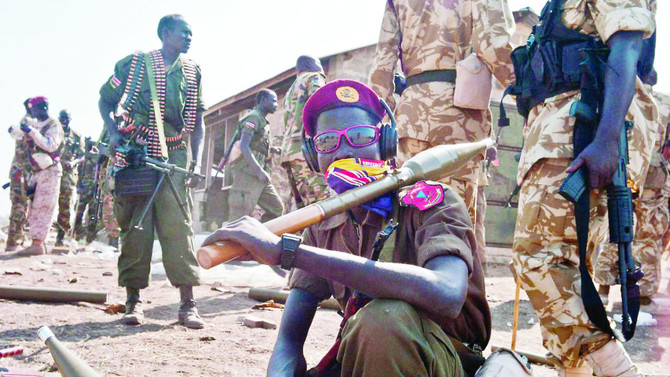
100,000 starve while S. Sudan buys weapons, say experts
100,000 starve while S. Sudan buys weapons, say experts


Latest updates


© 2026 SAUDI RESEARCH & PUBLISHING COMPANY, All Rights Reserved And subject to Terms of Use Agreement.