NEW YORK: The White House clashed with environmentalists on Wednesday over President Donald Trump’s retreat from tough future auto emission standards, with both sides predicting potentially big consequences for America’s car fleet.
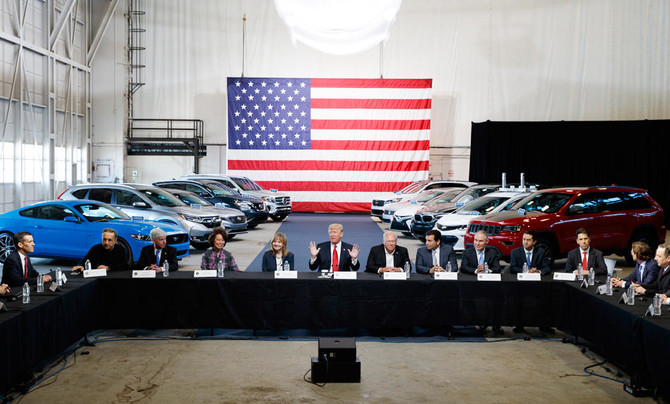
Appearing in Detroit, Trump ordered a review of the Obama administration’s decision in January to finalize stiff fuel economy standards for the 2022-2025 period.
Trump cast his decision as a defense of American jobs, while his new Environmental Protection Agency administrator, Scott Pruitt — an avowed skeptic of climate-change science — decried the rules as “costly for automakers and the American people.”
But the Natural Resources Defense Council warned the move would lead to a proliferation of gas guzzlers, while Senate Democratic leader Charles Schumer called the decision “one of the first steps in an all-out assault by the Trump administration to dismantle important environmental protections.”
Although Trump’s action opens the door to a potentially big change, auto industry experts said it is more likely the actual consequences will turn out to be less monumental than suggested by the rhetoric on both sides.
“It’s safe to assume, I imagine, we’ll have a less strict proposal sometime in the future,” said David Whiston, an auto industry equity analyst at Morningstar who predicted major investments in hybrid and more efficient internal combustion technology would have lasting impacts.
“Long term, companies are still going to invest in electric, and plug-in hybrids and hydrogen regardless of what these rules are.”
US automakers have already sunk large amounts into factories and technology programs to meet tough fuel economy standards in America and other key markets, such as Europe and China, the International Council on Clean Transportation (ICCT) said.
“Anything that puts the US 2025 standards at risk carries with it the risk that the US could once again become a relative technology laggard in the industry, with clear implications for US-based companies’ competitive position,” the think-tank said.
Trump’s move on Wednesday concerns a deal originally struck between Barack Obama and many leading automakers in 2011 that envisioned a series of gradual increases through 2025, when average fuel economy would rise to 54.5 miles per gallon.
To meet the standards, automakers have adopted lighter-weight materials such as aluminum and structural tweaks to promote better aerodynamics, among other moves.
As part of the agreement, the auto industry won a promise for a “midterm evaluation” of the deal scheduled for 2018 to assess the standards in light of technological changes and business conditions.
Obama administration officials finalized the review and upheld the standards in their final days in office, drawing criticism from the industry, which argues the rules are costly and out of step with current market dynamics, including the rising popularity of light trucks in the US.
Automakers cheered Trump’s move Wednesday.
“By restarting this review, analysis rather than politics will produce a final decision consistent with the process we all agreed to... for greenhouse gases and fuel economy standards,” said Mitch Bainwol, president of the Alliance of Automobile Manufacturers.
Efraim Levy, an auto industry analyst at the research group CFRA, said relaxing the rules should result in lower costs for automakers that can be passed on to consumers, boosting sales.
At the same time, analysts predict automakers will continue to invest heavily in hybrids and other fuel-efficient and electric vehicles to meet changing consumer tastes in an era when companies like Tesla are pushing the envelope with electric cars.
Pressure is also coming from US states that have adopted tough environmental rules, especially California, which has taken advantage of a provision under the Clean Air Act that permits states to set fuel emissions standards that go beyond federal rules.
An effort by the Trump administration to challenge California’s authority would almost certainly wind up in court, where it would create a legal quagmire.
“As much as automakers might want some leniency from the standards, they don’t want leniency with much greater uncertainty,” ICCT program director Nic Lutsey said.
One outcome of the review could be greater leniency in how automakers are tested for fuel economy, he said, permitting more technologies that boost fuel economy but are difficult to account for during the rule-setting process.


More gas guzzlers due to Trump? Not necessarily
More gas guzzlers due to Trump? Not necessarily

Acwa signs key terms to develop 5GW of renewable energy capacity in Turkiye
JEDDAH: Saudi utility giant Acwa has signed key investment agreements with Turkiye’s Ministry of Energy and Natural Resources to develop up to 5 gigawatts of renewable energy capacity, starting with 2GW of solar power across two plants in Sivas and Taseli.
Under the investment agreement, Acwa will develop, finance, and construct, as well as commission and operate both facilities, according to a press release.
The program builds on the company’s first investment in Turkiye, the 927-megawatt Kirikkale Independent Power Plant, valued at $930 million, which offsets approximately 1.8 million tonnes of carbon dioxide annually, the statement added.
A separate power purchase agreement has been concluded with Elektrik Uretim Anonim Sirketi for the sale of electricity generated by each facility.
Turkiye aims to boost solar and wind capacity to 120GW by 2035, supported by around $80 billion in investment, while recent projects have already helped prevent 12.5 million tonnes of CO2 emissions and reduced reliance on imported natural gas.
Turkiye’s energy sector has undergone a rapid transformation in recent years, with renewable power emerging as a central pillar of its strategy.
Raad Al-Saady, vice chairman and managing director of ACWA, said: “The signing of the IA (implementation agreement) and PPA key terms marks a pivotal moment in Acwa’s partnership with Turkiye, reflecting the country’s strong potential as a clean energy leader and manufacturing powerhouse.”
He added: “Building on our long-standing presence, including the 927MW Kirikkale Power Plant commissioned in 2017, this step elevates our partnership to a new level,” Al-Saady said.
In its statement, Acwa said the 5GW renewable energy program will deliver electricity at fixed prices, enhancing predictability for grid planning and supporting long-term industrial investment.
By replacing imported fossil fuels with domestically generated clean energy, the initiative is expected to reduce Turkiye’s exposure to global energy market volatility, strengthening energy security and lowering long-term power costs.
The company added that the economic impact will extend beyond the anticipated investment of up to $5 billion in foreign direct investment, with thousands of jobs expected during the construction phase and hundreds of high-skilled roles created during operations.
The energy firm concluded that its existing progress in Turkiye reflects a strong appreciation for Turkish engineering, construction, and manufacturing capacity, adding that localization has been a strategic priority, and it has already achieved 100 percent local employment at its developments in the country.


