Erdogan says apology from Netherlands not enough, further sanctions may follow

1 / 4
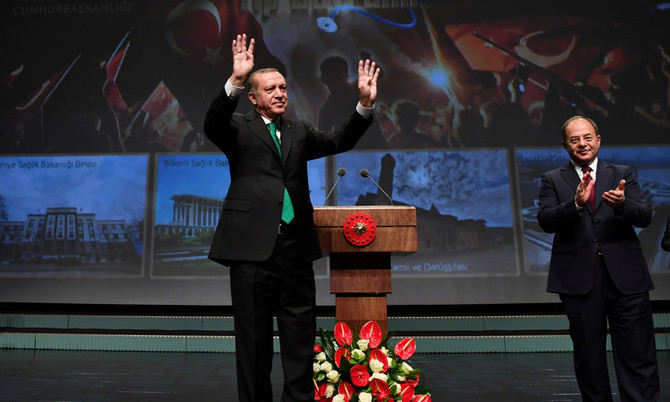
Turkish President Tayyip Erdogan, accompanied by Health Minister Recep Akdag, greets the audience during a meeting in Ankara on Tuesday. (Murat Cetinmuhurdar/Presidential Palace/Handout via Reuters)
2 / 4
Turkey's President Recep Tayyip Erdogan addresses his supporters in Istanbul on March 11, 2017. (Kayhan Ozer/Pool Photo via AP)
3 / 4
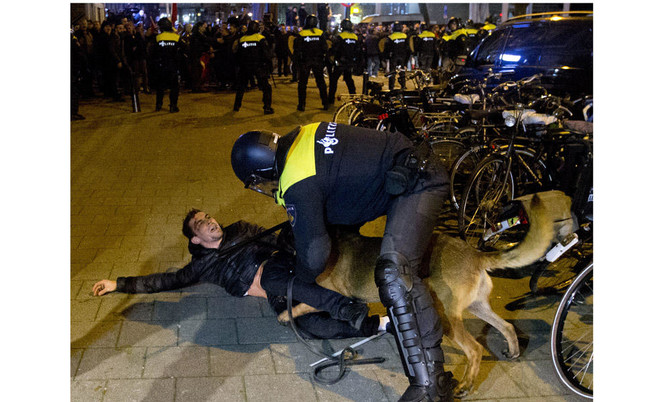
A Dutch riot policeman tries to get his dog to let go of a man after riots broke out during a pro-Erdogan demonstration at the Turkish consulate in Rotterdam, Netherlands, on Sunday. (AP Photo/Peter Dejong)
4 / 4
Turkey's President Recep Tayyip Erdogan, left, speaks during an interview with A Haber television in Istanbul, late Monday. (Kayhan Ozer/Presidential Press Service, Pool Photo via AP)
Updated 14 March 2017
Follow

Erdogan says apology from Netherlands not enough, further sanctions may follow

ANKARA: Turkish President Tayyip Erdogan said on Tuesday a diplomatic row with the Netherlands could not be dismissed with an apology, and that further actions could be taken, after Turkey on Monday suspended high-level diplomatic ties with the Dutch.
Speaking at an event in Ankara, Erdogan also accused German Chancellor Angela Merkel of attacking Turkey the same way Dutch police used dogs and water cannon to Turkish disperse protesters outside the Turkish consulate in Rotterdam.
Erdogan said Merkel was “no different from the Netherlands,” and urged emigre Turks to not vote for “the government and the racists” in upcoming European elections.
Turkey has suspended high-level diplomatic relations with the Netherlands after Dutch authorities prevented its ministers from speaking at rallies of expatriate Turks in order to drum up support for an April referendum to grant Erdogan’s office sweeping powers, deepening the row between the two NATO allies.
In an interview with Haber television in Istanbul late Monday, Erdogan held the Netherlands responsible for a massacre during the Bosnian war in the 1990s.
"We know the Netherlands' understanding of civilization and morality from its role in the Srebrenica genocide," he said.
Deputy Prime Minister Numan Kurtulmus has said the sanctions Turkey had slapped on the Netherlands would apply until the Netherlands takes steps “to redress” the actions that Ankara sees as a grave insult.
“There is a crisis and a very deep one. We didn’t create this crisis or bring it to this stage,” Kurtulmus said. “Those who did have to take steps to redress the situation.”
Erdogan's government also advised parliament to withdraw from a Dutch-Turkish friendship group.


Family of Palestinian-American shot dead by Israeli settler demand accountability

Updated 21 February 2026
Follow

Family of Palestinian-American shot dead by Israeli settler demand accountability

  • Relatives say Abu Siyam was among about 30 residents from the village of Mukhmas who confronted armed settlers attempting to steal goats from the community

LONDON: The family of a 19-year-old Palestinian-American man reportedly shot dead by an Israeli settler in the occupied West Bank have demanded accountability, amid mounting scrutiny over a surge in settler violence and a lack of prosecutions.

Nasrallah Abu Siyam, a US citizen born in Philadelphia, was killed near the city of Ramallah on Wednesday, becoming at least the sixth American citizen to die in incidents involving Israeli settlers or soldiers in the territory in the past two years.

Relatives say Abu Siyam was among about 30 residents from the village of Mukhmas who confronted armed settlers attempting to steal goats from the community. Witnesses said that stones were thrown by both sides before settlers opened fire, wounding at least three villagers.

Abu Siyam was struck and later died of his injuries.

Abdulhamid Siyam, the victim’s cousin, said the killing reflected a wider pattern of impunity.

“A young man of 19 shot and killed in cold blood, and no responsibility,” he told the BBC. “Impunity completely.”

The US State Department said that it was aware of the death of a US citizen and was “carefully monitoring the situation,” while the Trump administration said that it stood ready to provide consular assistance.

The Israeli embassy in Washington said the incident was under review and that an operational inquiry “must be completed as soon as possible.”

A spokesperson for the Israeli Defense Forces said troops were deployed to the scene and used “riot dispersal means to restore order,” adding that no IDF gunfire was reported.

The military confirmed that the incident remained under review and said that a continued presence would be maintained in the area to prevent further unrest.

Palestinians and human rights organizations say such reviews rarely lead to criminal accountability, arguing that Israeli authorities routinely fail to prosecute settlers accused of violence.

A US embassy spokesperson later said that Washington “condemns this violence,” as international concern continues to grow over conditions in the occupied West Bank.

Palestinians and human rights groups say Israeli authorities routinely fail to investigate or prosecute settlers accused of violence against civilians.

Those concerns were echoed this week by the UN, which warned that Israel’s actions in the occupied West Bank may amount to ethnic cleansing.

A UN human rights office report on Thursday said that Israeli settlement expansion, settler attacks and military operations have increasingly displaced Palestinian communities, with dozens of villages reportedly emptied since the start of the Gaza war.

The report also criticized Israeli military tactics in the northern West Bank, saying that they resembled warfare and led to mass displacement, while noting abuses by Palestinian security forces, including the use of unnecessary lethal force and the intimidation of critics.

Neither Israel’s foreign ministry nor the Palestinian Authority has commented on the findings.