ISTANBUL: The European Union on Monday warned President Recep Tayyip Erdogan to avoid inflammatory rhetoric as a diplomatic crisis between Turkey and the Netherlands deepened over the blocking of Turkish ministers from holding rallies to win support for plans to expand his powers.
Erdogan at the weekend twice accused NATO ally Netherlands of acting like the Nazis, comments that sparked outrage in a country bombed and occupied by German forces in World War II.
In an escalating standoff that risks damaging Turkey’s already deteriorating relations with the European Union ahead of the April 16 referendum on constitutional change, Brussels sternly warned Ankara to avoid making the situation worse.
In apparent reference to Erdogan’s comments, EU foreign policy chief Federica Mogherini and EU Enlargement Commissioner Johannes Hahn called on Turkey to “refrain from excessive statements and actions that risk further exacerbating the situation.
“It is essential to avoid further escalation and find ways to calm down the situation,” their statement added.
But Turkey’s EU Affairs Minister Omer Celik responded by warning that Ankara “should re-evaluate” a key part of a 2016 deal to stem the flow of migrants to the European Union.
He said Turkey should look at its policy on preventing migrant flows across land borders, although it would keep halting the illegal and dangerous sea crossings as a matter of human responsibility, state media said.
NATO chief Jens Stoltenberg also urged Turkey and its NATO allies to “show mutual respect, to be calm and have a measured approach to contribute to de-escalate the tensions.”
The Dutch authorities had at the weekend prevented the plane of Turkish Foreign Minister Mevlut Cavusoglu from landing and blocked Family Minister Fatma Betul Sayan Kaya from holding a rally in Rotterdam.
The ministers had been seeking to harness the support of an estimated 400,000 people of Turkish origin living in the country ahead of the April 16 referendum on constitutional changes giving Erdogan greater powers.
The Turkish Foreign Ministry on Monday summoned the Dutch envoy to Ankara for the third day in a row, handing two separate protest notes over The Hague’s behavior.
The Netherlands on Monday also issued a new travel warning to Dutch citizens in Turkey, urging them to stay “alert across the whole of Turkey.”
Turkey has already responded furiously to fellow NATO ally Germany’s refusal to give permission for ministers to hold rallies there, with Erdogan comparing such action to “Nazi practices.”
After Erdogan used the same language to scold the Netherlands, German Chancellor Angela Merkel said on Monday that the comparison was “completely wrong” and “banalizes suffering.”
“This is particularly unacceptable directed at the Netherlands which suffered so much” under the Nazis, she added, offering Dutch Prime Minister Mark Rutte her full support.
The issue risks spiralling into a crisis with the EU as a whole, which Turkey has sought to join for more than half a century in a so far fruitless membership bid.
Denmark has also asked Turkish Prime Minister Binali Yildirim to postpone a visit planned for later this month.
Erdogan, who has indicated he may personally travel to EU states to address rallies — in a move that could inflame the situation further — said on Sunday that the West was showing its “true face” in the standoff.
He has repeatedly accused the Netherlands of acting like “fascists” and “Nazis,” saying on Sunday: “I had thought that the era of Nazism was over but I was wrong.”
Deputy Prime Minister Nurettin Canikli described Europe as a “very sick man,” a nod to the moniker used in the mid-19th century of the declining Ottoman Empire as the “sick man of Europe.”
Rutte, under pressure to take a hard line against Erdogan as he faces the far-right populist Geert Wilders in general elections Wednesday, said there were no apologies to be made to Turkey.
He called for Dutch voters to be the first to stop Europe’s “trend of populism” but dismissed the idea that Turkey was trying to interfere in the Netherlands elections.
Bringing out the millions-strong expatriate vote could be key in a referendum that is expected to be close and potentially a turning point in Turkey’s modern history.
Analysts have said Erdogan is using the crisis to show that his strong leadership is needed against a Europe which he presents as being innately hostile to Turkey.
“Erdogan is looking for ‘imagined’ foreign enemies to boost his nationalist base in the run up to the April 16 referendum,” said Soner Cagaptay, director of the Turkish Research Program at The Washington Institute.
“By blocking (the rallies), they may have given Erdogan a lifeline to eke out a victory in the referendum,” he added.


EU warns Erdogan as Turkey-Netherlands crisis deepens
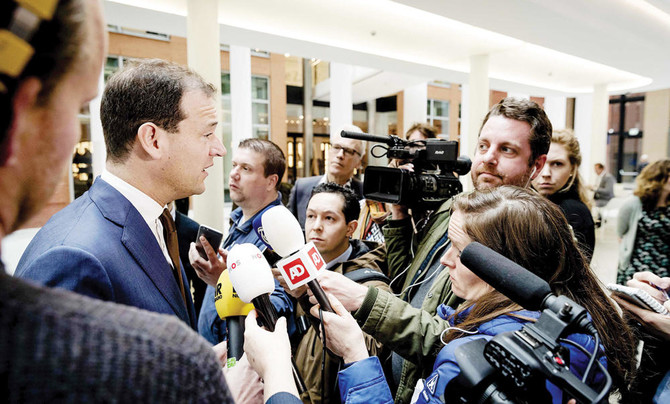
EU warns Erdogan as Turkey-Netherlands crisis deepens

Trump takes unconventional approach to communicating to the public about war in Iran
- The communications strategy opened Trump to criticism that he hadn’t done enough to explain the rationale and objectives of the war
Typical of an unconventional presidency, the Trump administration waited more than 48 hours to make any live, public communication to the American people about why it had decided to go to war with Iran.
President Donald Trump discussed why he launched the attack prior to a White House ceremony honoring military heroes on Monday but took no questions from reporters. Earlier in the day, Defense Secretary Pete Hegseth and Joint Chiefs of Staff Chairman Dan Caine briefed journalists at the Pentagon.
The two days previous, Trump delivered two pretaped statements that were released on Truth Social, the social media site owned by the president’s media company, and granted telephone interviews to more than a dozen journalists — several of which produced fragmented responses that, to some, clouded as much as they cleared up.
The communications strategy opened Trump to criticism that he hadn’t done enough to explain the rationale and objectives of the war, even as the American military suffered its first casualties. By contrast, Israeli Prime Minister Benjamin Netanyahu, who has teamed with the US against Iran, delivered two statements the day the war began and addressed reporters Monday at the site of a missile attack that killed nine people. The Israeli military has held multiple press briefings each day.
“The American people need a commander in chief, and he has been absent in that role,” Rahm Emanuel, White House chief of staff under President Barack Obama, said on CNN Monday. Emanuel, a Democrat, is contemplating a run for the presidency in 2028.
An unconventional strategy leads to criticism
Peter Baker, chief White House correspondent for The New York Times, wrote on social media that “after Trump launched a new war on Iran, he did not rush back to the White House to make an Oval Office address to rally the nation as other presidents have done. He stayed at Mar-a-Lago to attend a glitzy political fundraiser.”
That post provoked a response from Steven Cheung, White House communications director. “Imagine being a reporter so consumed with Trump Derangement Syndrome that he wants President Trump to mimic the failed policies of the past. The truth is that President Trump spent the majority of his time monitoring the situation in a secure facility, in constant contact with world leaders, and made multiple addresses to the nation that garnered hundreds of millions of views. He also took dozens of calls with reporters.”
The calls included one with Baker’s colleague at The Times, Zolan Kanno-Youngs. Trump’s mobile phone number is known to many of the reporters who cover him, and the president often takes their calls for on-the-spot interviews. Besides The Times, he spoke in the aftermath of the attack to journalists for ABC, CBS, NBC, CNN, CNBC, Fox News Channel, The Atlantic, The Washington Post, Axios, Politico and an Israeli television station.
Most of the calls were brief and marginally illuminating; Politico’s Dasha Burns said Trump answered but said he was too busy to talk. The public couldn’t hear what Trump said in the interviews and was dependent upon what the journalists chose to report on the conversations.
“I spoke to President Trump today and he told me that the operation in Iran is going to go very fast,” Libby Alon, a reporter for Channel 14 News in Israel, wrote about her interview on X. “It’s doing very well, and (will) make the people of Israel very happy, and the people of the world very happy.”
The Times reported that in its six-minute chat, Trump “offered several seemingly contradictory visions of how power might be transferred to a new government — or even whether the existing Iranian power structure would run that government or be overthrown.”
In one of his two conversations with Trump, ABC News’ Jonathan Karl said when he asked about the death of Iranian Ayatollah Ali Khamenei, the president said: “I got him before he got me. They tried twice. Well I got him first.” CNN’s Jake Tapper went on the air minutes after his conversation Monday, saying Trump told him “the big one is coming soon,” an apparent reference to a future attack.
Asked for comment, White House spokeswoman Anna Kelly said: “President Trump is the most transparent and accessible president in American history. The American people have never had a more direct and authentic relationship with a president of the United States than they have with President Trump.”
Hegseth briefing concentrates on friendly reporters
Pentagon reporters learned late Sunday about Hegseth’s briefing. Reporters from The Associated Press, Reuters, ABC, CBS, NBC, CNN, Fox News Channel and Stars & Stripes were permitted into the briefing room, but Hegseth did not call on them. Instead, he took questions from NewsNation and Trump-friendly outlets like the Daily Caller, Daily Wire, One America News and the Christian Broadcasting Network. Most mainstream news outlets left their regular stations at the Pentagon last fall rather than agree to Hegseth’s rules restricting their work.
Hegseth denounced the “foolishness” of people wanting to know details of the operation in advance, such as whether Americans would commit to more than air power, and said the operation would continue as long as it took to achieve objections. He initially ignored NBC News’ Courtney Kube when she called out a question: “President Trump put a four-week time limit on it. Are you saying he’s wrong?”
Later, Hegseth denounced Kube for asking “the typical NBC sort of gotcha-type question. President Trump has all the latitude in the world to talk about how long it might take — four weeks, two weeks, six weeks, it could move up, it could move back. We’re going to execute at his command the objectives he set out to achieve.”
Unlike Pentagon briefings in past administrations, reporters were given assigned seats, with the Trump-friendly outlets seated in front. Jennifer Griffin, Hegseth’s former colleague at Fox News Channel who left the Pentagon with other reporters after not accepting his new rules, was seated in the last row.


