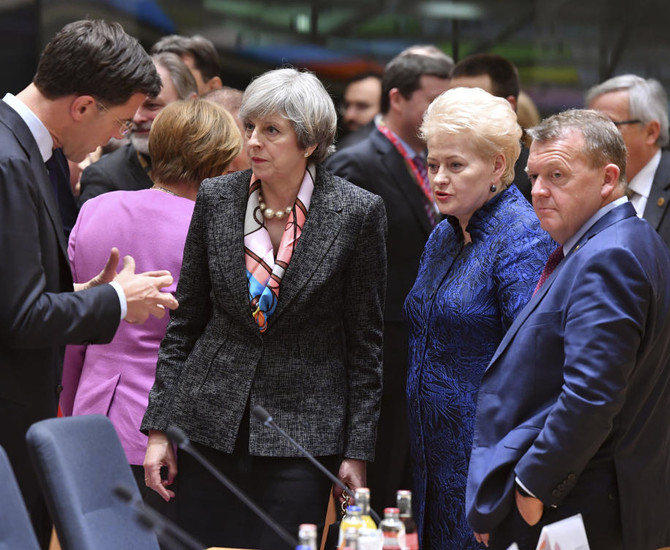
LONDON: Prime Minister Theresa May is expected to trigger Brexit this week by formally informing the European Union of Britain’s intention to leave the bloc, sending her country into uncharted waters.
The legislation empowering May to put Britain on a course that no member state has ever taken returns to parliament for its final stages on Monday as European capitals prepare for mammoth negotiations.
After heated debate and a delay in the upper House of Lords, the bill could win final approval by both Houses by Monday evening — leaving May’s path clear to begin Brexit whenever she wants.
The prime minister promised months ago to invoke Article 50 of the EU’s Lisbon Treaty, starting the two-year withdrawal process, by the end of March.
Last week she expressed her impatience, telling reporters at a Brussels summit: “Our European partners have made clear to me that they want to get on with the negotiations, and so do I.”
Irish premier Enda Kenny revealed at the same summit that the EU was preparing for Article 50 from Wednesday, while Britain’s opposition Labour party has also spoken of Wednesday or Thursday.
Once May has notified the EU of her decision by letter, the other 27 EU leaders will take some 48 hours to issue their first draft proposal for the negotiations but talks are not actually expected to begin for months as both sides finalize strategies.
EU leaders have planned a follow-up meeting on April 6, “provided that the prime minister moves Article 50, I think by March 15th,” Kenny said.
Triggering Article 50 this week would put Britain on course to leave the European Union by March 2019 — a prospect that has caused concern about the future of European unity in some capitals.
But unraveling four decades of membership and forging new trade ties to replace Britain’s membership of the single market within two years will be fiendishly complex.
EU leaders are determined that Brexit will not undermine the unity of the bloc, and that the final terms do not encourage other member states to follow Britain.
There have already been sharp exchanges, although European Commission head Jean-Claude Juncker voiced hope that Britain would one day return.
“I would like to be in the same boat as the British. The day will come when the British will re-enter the boat, I hope,” he said last week.
May was forced to introduce the two-clause bill empowering her to trigger Article 50 after the Supreme Court ruled in January that she must seek parliament’s approval to start Brexit.
The bill was held up earlier this month by amendments passed in the unelected House of Lords, demanding guarantees for EU nationals’ rights and a parliamentary vote on the final withdrawal deal.
The Conservative government has given assurances on both issues, but says it does not want to tie its hands in the EU negotiations.
MPs in the lower elected House of Commons, where May has a majority, overwhelmingly supported the bill in its first stage last month.
Ministers are hopeful the Commons will overturn the Lords amendments in a vote on Monday afternoon, although some europhile Conservative MPs may rebel.
The bill would then return to the Lords later that evening for final approval, where further opposition is possible, but unlikely.
Adding to the day of drama in Westminster, anti-austerity and pro-immigration campaigners are set to protest outside parliament later on Monday to urge MPs to guarantee the status of the three million EU nationals living in Britain.
Downing Street has played down speculation that May could announce the start of Brexit during a planned statement to MPs on the EU summit on Tuesday.
Triggering Article 50 this week would cheer euroskeptics in May’s Conservative party, which is holding a conference in Wales on Friday and Saturday.
It could also encourage the Scottish nationalists who hold power in the devolved government in Edinburgh, who are also meeting on Friday.
Scotland voted to stay in the EU, but Brexit supporters in England and Wales pushed through the final result of 52 percent to 48 percent to leave.
First Minister Nicola Sturgeon, the leader of the Scottish National Party (SNP), has said Brexit makes a second independence vote “highly likely.”

Brexit set to begin as bill enters final stages
Sri Lanka takes custody of an Iranian vessel off its coast after US sank an Iranian warship
- Sri Lankan President Anura Kumara Dissanayake said the country took control of the vessel after it reported an engine failure and that the decision followed talks with Iranian officials and the ship’s
COLOMBO: Sri Lanka began transferring more than 200 sailors from an Iranian vessel to shore Friday after the ship sought assistance while anchored outside the country’s waters, as tensions mounted in the Indian Ocean following the sinking of an Iranian warship by a US submarine.
Sri Lankan navy spokesperson Cmdr. Buddhika Sampath said 204 sailors of the IRIS Bushehr were brought to the Welisara Naval Base near the capital, Colombo. They underwent border control procedures and medical tests, but none were found to have health issues.
About 15 others have been left aboard the ship with Sri Lankan naval personnel for assistance because they had reported a fault with the ship.
The Iranian sailors are interpreting operational instructions, manuals and logs for their Sri Lankan counterparts because the ship will be in Sri Lankan custody until further notice, Sampath said.
The ship will be taken to the port of Trincomalee in eastern Sri Lanka, Sampath said.
Iranian ship was taking part in naval exercises
The Sri Lankan government took custody of the Bushehr after the US sank an Iranian warship, the IRIS Dena, off Sri Lanka’s coast Wednesday. The strike marked one of the rare instances since World War II in which a submarine sank a surface warship, and highlighted the expanding scope of the US-Israeli military campaign against Iran.
The Dena had participated in naval exercises hosted by India before heading into international waters on its way home. At least 74 countries had joined the events, according to India’s Defense Ministry, including the US Navy, which conducted reconnaissance aircraft and maritime patrol drills.
The Indian navy received a distress signal from the Dena but by the time it launched a search and rescue operation, the Sri Lankan navy had already begun its own rescue efforts, the ministry said.
The Sri Lankan navy rescued 32 sailors and recovered 87 bodies.
Iran’s Foreign Minister Abbas Araghchi said the Dena had been carrying “almost 130” crew. The normal crew size for a warship of that class is 140.
Araghchi called the sinking an “atrocity at sea” and said the US would “bitterly regret” the attack.
Sri Lanka says it acted under international law
Sri Lankan President Anura Kumara Dissanayake said late Thursday that authorities decided to take control of the IRIS Bushehr after discussions with Iranian officials and the ship’s captain, after one of its engines failed.
“We have to understand that this is not an ordinary situation. It’s a request by a ship belonging to one party to enter into our port. We have to consider that according to the international treaties and conventions,” he told journalists Thursday night.
Separately on Friday, he wrote on X: “No civilian should die in wars. Our approach is that every single life is as precious as our own.”
The IRIS Bushehr had been described in previous Iranian media reports as a navy logistics ship equipped with a helicopter pad.
Dissanayake said Sri Lanka was guided by neutrality while seeking to uphold humanitarian principles.
“We have followed a very clear stance. We will not be biased to any state nor we will be submissive to any state,” he said.
Sri Lanka’s neutrality is tested
The broadening Middle East conflict is putting strategically located Sri Lanka in a delicate position as it tries to balance humanitarian obligations, international maritime law and its longstanding policy of non-alignment.
H.M.G.S. Palihakkara, Sri Lanka’s retired former foreign secretary who also served as its permanent representative to the United Nations, said the country had acted responsibly and impartially.
“There has been a distress call from the ship. So naturally Sri Lanka, as a party to the Law of Sea and The Hague Convention, had no option but to do what it did by mounting a humanitarian operation to provide assistance to save lives and provide medical care to the affected,” he said.
Palihakkara said parties to the conflict would understand that Sri Lanka was not taking sides.
“You could not have ignored the distress call. Even the attacking powers cannot leave shipwrecked sailors dying. That is the law,” Palihakkara said.
Katsuya Yamamoto, director of the Strategy and Deterrence Program at the Sasakawa Peace Foundation in Tokyo, said Sri Lanka, which is not at war with either the US or Iran, is considered a neutral state. As such, the Bushehr can enter a Sri Lankan port if granted permission by the government, he said.
Yamamoto said that once the vessel is docked, it falls under Iranian jurisdiction, leaving Sri Lankan authorities without legal grounds to inspect it unless Colombo decides to side with the US
Australians aboard submarine
Australia’s government confirmed on Friday that three Australians were aboard the submarine that sank the IRIS Dena. The Australians were there as part of the trilateral US, Australian and British training program under the AUKUS security pact.
The Australian government has maintained it was not warned that the USand Israel planned to attack Iran. Australia has not commented on the legality of the attack, but supports the objective of preventing Iran from gaining nuclear weapons.
Neil James, executive director of the Australian Defense Association policy think tank, said it is “reasonably rare” for Australians embedded with another nation’s military to go to war against a country such as Iran that Australia wasn’t at war with.
He said an Australian would not have fired the torpedo that sank the Iranian ship
“The Australians wouldn’t have a job where they had to push the button on the torpedo because the captain of the boat gives the order and someone else, perhaps the weapons officer, presses the button but they’re not going to be Australian,” James said.
Sri Lankan navy spokesperson Cmdr. Buddhika Sampath said 204 sailors of the IRIS Bushehr were brought to the Welisara Naval Base near the capital, Colombo. They underwent border control procedures and medical tests, but none were found to have health issues.
About 15 others have been left aboard the ship with Sri Lankan naval personnel for assistance because they had reported a fault with the ship.
The Iranian sailors are interpreting operational instructions, manuals and logs for their Sri Lankan counterparts because the ship will be in Sri Lankan custody until further notice, Sampath said.
The ship will be taken to the port of Trincomalee in eastern Sri Lanka, Sampath said.
Iranian ship was taking part in naval exercises
The Sri Lankan government took custody of the Bushehr after the US sank an Iranian warship, the IRIS Dena, off Sri Lanka’s coast Wednesday. The strike marked one of the rare instances since World War II in which a submarine sank a surface warship, and highlighted the expanding scope of the US-Israeli military campaign against Iran.
The Dena had participated in naval exercises hosted by India before heading into international waters on its way home. At least 74 countries had joined the events, according to India’s Defense Ministry, including the US Navy, which conducted reconnaissance aircraft and maritime patrol drills.
The Indian navy received a distress signal from the Dena but by the time it launched a search and rescue operation, the Sri Lankan navy had already begun its own rescue efforts, the ministry said.
The Sri Lankan navy rescued 32 sailors and recovered 87 bodies.
Iran’s Foreign Minister Abbas Araghchi said the Dena had been carrying “almost 130” crew. The normal crew size for a warship of that class is 140.
Araghchi called the sinking an “atrocity at sea” and said the US would “bitterly regret” the attack.
Sri Lanka says it acted under international law
Sri Lankan President Anura Kumara Dissanayake said late Thursday that authorities decided to take control of the IRIS Bushehr after discussions with Iranian officials and the ship’s captain, after one of its engines failed.
“We have to understand that this is not an ordinary situation. It’s a request by a ship belonging to one party to enter into our port. We have to consider that according to the international treaties and conventions,” he told journalists Thursday night.
Separately on Friday, he wrote on X: “No civilian should die in wars. Our approach is that every single life is as precious as our own.”
The IRIS Bushehr had been described in previous Iranian media reports as a navy logistics ship equipped with a helicopter pad.
Dissanayake said Sri Lanka was guided by neutrality while seeking to uphold humanitarian principles.
“We have followed a very clear stance. We will not be biased to any state nor we will be submissive to any state,” he said.
Sri Lanka’s neutrality is tested
The broadening Middle East conflict is putting strategically located Sri Lanka in a delicate position as it tries to balance humanitarian obligations, international maritime law and its longstanding policy of non-alignment.
H.M.G.S. Palihakkara, Sri Lanka’s retired former foreign secretary who also served as its permanent representative to the United Nations, said the country had acted responsibly and impartially.
“There has been a distress call from the ship. So naturally Sri Lanka, as a party to the Law of Sea and The Hague Convention, had no option but to do what it did by mounting a humanitarian operation to provide assistance to save lives and provide medical care to the affected,” he said.
Palihakkara said parties to the conflict would understand that Sri Lanka was not taking sides.
“You could not have ignored the distress call. Even the attacking powers cannot leave shipwrecked sailors dying. That is the law,” Palihakkara said.
Katsuya Yamamoto, director of the Strategy and Deterrence Program at the Sasakawa Peace Foundation in Tokyo, said Sri Lanka, which is not at war with either the US or Iran, is considered a neutral state. As such, the Bushehr can enter a Sri Lankan port if granted permission by the government, he said.
Yamamoto said that once the vessel is docked, it falls under Iranian jurisdiction, leaving Sri Lankan authorities without legal grounds to inspect it unless Colombo decides to side with the US
Australians aboard submarine
Australia’s government confirmed on Friday that three Australians were aboard the submarine that sank the IRIS Dena. The Australians were there as part of the trilateral US, Australian and British training program under the AUKUS security pact.
The Australian government has maintained it was not warned that the USand Israel planned to attack Iran. Australia has not commented on the legality of the attack, but supports the objective of preventing Iran from gaining nuclear weapons.
Neil James, executive director of the Australian Defense Association policy think tank, said it is “reasonably rare” for Australians embedded with another nation’s military to go to war against a country such as Iran that Australia wasn’t at war with.
He said an Australian would not have fired the torpedo that sank the Iranian ship
“The Australians wouldn’t have a job where they had to push the button on the torpedo because the captain of the boat gives the order and someone else, perhaps the weapons officer, presses the button but they’re not going to be Australian,” James said.
© 2026 SAUDI RESEARCH & PUBLISHING COMPANY, All Rights Reserved And subject to Terms of Use Agreement.