

Oil industry revives quest for deepwater reserves

After cutting the cost of deepwater development, companies are also reviving the search for new resources. (Reuters)
Updated 11 March 2017
Follow

Oil industry revives quest for deepwater reserves

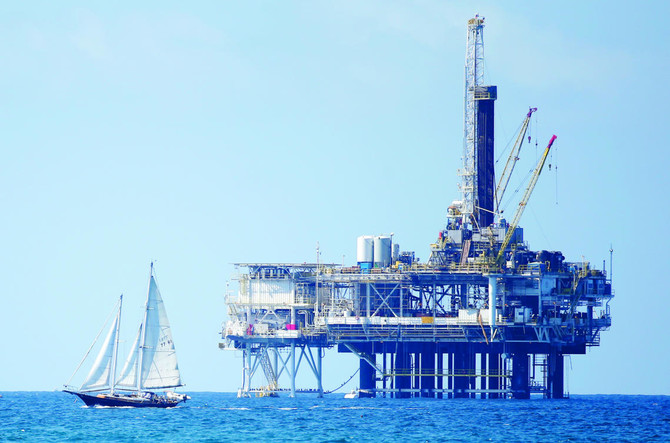
HOUSTON: Deepwater oil drilling can be expensive, time-consuming and a hard sell to investors. But the world’s top energy firms are restarting their search for giant oilfields under the ocean after a two-year lull.
A recovery in oil prices to about $50 a barrel from a 12-year low in 2016 is reviving oil majors’ appetite for risk.
Reductions in offshore production costs mean that some projects may be able to compete with North American shale fields, executives said at an energy conference in Houston this week.
The recovery in the industry has so far been focused on onshore shale output from the largest US oilfield, the Permian Basin.
“Our competition over the past years has evolved from ‘we want to be the best in deepwater’ to ‘we want to compete with shale’ to ‘we want to beat the Permian,’” Wael Sawan, Royal Dutch Shell’s executive vice president for deepwater, said in an interview.
After cutting the cost of deepwater development, companies are also reviving the search for new resources.
They are focusing exploration efforts on areas close to existing fields to maximize the chances of discovery and minimize costs. Many such areas are in Brazil, the Gulf of Mexico and Southeast Asia.
“Right now, we have entered the best time in the last decade to be in the exploration business,” Gregory Hebertson, who heads Murphy’s western hemisphere exploration, said at the CERAWeek conference in Houston. “There is probably a two- or three-year window that we can capture the cost efficiency in the market.”
Discovering new resources is essential for oil firms to grow and to offset natural decline of fields. But deepwater exploration requires money, time, expertise — and luck.
Some shareholders would prefer that oil firms stick to other, less risky growth options, said Federico Arisi Rota, executive vice president Americas for Italy’s Eni, which operates major offshore drilling projects.

Foreigners eye US pipeline investments
Foreign institutional investors, including sovereign wealth funds, are studying investments in the US interstate oil and gas pipeline network as a way to obtain recurring returns in a low interest-rate environment.
Dealmakers said they are advising funds, including from Asia, Australia and the Middle East, about potential investments that could bring billions of dollars of new capital to the sector.
Other infrastructure areas also have attracted institutional investors.
Drawn to the potential for steady long-term incomes, they have purchased stakes in companies operating toll roads, airports and utilities.
Dealmakers said more foreign entities could start buying directly into pipeline projects as a number of factors converge to eliminate such obstacles.
Structuring an investment to address the tax implications is already fairly straightforward, according to an energy lawyer.
The election of President Donald Trump, and his promised wave of deregulation, is expected to reduce Committee on Foreign Investment in the United States’ (CFIUS) objections to transactions.
One dealmaker noted the pending purchase of the Port Arthur refinery, the largest in the US, by Saudi Aramco had not triggered any CFIUS actions. That deal is on course to close in the second quarter.
Infrastructure needs in certain regions of the country should also provide opportunities for further capital deployment, said Osmar Abib, global head of oil and gas, global energy investment banking, at Credit Suisse who spoke on the sidelines of the CERAWeek energy conference.

Supplier hub to anchor Saudi car industry, says TASARU CEO

Updated 09 February 2026
Follow

Supplier hub to anchor Saudi car industry, says TASARU CEO

RIYADH: Saudi Arabia’s Public Investment Fund is stepping up efforts to localize automotive manufacturing, with its portfolio company TASARU announcing partnerships with five Tier-1 global suppliers to localize advanced component manufacturing in the Kingdom. 

The agreements were announced at the fourth PIF Private Sector Forum in Riyadh. TASARU also revealed plans to establish a new Supplier Hub in the King Salman Automotive Cluster in King Abdullah Economic City, designed to support next-generation vehicle development and strengthen the national automotive ecosystem in alignment with Vision 2030. 

TASARU also revealed plans to establish a new Supplier Hub in the King Salman Automotive Cluster in King Abdullah Economic City. Supplied

Speaking to Arab News on the sidelines of the forum, Michael Mueller, CEO of TASARU, said: “You cannot build cars without having the right partners from the supplier side, and with that, together with the OEMs, we selected the partners that we just announced today to localize them.” 

He added that the presence of large international suppliers is expected to attract smaller Tier-2 and Tier-3 manufacturers, helping the ecosystem scale. 

The five partners include Shin Young for metal stamping and body structures, JVIS for exterior plastics, and BENTELER for chassis and hot-formed steel components. Guangxi Fangxin will supply interior systems, while Lear Corp. completes the group, with all expected to establish manufacturing operations in the Kingdom. 

Founded more than three years ago, TASARU was established to introduce new technologies into Saudi Arabia’s mobility sector. The company has prioritized localizing smaller OEM and supplier businesses while bringing next-generation solutions into the Kingdom. 

Mueller said visible progress on factory construction by Ceer, Lucid and Hyundai is shifting perceptions about the sector’s viability. 

“A lot of people on the sideline watched whether automotive is really happening,” he said. “Now they recognize that the factories … are under construction, so that’s the first signal that it’s not just the bubble. It’s not just PowerPoint. It’s getting real now on the ground.” 

The CEO shares that KAEC is positioned as a hub for Saudi Arabia’s automotive industry, making it a strategic location for the TASARU Supplier Hub. The facility is designed to support OEMs and next-generation vehicles, including Ceer and Lucid Motors, through a shared, just-in-time manufacturing model with integrated logistics and regulatory support. 

TASARU will provide infrastructure and operational support, while partners bring technical expertise and gradually develop training centers to build a local workforce, Mueller said. 

He positioned Saudi Arabia as an attractive base for global suppliers because of its access to minerals and rare earth resources, energy availability and coordination across PIF portfolio companies and government entities.  

“They have access to minerals. They have access to rare earth. They can benefit from what is already existing. They have stable energy solutions. I think this footprint might benefit from the whole ecosystem as it is, not just automotive,” he said. 

Companies without a Saudi footprint risk missing a “huge opportunity,” Mueller added. 

He said advancing the industry will require clearer regulatory frameworks, including defined trigger points and licensing pathways that allow companies to execute their mandates. 

“Of course, you need to have more or less the regulatory framework to allow autonomous cars, sooner or later, on the streets. But it's happening, and this is a huge chance also for Saudi Arabia,” Muller said. 

He added: “If you are advanced in bringing such regulations onto a fast track, then you have a huge opportunity to be one of the first countries that establish this.”  

With rising traffic levels in Riyadh, Mueller said emerging mobility technologies could help solve first- and last-mile transportation challenges. 

“If the Metro is already full, that is good because people are using it. Now, you have to connect the dots. You have to finally make sure that people get from home to the metros and or to the bus station. So this first last-mile transportation is something where new technologies might help to bridge that,” he said. 

The CEO said the project is expected to take roughly one and a half to two years for suppliers to go live. More broadly, the initiative reflects Saudi Arabia’s transition from investment attraction to full-scale industrial localization, strengthening local content, private-sector participation, and long-term industrial resilience in line with Vision 2030.