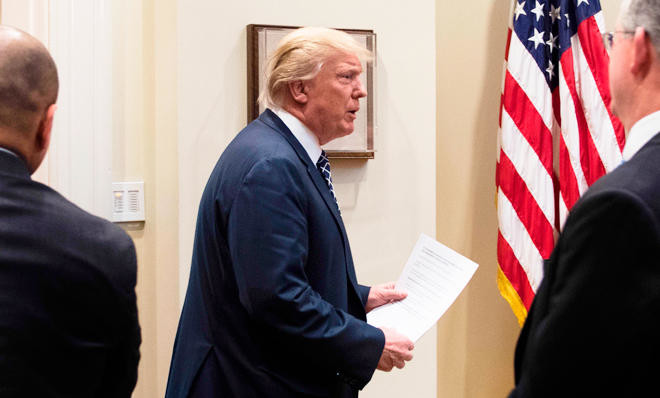
WASHINGTON: As it prepares for its first counter-Daesh summit on March 22-23, the Trump administration is also signaling a counter-Iran strategy in its efforts in Syria.
Nikki Haley, US ambassador to the UN, in remarks on Wednesday night that addressed the lingering conflict in Syria said, “We have got to make sure we get Iran and their proxies out, we have got to make sure that, as we move forward, we are securing the borders for our allies as well.”
Analysts, however, point to the fact that beyond Haley’s statement, there is no clear strategy for the US government yet on how to achieve such goal.
Amidst diplomatic speculation that UN envoy for Syria Staffan de Mistura might be on his way out, Haley renewed US confidence in de Mistura’s efforts. She said, “The United States absolutely supports de Mistura and the work that he is doing. We support the UN process, we support the talks in Geneva, we want to see them continue.”
Haley, known for her blunt criticism since she took the job in January of Russia and Iran, said the Syria question “is very much about a political solution now ... and that basically means that Syria can no longer be a safe haven for terrorists.”
But Syria watchers voiced skepticism over Trump’s roadmap to execute such a goal and drive Iran with its many proxies from Syria.
Joseph Bahout, of the Carnegie Endowment for International Peace, told Arab News that Haley’s sentiment “will only be considered a departure from the last eight years of US policy on Syria under the Obama administration, if the Trump team has thoroughly thought of a new policy as a whole. We must see if this is only an isolated statement, like Haley’s own Russia’s statement a few weeks ago.”
On the ground in Syria, the “US has been so far toothless on this issue of pushing Iran out,” but if there are plans in that direction, Bahout said, “it is easier to do it in Syria than in Iraq.”
He said that in Syria, unlike Iraq, “it is via proxy and less face to face than Iraq where US troops are on the ground, and Iran is a co-owner of the country” following the toppling of Saddam Hussein in 2003.
The Russian influence in Syria could also drive attempts by Washington to peel it from Iran, added Bahout. Russia’s President Vladimir Putin discussed Iranian influence in Syria with Israeli Prime Minister Benjamin Netanyahu, and he is expected to meet Turkish President Recep Tayib Erdogan Friday.
The questions that drive skepticism around Trump vision to oust Iran from Syria, relate to the new US administration not having a clear strategy for the conflict, nor a complete staffed team that is addressing the issue. Michael Ratney, the former US envoy for Syria, has been promoted to deputy assistant secretary last month, and is directing both the Syria file and the Israeli-Palestinian peace process according to the State Department.
The State Department also confirmed Thursday that Secretary of State Rex Tillerson will host on March 22-23 a 68-nation meeting in Washington to discuss the next moves by the coalition fighting Daesh.

Trump administration wants ‘Iran out of Syria’ but no clear strategy yet
Germany says UN rights rapporteur for Palestinian territories should quit
BERLIN: German Foreign Minister Johann Wadephul on Thursday called for the resignation of the UN special rapporteur for the Palestinian territories, Francesca Albanese, over comments she made allegedly targeting Israel at a conference.
“I respect the UN system of independent rapporteurs. However, Ms Albanese has made numerous inappropriate remarks in the past. I condemn her recent statements about Israel. She is untenable in her position,” Wadephul wrote on X.
Albanese has said that her comments are being falsely portrayed. She denounced what she called “completely false accusations” and “manipulation” of her words in an interview with broadcaster France 24 on Wednesday.
Speaking via videoconference at a forum in Doha on Saturday organized by the Al Jazeera network, Albanese referred to a “common enemy of humanity” after criticizing “most of the world” and much of Western media for enabling the “genocide” in Gaza.
“And this is a challenge — the fact that instead of stopping Israel, most of the world has armed, given Israel political excuses, political sheltering, economic and financial support,” she said.
Albanese said that “international law has been stabbed in the heart” but added that there is an opportunity since “we now see that we as a humanity have a common enemy.”
Wadephul’s French counterpart Jean-Noel Barrot on Wednesday made the same call for Albanese to resign over the comments.
“France unreservedly condemns the outrageous and reprehensible remarks made by Ms Francesca Albanese, which are directed not at the Israeli government, whose policies may be criticized, but at Israel as a people and as a nation, which is absolutely unacceptable,” Barrot told French lawmakers.
Albanese posted video of her comments to X on Monday, writing in the post that “the common enemy of humanity is THE SYSTEM that has enabled the genocide in Palestine, including the financial capital that funds it, the algorithms that obscure it and the weapons that enable it.”
In her interview with France 24, which was recorded before Barrot’s statement, she contended that her comments were being misrepresented.
“I have never, ever, ever said ‘Israel is the common enemy of humanity’,” Albanese told the broadcaster.
“I respect the UN system of independent rapporteurs. However, Ms Albanese has made numerous inappropriate remarks in the past. I condemn her recent statements about Israel. She is untenable in her position,” Wadephul wrote on X.
Albanese has said that her comments are being falsely portrayed. She denounced what she called “completely false accusations” and “manipulation” of her words in an interview with broadcaster France 24 on Wednesday.
Speaking via videoconference at a forum in Doha on Saturday organized by the Al Jazeera network, Albanese referred to a “common enemy of humanity” after criticizing “most of the world” and much of Western media for enabling the “genocide” in Gaza.
“And this is a challenge — the fact that instead of stopping Israel, most of the world has armed, given Israel political excuses, political sheltering, economic and financial support,” she said.
Albanese said that “international law has been stabbed in the heart” but added that there is an opportunity since “we now see that we as a humanity have a common enemy.”
Wadephul’s French counterpart Jean-Noel Barrot on Wednesday made the same call for Albanese to resign over the comments.
“France unreservedly condemns the outrageous and reprehensible remarks made by Ms Francesca Albanese, which are directed not at the Israeli government, whose policies may be criticized, but at Israel as a people and as a nation, which is absolutely unacceptable,” Barrot told French lawmakers.
Albanese posted video of her comments to X on Monday, writing in the post that “the common enemy of humanity is THE SYSTEM that has enabled the genocide in Palestine, including the financial capital that funds it, the algorithms that obscure it and the weapons that enable it.”
In her interview with France 24, which was recorded before Barrot’s statement, she contended that her comments were being misrepresented.
“I have never, ever, ever said ‘Israel is the common enemy of humanity’,” Albanese told the broadcaster.
© 2026 SAUDI RESEARCH & PUBLISHING COMPANY, All Rights Reserved And subject to Terms of Use Agreement.