Daesh leader Baghdadi ‘flees Mosul’ as Iraqi forces advance

1 / 3
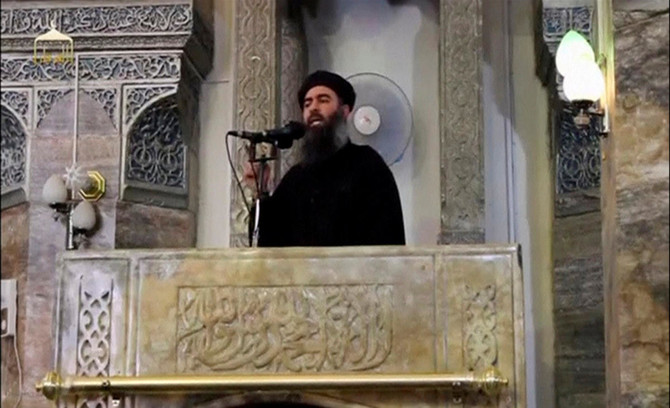
A man purported to be the reclusive leader of the militant Daesh, Abu Bakr al-Baghdadi, making what would have been his first public appearance, at a mosque in the center of Iraq's second city, Mosul, according to a video recording posted on the Internet on July 5, 2014. (REUTERS/Social Media Website via Reuters TV/File Photo)
2 / 3
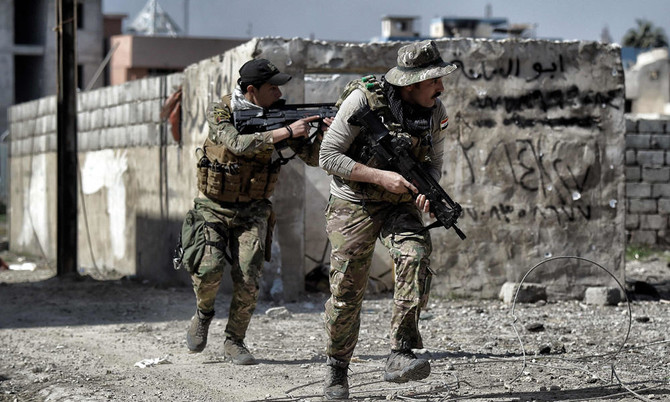
Members of the Iraqi forces patrol areas that they retook from Daesh group fighters in western Mosul as they advance in the city in the ongoing battle to seize the city from the jihadists on Thursday. (AFP / ARIS MESSINIS)
3 / 3
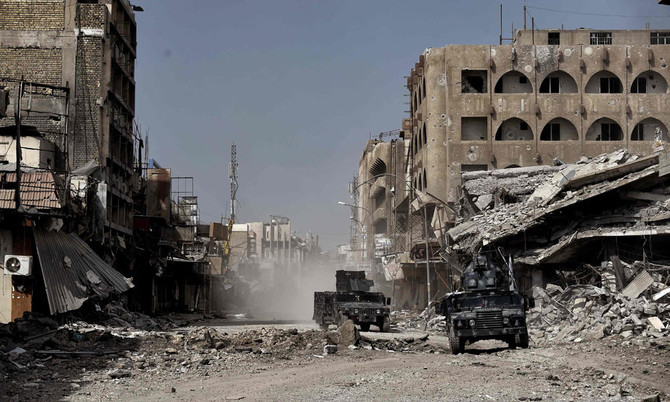
Iraqi forces patrol in a street in west Mosul as they advance inside the city during fighting against Daesh militants on Wednesday. (AFP / ARIS MESSINIS)
Updated 09 March 2017
Follow

Daesh leader Baghdadi ‘flees Mosul’ as Iraqi forces advance

MOSUL, Iraq: Daesh group chief Abu Bakr Al-Baghdadi is reported to have abandoned Mosul, leaving local commanders behind to lead the battle against Iraqi forces advancing in the city.
With Iraqi troops making steady progress in their assault to retake Mosul from the jihadists, a US defense official said Baghdadi had fled to avoid being trapped inside.
It was the latest sign that Daesh is feeling the pressure from twin US-backed offensives that have seen it lose much of the territory it once controlled in Iraq and Syria.
Speaking to reporters in Washington, the defense official said Baghdadi had left Mosul before Iraqi forces seized control of a key road at the beginning of this month, isolating the jihadists in the city.
“He was in Mosul at some point before the offensive.... He left before we isolated Mosul and Tal Afar,” a town to the west, the official said.
“He probably gave broad strategic guidance and has left it to battlefield commanders.”
Baghdadi, who declared Daes’s cross-border “caliphate” at a Mosul mosque in 2014, in an audio message in November urged supporters to make a stand in the city rather than “retreating in shame.”
Iraq launched the offensive to retake Mosul — which involves tens of thousands of soldiers, police and allied militia fighters — in October.
After recapturing its eastern side, the forces set their sights on the city’s smaller but more densely populated west.

'They ran away like chickens'
In recent days Iraqi forces have retaken a series of neighborhoods in west Mosul as well as the provincial government headquarters and a museum where Daesh militants filmed themselves destroying priceless artifacts.
On Thursday Iraqi forces were “combing the city center area to defuse (bombs in) homes and shops and buildings,” Lt. Col. Abdulamir Al-Mohammedawi of Iraq’s elite Rapid Response Division told AFP.
The area is located on the edge of Mosul’s Old City, a warren of narrow streets and closely spaced houses that could see some of the toughest fighting of the battle.
“Currently there is no order from the operations command to advance toward the Old City. We will advance when this order is issued,” Mohammedawi said.
Hundreds of thousands of civilians are believed to still be trapped under Daesh rule in Mosul.
Those who did manage to escape the city said the jihadists were growing increasingly desperate.
“We were used as human shields,” said Abdulrazzaq Ahmed, a 25-year-old civil servant, who escaped along with hundreds of other civilians to Iraqi police waiting outside the city.
Rayan Mohammed, a frail 18-year-old who was once given 60 lashes for missing prayers, said the jihadists were scrambling in the face of the Iraqi offensive.
“They ran away like chickens,” he said.

Still a major threat
West Mosul is the most heavily populated area under Daesh control and one of two major urban centers it still holds, along with Raqqa in Syria.
In Syria, a US-backed alliance of Kurdish and Arab fighters known as the Syrian Democratic Forces (SDF) has been advancing on Raqqa.
A US official said Wednesday that a Marine Corps artillery battery had been sent into Syria to support the battle for Raqqa — joining around 500 American special operations fighters who have been training and assisting the SDF.
The United States has been leading a coalition since mid-2014 carrying out air strikes against the jihadists in both Syria and Iraq.
Strikes on a Daesh-held northern Syrian village thought to have been conducted by the coalition killed at least 23 civilians on Thursday, a monitor said.
Among the dead were at least eight children and six women, according to the Syrian Observatory for Human Rights.
The coalition said earlier this month that its raids had unintentionally killed at least 220 civilians since 2014 in both countries.
Elsewhere in Syria, Turkish troops and their rebel allies have pushed south from the Turkish border and driven IS out of the northern town of Al-Bab.
Russian-backed government troops have meanwhile swept eastwards from Syria’s second city Aleppo and seized a swathe of countryside from the jihadists.
The US defense official said Daesh was now looking beyond the seemingly inevitable losses of Mosul and Raqqa.
“They... are still making plans to continue to function as a pseudo-state centered in the Euphrates River valley,” the official said.
Even with the territory they control greatly reduced, the jihadists remain a major threat.
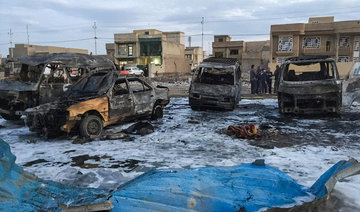
At least 26 people were killed late on Wednesday when two suicide bombers attacked a celebration being held the night before a wedding north of Baghdad, Iraqi officials said.
The bombings in the Al-Hajaj area, north of the city of Tikrit, also wounded 25 people.
There was no immediate claim of responsibility for the attack, but Daesh carries out frequent suicide bombings targeting both civilians and members of the security forces in Iraq.

Battered by Gaza war, Israel’s tech sector in recovery mode

Updated 21 February 2026
Follow

Battered by Gaza war, Israel’s tech sector in recovery mode

  • “High-tech companies had to overcome massive staffing cuts, because 15 to 20 percent of employees, and sometimes more, were called up” to the front as reservists, IIA director Dror Bin told

JERUSALEM: Israel’s vital tech sector, dragged down by the war in Gaza, is showing early signs of recovery, buoyed by a surge in defense innovation and fresh investment momentum.
Cutting-edge technologies represent 17 percent of the country’s GDP, 11.5 percent of jobs and 57 percent of exports, according to the latest available data from the Israel Innovation Authority (IIA), published in September 2025.
But like the rest of the economy, the sector was not spared the knock-on effects of the war, which began in October 2023 and led to staffing shortages and skittishness from would-be backers.
Now, with a ceasefire largely holding in Gaza since October, Israel’s appeal is gradually returning, as illustrated in mid-December, when US chip giant Nvidia announced it would create a massive research and development center in the north that could host up to 10,000 employees.
“Investors are coming to Israel nonstop,” Prime Minister Benjamin Netanyahu said at the time.
After the war, the recovery can’t come soon enough.
“High-tech companies had to overcome massive staffing cuts, because 15 to 20 percent of employees, and sometimes more, were called up” to the front as reservists, IIA director Dror Bin told AFP.
To make matters worse, in late 2023 and 2024, “air traffic, a crucial element of this globalized sector, was suspended, and foreign investors froze everything while waiting to see what would happen,” he added.
The war also sparked a brain drain in Israel.
Between October 2023 and July 2024, about 8,300 employees in advanced technologies left the country for a year or more, according to an IIA report published in April 2025.
The figure represents around 2.1 percent of the sector’s workforce.
The report did not specify how many employees left Israel to work for foreign companies versus Israeli firms based abroad, or how many have since returned to Israel.

- Rise in defense startups -

In 2023, the tech sector far outpaced GDP growth, increasing by 13.7 percent compared to 1.8 percent for GDP.
But the sector’s output stagnated in 2024 and 2025, according to IIA figures.
Industry professionals now believe the industry is turning a corner.
Israeli high-tech companies raised $15.6 billion in private funding in 2025, up from $12.2 billion in 2024, according to preliminary figures published in December by Startup Nation Central (SNC), a non-profit organization that promotes Israeli innovation.
Deep tech — innovation based on major scientific or engineering advances such as artificial intelligence, biotech and quantum computing — returned in 2025 to its pre-2021 levels, according to the IIA.
The year 2021 is considered a historic peak for Israeli tech.
The past two years have also seen a surge in Israeli defense technologies, with the military engaged on several fronts from Lebanon and Syria to Iran, Yemen, Gaza and the occupied West Bank.
Between July 2024 and April 2025, the number of startups in the defense sector nearly doubled, from 160 to 312, according to SNC.
Of the more than 300 emerging companies collaborating with the research and development department of Israel’s defense ministry, “over 130 joined our operations during the war,” Director General Amir Baram said in December.
Until then, the ministry had primarily sourced from Israel’s large defense firms, said Menahem Landau, head of Caveret Ventures, a defense tech investment company.
But he said the war pushed the ministry “to accept products that were not necessarily fully finished and tested, coming from startups.”
“Defense-related technologies have replaced cybersecurity as the most in-demand high-tech sector,” the reserve lieutenant colonel explained.
“Not only in Israel but worldwide, due to the war between Russia and Ukraine and tensions with China.”