BANDARERO, Kenya: Loko Kalicha Junno says she trekked for a week to save her 10 cattle from dying of thirst and hunger. But none survived. Now, at one of the last watering holes in this remote village, she fears for herself.
“If this water gets finished I am going to die,” said the 64-year-old single mother of four.
The scorched earth and scrubland in this semi-arid region of Kenya are littered with livestock carcasses in various stages of decomposition. Vultures wait patiently, waiting for nearby humans to leave. Kenya has declared the drought that affects nearly half of its counties a national disaster.
To ensure the survival of her children, Junno has resorted to selling tea to other pastoralists, some even from neighboring Ethiopia, who like her have traveled long distances to remaining watering holes.
The prices of livestock have plummeted as buyers take advantage of herders’ desperation. A cow that used to sell for $150 or more now sells for $20, and a goat that used to sell for $35 now goes for $2.
Marsabit County is among 10 counties hit hardest by the drought in Kenya and beyond. Some areas have reported inter-community fighting and land invasions as pastoralists push further their search for increasingly limited water.
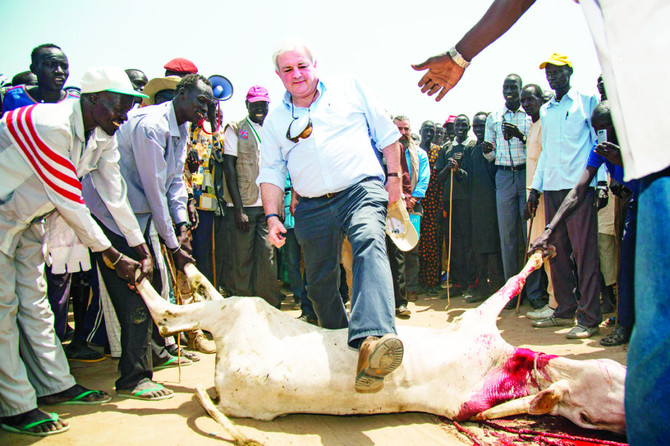
The UN humanitarian chief, Stephen O’Brien, toured Bandarero village on Friday and called on the international community to act to “avert the very worst of the effects of drought and to avert a famine to make sure we do not go from what is deep suffering to a catastrophe.” He pointed out that famine was declared last month in parts of neighboring South Sudan, and that another neighbor, Somalia, is at risk of famine for the second time in a decade.
In Kenya, more than 2.7 million people are severely food insecure, O’Brien said.
“Crops are failing, food prices are rising and families are going hungry. The specter of hunger and disease is haunting East Africa again. We need to put a stop to this.”
After a severe drought hit East Africa in 2011, Kenya and donors put in place measures to lessen the impact of future droughts on parts of northern Kenya that government reports have called vulnerable. Long marginalized, they have not received an equal share of national resources.
The measures include a Hunger Safety Program that provides $24 for more than 100,000 households every month, as well as a school feeding program.
But the measures are limited. Junno and other pastoralists said cash safety net services meant to cushion the vulnerable have not reached them.
The United Nations International Children’s Emergency Fund (UNICEF) country director for Kenya, Werner Schultink, said an estimated 180,000 children had dropped out school at the beginning of the year in the 10 regions worst affected by the drought. The agency anticipates more than 100,000 children will need treatment for severe malnourishment by the end of the year.
“I think that if there is continued shortage (of water) we are truly going to see a very bad impact on life and well-being of the population here in northern Kenya,” he said.

Desperate herders lose animals, hope amid drought in Kenya
Reference to Trump’s impeachments is removed from the display of his Smithsonian photo portrait
- For now, references to Presidents Andrew Johnson and Bill Clinton being impeached in 1868 and 1998, respectively, remain as part of their portrait labels, as does President Richard Nixon’s 1974 resignation as a result of the Watergate scandal
WASHINGTON: President Donald Trump’s photo portrait display at the Smithsonian’s National Portrait Gallery has had references to his two impeachments removed, the latest apparent change at the collection of museums he has accused of bias as he asserts his influence over how official presentations document US history.
The wall text, which summarized Trump’s first presidency and noted his 2024 comeback victory, was part of the museum’s “American Presidents” exhibition. The description had been placed alongside a photograph of Trump taken during his first term. Now, a different photo appears without any accompanying text block, though the text was available online. Trump was the only president whose display in the gallery, as seen Sunday, did not include any extended text.
The White House did not say whether it sought any changes. Nor did a Smithsonian statement in response to Associated Press questions. But Trump ordered in August that Smithsonian officials review all exhibits before the nation celebrates the 250th anniversary of the Declaration of Independence on July 4. The Republican administration said the effort would “ensure alignment with the president’s directive to celebrate American exceptionalism, remove divisive or partisan narratives, and restore confidence in our shared cultural institutions.”
Trump’s original “portrait label,” as the Smithsonian calls it, notes Trump’s Supreme Court nominations and his administration’s development of COVID-19 vaccines. That section concludes: “Impeached twice, on charges of abuse of power and incitement of insurrection after supporters attacked the US Capitol on January 6, 2021, he was acquitted by the Senate in both trials.”
Then the text continues: “After losing to Joe Biden in 2020, Trump mounted a historic comeback in the 2024 election. He is the only president aside from Grover Cleveland (1837– 1908) to have won a nonconsecutive second term.”
Asked about the display, White House spokesman Davis Ingle celebrated the new photograph, which shows Trump, brow furrowed, leaning over his Oval Office desk. Ingle said it ensures Trump’s “unmatched aura ... will be felt throughout the halls of the National Portrait Gallery.”
The portrait was taken by White House photographer Daniel Torok, who is credited in the display that includes medallions noting Trump is the 45th and 47th president. Similar numerical medallions appear alongside other presidents’ painted portraits that also include the more extended biographical summaries such as what had been part of Trump’s display.
Sitting presidents are represented by photographs until their official paintings are commissioned and completed.
Ingle did not answer questions about whether Trump or a White House aide, on his behalf, asked for anything related to the portrait label.
The gallery said in a statement that it had previously rotated two photographs of Trump from its collection before putting up Torok’s work.
“The museum is beginning its planned update of the America’s Presidents gallery which will undergo a larger refresh this Spring,” the gallery statement said. “For some new exhibitions and displays, the museum has been exploring quotes or tombstone labels, which provide only general information, such as the artist’s name.”
For now, references to Presidents Andrew Johnson and Bill Clinton being impeached in 1868 and 1998, respectively, remain as part of their portrait labels, as does President Richard Nixon’s 1974 resignation as a result of the Watergate scandal.
And, the gallery statement noted, “The history of Presidential impeachments continues to be represented in our museums, including the National Museum of American History.”
Trump has made clear his intentions to shape how the federal government documents US history and culture. He has offered an especially harsh assessment of how the Smithsonian and other museums have featured chattel slavery as a seminal variable in the nation’s development but also taken steps to reshape how he and his contemporary rivals are depicted.
In the months before his order for a Smithsonian review, he fired the head archivist of the National Archives and said he was firing the National Portrait Gallery’s director, Kim Sajet, as part of his overhaul. Sajet maintained the backing of the Smithsonian’s governing board, but she ultimately resigned.
At the White House, Trump has designed a notably partisan and subjective “Presidential Walk of Fame” featuring gilded photographs of himself and his predecessors — with the exception of Biden, who is represented by an autopen — along with plaques describing their presidencies.
The White House said at the time that Trump himself was a primary author of the plaques. Notably, Trump’s two plaques praise the 45th and 47th president as a historically successful figure while those under Biden’s autopen stand-in describe the 46th executive as “by far, the worst President in American History” who “brought our Nation to the brink of destruction.”