

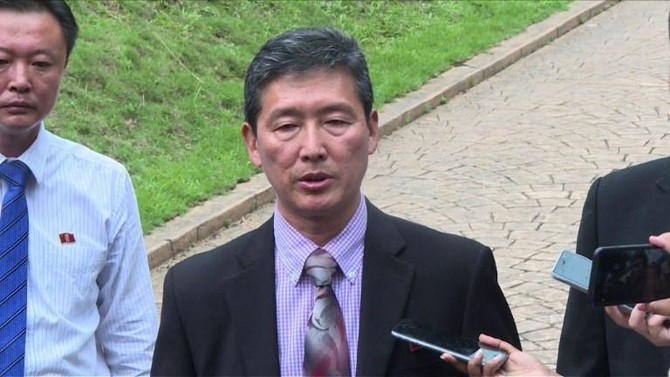
N. Korean envoy rejects Malaysian autopsy

North Korea suggests that Kim Jong-Nam died of a heart attack and demands that Malaysian authorities release the body of the late half-brother of leader Kim Jong-Un. (AFP)
Updated 02 March 2017
Follow

N. Korean envoy rejects Malaysian autopsy

KUALA LUMPUR: A North Korean envoy says a heart attack likely killed Kim Jong Nam, not VX nerve agent as a Malaysia autopsy showed.
Ri Tong Il, the former North Korean deputy ambassador to the United Nations, told reporters Thursday that the victim took medication for heart disease, diabetes and high blood pressure.
He referred to the victim as Kim Chol — the name on the diplomatic passport the victim was carrying. But authorities in Malaysia have said he is Kim Jong Nam, the estranged half brother of North Korea’s ruler.
A high-level defector says he’s certain North Korean leader Kim Jong Un was behind Kim Jong Nam’s death.
Thae Yong Ho told reporters from Hong Kong-based Phoenix TV that it was unthinkable that Kim Jong Un would not have approved of the high-profile assassination of his half brother.
In the report broadcast Thursday from Seoul, Thae says “North Korea is a society ruled in terror. For a big decision like killing Kim Jong Nam, no one could make a decision like that except Kim Jong Un.”

Thae was the former deputy head of the North Korean Embassy in London until last year, when he fled to South Korea, becoming the most senior diplomat to switch sides.
He added that he was “not afraid of terrifying threats (from North Korea). I have to be in public.”
Malaysia’s attorney general says a North Korean man will be released and deported because of lack of evidence connecting him to the nerve agent attack on Kim Jong Nam, the estranged half brother of the North Korean ruler.
Attorney General Mohamad Apandi Ali said Thursday that 45-year-old Ri Jong Chol will be released Friday. Malaysia has not described his alleged role in the killing.
He was arrested on Feb. 17, four days after Kim was attacked at Kuala Lumpur’s airport.



In South Africa’s affluent Western Cape, farmers lose cattle to drought

Updated 2 sec ago
Follow

In South Africa’s affluent Western Cape, farmers lose cattle to drought

  • Drought in country’s south follows flooding ‌in north
  • Farmers try to adapt but lose livestock
KNYSNA: In South Africa’s most visited and affluent province, Western Cape, one of the worst droughts in living memory is drying up dams, scorching grass and killing livestock, prompting the government to declare a national emergency this month.
Scientists say climate change is causing worsening droughts in the province, which draws tourists to ‌its vineyards, ‌beaches and the lush slopes of ​Table ‌Mountain ⁠above ​Cape Town, ⁠but lies on the edge of the advancing semi-desert Karoo. In 2015, a drought almost dried up the taps in the city; farmers say this one has been even more brutal than a decade ago.
Over the weekend, mixed-race couple Christian and Ilze Pienaar were ⁠distributing feed to keep their hungry cattle alive. ‌One cow had recently ‌starved to death, its bones ​visible through its skin.
“The drought ‌before wasn’t this bad because there was still ... ‌grazing,” Ilze, 40, told Reuters. “Now there’s nothing, the dams are dry ... (and) we’re spending all our money on feed.”
She said she’d lost 16 cattle and 13 sheep since January alone.
The ‌drought, which has also ravaged parts of Eastern Cape and Northern Cape, comes weeks ⁠after ⁠floods blamed on climate change and cyclical La Niña weather washed out the northeastern part of South Africa and killed 200 people across the region.
“The intensity and duration of both droughts and floods in this corner of the world is increasing,” Anton Cartwright, an economist with the African Center for Cities, said.
“Farmers (here) are very good at adapting to weather (but) ... the weather is just becoming much less predictable,” ​he said. “Seasons aren’t occurring, starting, ​ending at the same time of the year. It’s probably going to get worse.”
(Writing by Tim Cocks; editing by ​Philippa Fletcher)