RIYADH: Wide-ranging talks in Kuala Lumpur between Saudi Arabia’s King Salman and Malaysian Prime Minister Najib Razak have stressed the need to find solutions to the crises in Syria and Yemen, as well as the Israeli-Palestinian conflict.
The two countries also announced the establishment of an international center for peace and harmony that will carry the name “King Salman Center for Global Peace.”
In a joint statement released on Wednesday, the two countries reiterated the urgent need to find solutions to the conflicts in the Middle East, and expressed concern over “the growing Iranian interference in the internal affairs of the Arab countries.”
The joint statement covers political, commercial and cultural issues that were discussed during King Salman’s four-day visit to Malaysia.
Regarding the proposed King Salman Center for Global Peace in Malaysia, the statement named the stakeholders in the project, which are: The Saudi Ministry of Defense, the Center for Security and Defense at the Malaysian Ministry of Defense, the Malaysian University of Islamic Sciences and the Makkah-based Muslim World League (MWL).
“These bodies shall coordinate to complete the necessary arrangements to implement the launch of the center within 90 days from the date of its announcement,” said the statement.
The statement also said that Saudi Arabia and Malaysia have identical views on key issues in the Middle East region.
“Within the constructive spirit that prevailed at the meetings between the two sides, the two leaders reviewed political issues in the Middle East, particularly the Palestinian cause, and stressed the importance and need to achieve a lasting, comprehensive and just solution, in accordance with the Arab Peace Initiative and relevant UN resolutions,” the statement said.
The two sides also reaffirmed the need to “find a solution to the Syrian crisis on the basis of UN Security Council Resolution 2254 and the importance of providing humanitarian assistance and relief to Syrian refugees in Syria and abroad.”
The two sides also stressed the importance of maintaining the unity of Yemen, and of achieving its security and stability, as well as the importance of coming up with a political solution to the Yemeni crisis, based on the Gulf initiative, outputs of the Yemeni national dialogue and UN Security Council Resolution 2216.
The statement said that the Kingdom and Malaysia “lend all support to the legitimate authority in Yemen, and to the efforts exerted in this regard, as well as facilitating access of aid to all regions of Yemen.”
The two countries expressed deep concern about Iranian interference in the internal affairs of countries in the region, emphasizing “the need for Iran to commit to the principle of good neighborliness and respect for the sovereignty of states.”
In the field of defense cooperation, the statement said: “The two sides agreed to strengthen military cooperation, develop training and joint exercises and exchange military experience.”
The Kingdom and Malaysia have been on the same page over the need to address common security issues, including those posed by Daesh and other terrorist groups.
Malaysia and Saudi Arabia share a strong commitment to countering extremist ideologies and misconceptions about Islam, which are contrary to the moderate and peaceful nature of this world religion.
The statement said that King Salman and Najib held constructive and fruitful talks during which they exchanged views on ways to develop bilateral relations and increase cooperation between the two countries in “political, economic, cultural, military and security fields, as well as regional and international issues of mutual interest.”
The two countries also welcomed the deal signed by Saudi Aramco and Malaysian Petronas to develop and establish an integrated giant complex for petroleum refining and petrochemicals in Malaysia’s Johor state.


![]()
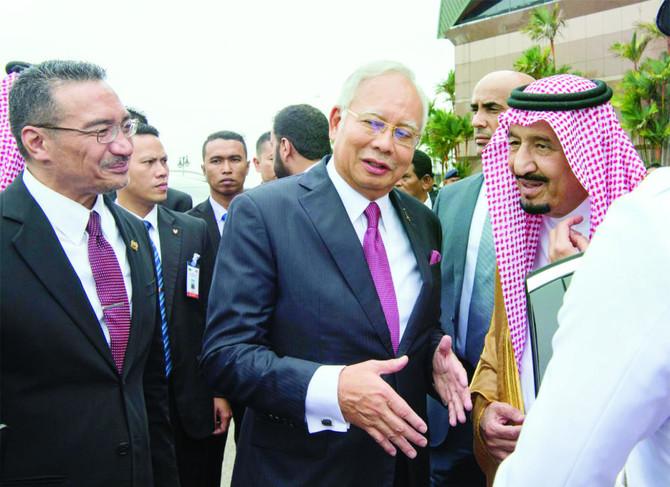
Saudi Arabia, Malaysia to establish ‘King Salman Center for Global Peace’
Saudi Arabia, Malaysia to establish ‘King Salman Center for Global Peace’
Latest updates


© 2026 SAUDI RESEARCH & PUBLISHING COMPANY, All Rights Reserved And subject to Terms of Use Agreement.