ISTANBUL: President Recep Tayyip Erdogan on Tuesday warned that a Turkish newspaper would pay a “price” after a contentious report over alleged tensions between his government and the army.
Istanbul prosecutors launched an investigation into the Hurriyet front page story on Saturday which suggested that the army was not satisfied with the recent actions by the government.
The story listed seven grievances including the lifting of a historic ban on female officers wearing the Islamic headscarf in the officially secular country.
“Let me put it very clearly, what’s done here, the headline they have used is insolent,” Erdogan told reporters at an Istanbul airport before leaving for Pakistan on an official visit.
Erdogan said nobody had the right to set the army against the government and warned: “Whoever tries to set us against one another will pay a price.”
“No offense but I don’t find such an approach forgivable at a time when we need unity, fraternity and solidarity more than ever,” he added.
Erdogan said he discussed the issue with Chief of Staff General Hulusi Akar on Monday.
The government increased control over the armed forces in the wake of an attempted coup in July last year blamed on followers of preacher Fethullah Gulen.
The Hurriyet newspaper, the flagship daily of Dogan Media Group — the Turkish media giant which owns television channels Kanal D and CNN-Turk — is a mainstream daily but houses pro-government columnists as well.
The story headlined “the army headquarters are uneasy,” based on military sources, carried the byline of Hurriyet’s Ankara bureau chief Hande Firat.
Firat, one of Turkey’s most prominent journalists, was fiercely condemned by pro-government media for “coup mongering.”
Ironically, Firat played a crucial role in defeating the July 15 coup when she spoke to Erdogan live on her CNN-Turk show by FaceTime on the night of the putsch.
Erdogan used the interview to rally his supporters, calling them into the streets to resist the attempted power-grab.
An Istanbul prosecutor’s office on Monday launched an investigation into whether there was a pro-coup faction within the military that was trying to block the government’s actions, the state-run Anadolu news agency reported.
The army on Tuesday dismissed “baseless and intentional criticism” in the Hurriyet story, which it said was a “distortion” aimed at harming the armed forces at a time when it is fighting terror at home and in Syria.
Appearing on CNN-Turk, Firat said the critics had not read her story properly, adding that Hurriyet had sought comment from the military chief of staff.
“We, as Hurriyet newspaper and Dogan Group, will continue to defend democracy,” she said.
Erdogan defended the lifting of the headscarf ban in the army and said women would enjoy their freedom.
“In the following process our victimized, oppressed sisters will take their place in all institutions” from the judiciary to the education sector, he said.


![]()
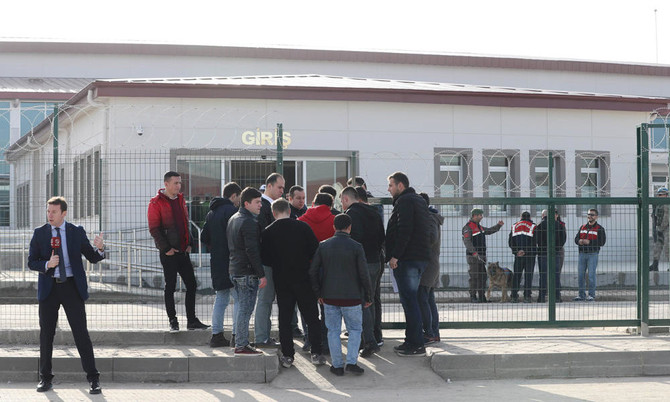
Erdogan says paper to pay ‘price’ over controversial report
Erdogan says paper to pay ‘price’ over controversial report
Latest updates




© 2026 SAUDI RESEARCH & PUBLISHING COMPANY, All Rights Reserved And subject to Terms of Use Agreement.