‘Artist of Arabs’ Mohammed Abdu enchants Jeddah in rare gig

Saudi singer Mohammed Abdu performs during a concert in Jeddah on Monday. (AFP)
Updated 31 January 2017
Follow

‘Artist of Arabs’ Mohammed Abdu enchants Jeddah in rare gig

JEDDAH: Prominent Saudi singer Mohammed Abdu wowed crowds in Jeddah in a rare public concert on Monday evening. Around 6,000 music lovers attended the long-awaited show organized by Rotana at King Abdullah Sports City. Abdu, dubbed “The Artist of Arabs,” was backed by an Egyptian orchestra and performed alongside another Saudi artist, Rabeh Sager, and Iraqi-Saudi singer Majid Al-Muhandis.
As Abdu took the stage, an excited audience welcomed their star with a wave of applause. It was a performance filled with many of the singer’s masterpieces and constant audience interactions.
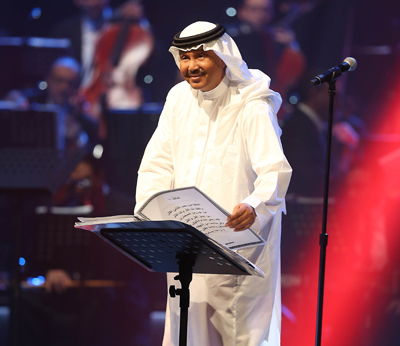
At one point, when Abdu sang his famous nationalistic song “Fouq Ham Al-Sahab,” the audience began to sing along with him, prompting Abdu to stop and listen to them sing.
As a show of his love and appreciation for the audience, Abdu flung his igal, a black rope-like cord used to secure the ghutra, at them.
Later, Sager and Al-Muhandis entertained the audience with the rendition of their old and new songs.
“I am very happy to sing in my homeland,” Sager said, adding, “Please don’t make me cry.” Jeddah previously featured live concerts held during summer festivals, but these were completely stopped more than seven years ago. Other events have been held in closed stadiums, Jeddah’s International Exhibition and Convention Center and private wedding halls.
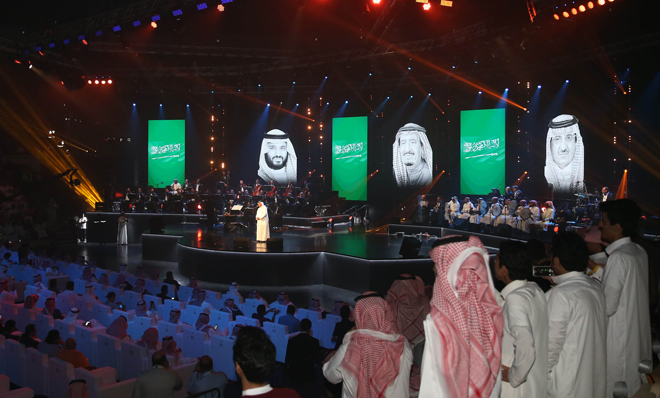
Abdu launched his masterpiece “Al-Amaken” in 2005 during a memorable concert at the Jeddah Festival. He was set to perform live at the King Fahd Cultural Center in Riyadh during Eid festivities but it was later canceled.


Berlinale responds to backlash over Gaza-related comments

Updated 16 February 2026
Follow

Berlinale responds to backlash over Gaza-related comments

The Berlin International Film Festival has issued a statement after what organisers described as a growing “media storm” linked to comments about the war in Gaza and the broader role of politics in cinema.

Festival director Tricia Tuttle released a lengthy note late Saturday following criticism directed at several high-profile guests. The controversy began during the opening day press conference when jury president Wim Wenders was asked about the conflict in Gaza. He responded: “We have to stay out of politics because if we make movies that are dedicatedly political, we enter the field of politics,” a remark that sparked swift backlash online.

Indian author Arundhati Roy later withdrew from the festival, reportedly angered by the remarks.

Other prominent figures, including Michelle Yeoh and Neil Patrick Harris, also faced online criticism after responding cautiously to questions about politics. Harris stated that he was interested in “doing things that were ‘apolitical,’” a comment that further fuelled debate.

In her statement, Tuttle defended the festival and its participants, stressing the importance of artistic freedom. “People have called for free speech at the Berlinale. Free speech is happening at the Berlinale. But increasingly, filmmakers are expected to answer any question put to them. They are criticised if they do not answer. They are criticised if they answer and we do not like what they say. They are criticised if they cannot compress complex thoughts into a brief sound bite when a microphone is placed in front of them when they thought they were speaking about something else,” she said.

She added: “It is hard to see the Berlinale and so many hundreds of filmmakers and people who work on this festival distilled into something we do not always recognise in the online and media discourse… It is a large, complex festival.”

“Artists are free to exercise their right of free speech in whatever way they choose… nor should they be expected to speak on every political issue raised to them unless they want to,” Tuttle said.