JEDDAH: After years of being prohibited from appearing in court, female lawyers in 2013 achieved a significant victory in being able to practice law and argue their cases in Saudi courtrooms.
Female lawyers have the right to advocate for issues that are not only women-related, but cover a variety of cases such as commercial, personal and labor affairs.
They were not content to just obtain a license to practice law — they demanded to be included in legal committees and bodies, including the Saudi Bar Association.
On their way to realizing their rights, female lawyers had to overcome many obstacles in law offices and courtrooms to work legally and formally under the Ministry of Justice.
Some did not limit their work to the domestic sphere, undertaking studies and research on legal problems at an international level.
A research paper by lawyer Huda Omar Ba-Shmail, entitled “Investment disputes settlement within the framework of the International Center for Settlement of Investment Disputes (ICSID) and the Protection of Foreign Direct Investment (FDI),” was published in an American banking trade magazine.
Bayan Zahran, a Jeddah-based attorney who in January 2014 became the first Saudi woman to open a law firm, says women’s presence in courtrooms long predated the granting of licenses.
“I’ve been arguing my cases since opening my law firm officially, but even before the license we used to do the same through attorneyship,” she said.
Women have been authorized lawyers in Saudi courts for three years. They are recognized, and have rights and duties like their male counterparts based on the Saudi legal system.
Zahran said expertise dictated which cases a lawyer could argue: “As long as a lawyer, male or female, has the expertise that qualifies him or her to obtain the law license, they can argue any cases without exceptions.”
Some 90 percent of her clients are women, as women usually prefer someone who can relate to their issues, and Saudi Arabia is a conservative place where they would hesitate to talk freely with male lawyers.
Female lawyers can also get male clients who are willing to hire them. Zahran was recently hired by a group of male doctors to get their rights from a hospital they work at.
Among the obstacles female lawyers have had to deal with is society’s view of such a job for women. Some people did not accept their presence in courtrooms alongside men.
Zahran said ignoring negative feedback was the best approach: “Criticism doesn’t really mean anything to me. What I truly care about is my job, delivering justice and improving work standards in a good and humanitarian manner.”
There are neither specific regulations nor privileges that apply to female lawyers in the Saudi legal system.
Zahran says some fresh graduates have the wrong idea about the nature of their work, whereby female lawyers are treated differently than their male counterparts.
“If women keep in mind that law is all about sticking to the text, and interpreting and using it in a way that serves justice, they can defend their rights as lawyers.”
A number of female lawyers have volunteered to provide legal aid for those unable to hire lawyers in family and labor cases via a charitable initiative organized by the Takamul Investment Company in Jeddah.
The initiative involves training, employment assistance for participating lawyers, and legal services for those who cannot plead for themselves or afford to hire lawyers, says Takamul’s president, lawyer Majed Garoub.
As part of the initiative, graduates from regions throughout the Kingdom have been trained by jurists, judges, academics and members of judicial committees.
Volunteers undergo a training program to provide a thousand hours of voluntary work within five years.
Dima Talal Al-Sharif, a legal consultant at the Health, Food and Medicine Department at The Law Firm of Majed M. Garoub, said Saudi female lawyers were “the pioneers of the human rights renaissance in the Kingdom, where they have added much to the prosperity of this profession.”
Al-Sharif, who is a member of the Union Internationale des Avocats (UIA), says practicing law is not a profession or a title, but a passion and a challenge to prove oneself.
“This is what I saw and experienced through the participation of a large number of female lawyers at the Takamul initiative,” she said.
Al-Sharif expressed her wish that her colleagues get the encouragement and trust of Saudi society so they could give more.
“I wish that the voice of female lawyers in Saudi Arabia reaches greater places in the field of human rights in the Middle East and globally, not just in the Kingdom.”


![]()
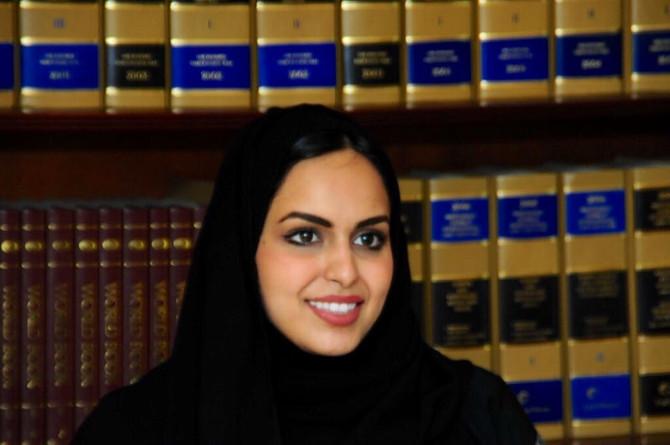
Female lawyers in Saudi courts: ‘We are equal to male counterparts’
Female lawyers in Saudi courts: ‘We are equal to male counterparts’
Latest updates


© 2026 SAUDI RESEARCH & PUBLISHING COMPANY, All Rights Reserved And subject to Terms of Use Agreement.