

Trump signals different approach in Nikki Haley’s UN appointment

South Carolina Gov. Nikki Haley speaks in Orlando, Florida on Nov. 15. (AP)
Updated 24 November 2016
Follow

Trump signals different approach in Nikki Haley’s UN appointment

WASHINGTON: For US President-elect Donald Trump, who is known to hold grudges and reward loyalty, his selection of South Carolina Gov. Nikki Haley is a clear departure in form and substance from the previous nominations.
 
Haley, who accepted the offer to become — awaiting Senate approval — the fifth US woman ambassador to the United Nations, harshly criticized Trump during the campaign calling him “everything a governor doesn’t want in a president” and repudiating his old Muslim ban proposal as “un-American” and “unconstitutional.”
 
So why did Trump nominate her?


Diverse and outsider pick
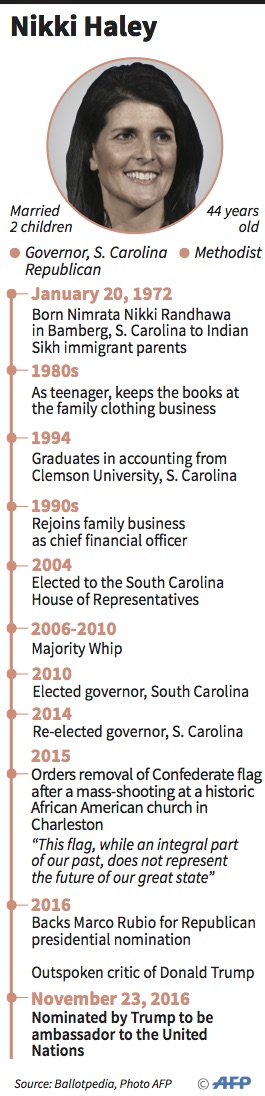
The nomination of 44-year-old Haley — born to immigrant parents from India — cannot be seen outside the sequence of the five white male appointments that Trump made in the last two weeks since winning the election.
This contrast led former Republican strategist Ana Navarro to sing Haley plenty of praise on Twitter, saying: “Don’t care if @nikkihaley has little foreign policy experience. She’s not: a jerk; a white supremacist; a peddler of fake news. She’s great!”
“Personally, I think Trump wanted a woman appointment, and that is why Haley was chosen,” says David Shor, a foreign policy analyst based in New York. “Haley’s immigrant roots, along with other political calculus that Trump had, and not her diplomatic repertoire or little known foreign policy experience are likely behind the pick.”
Haley brings the profile of an outsider to the UN position, and she is known to have rocked the establishment boat during her tenure as governor, calling to remove the Confederate Flag from the statehouse in 2015. Unlike her predecessors Ambassadors Samantha Power, Susan Rice, Zalmay Khalilzad and John Bolton, Haley does not come with international expertise to the arena.
Foreign policy views
There is little known about Haley’s foreign policy positions. Unlike her boss, Haley has taken a softer position on settling refugees, with her state — South Carolina — accepting 22 refugees from Syria and looking into the resettlement of another 26.
However, Haley’s position on the Iran nuclear deal is more aligned with the new US president, signing a letter with other governors last year that opposes “the lifting of federal sanctions that will result from this agreement” warning that it “will only result in Iran having more money available to fund terrorist groups and attacks.”
Haley, along with 13 other governors, said: “The people of our states will not be safer as a result of this agreement, much less citizens of countries such as Israel which Iran has threatened to destroy.”
As governor of the “Palmetto State,” Haley has also vehemently opposed boycott calls against Israel.
Her being a foreign policy “novice” could work in her favor, says Shor, in preventing clashes with Trump and possibly bringing unconventional positions to the floor of the Security Council.
The biggest challenges she could face could be “to ensure the UN doesn’t do stupid things and pays attention to the North Koreans and Iranians,” says Danielle Pletka, senior vice president for foreign and defense policy studies at the American Enterprise Institute. She compliments Haley’s appointment but sees the task as unenviable, telling Arab News, “I don’t envy her but I’m sure she’s up to the job.”
The “pick for secretary of state will be far more telling of Trump’s trajectory,” says Shor. If the president-elect picks former Gov. Mitt Romney, it will cement Trump’s approach for bringing on rivals and more moderate GOP voices to his Cabinet, whereas assigning the first diplomatic job to his close adviser Rudy Giuliani would tip the balance in favor of Trump loyalists.
The Nikki Haley nod is a more diverse and unconventional pick for Trump, earning him praise among former critics, coupled with skepticism for the lack of her foreign policy experience.


Nigerian police deny church attacks as residents insist 168 people are held by armed groups

Updated 11 sec ago
Follow

Nigerian police deny church attacks as residents insist 168 people are held by armed groups

Kaduna State Police Commissioner Muhammad Rabiu described news reports of the attacks as rumors
It is common for police and locals to have contradicting accounts of attacks in Nigeria’s hard-hit villages

KADUNA, Nigeria: Nigerian police denied reports of simultaneous church attacks in northwestern Kaduna state over the weekend, even as residents shared accounts of kidnappings at the churches in interviews Tuesday.
A state lawmaker, Usman Danlami Stingo, told The Associated Press on Monday that 177 people were abducted by an armed group Sunday. Eleven escaped and 168 are still missing, according to the lawmaker and residents interviewed by AP.
Kaduna State Police Commissioner Muhammad Rabiu described news reports of the attacks as rumors, saying the police visited one of the three churches in the district of Kajuru and “there was no evidence of the attack.”
It is common for police and locals to have contradicting accounts of attacks in Nigeria’s hard-hit villages.
“I am one of the people who escaped from the bandits. We all saw it happen, and anyone who says it didn’t happen is lying,” said Ishaku Dan’azumi, the village head of Kurmin Wali.
Nigeria is struggling with several armed groups that launch attacks across the country, including Boko Haram and Daesh-WAP, which are religiously motivated, and other amorphous groups commonly called “bandits.”
Rights group Amnesty International condemned the “desperate denial” of the attack by the police and government.
“The latest mass abduction clearly shows President Bola Tinubu and his government have no effective plan for ending years of atrocities by armed groups and gunmen that killed thousands of people,” the group said in a statement.
A Kaduna-based Christian group, the Christian Solidarity Worldwide Nigeria, said in a press release that security operatives did not allow its members to visit the sites of the attacks.
“The military officer who stopped the CSWN car said there was a standing order not to allow us in,” Reuben Buhari, the group’s spokesperson, said.
The Chikun/Kajuru Active Citizens Congress, a local advocacy group, published a list of the hostages. The list could not be independently verified by the AP. Police did not respond to a request for questions on the list.
The Christian Association of Nigeria also verified the attacks and has a list of the hostages, according to a senior Christian leader in the state who spoke on condition of anonymity for fear of his safety.
“This happened, and our job is to help them. These people came, attacked and picked people from churches,” he said. “But I think they prefer to play the politics of denying, and I don’t think that’s what we want.”
Attacks against religious worship centers are common in Nigeria’s conflict-battered north. They are a part of the country’s complex security crisis that also affects schools, such as in November when hundreds of schoolchildren and their teachers were abducted in another part of Kaduna.
In the past few months, the West African nation has been in the crosshairs of the US government, which has accused the Nigerian government of not protecting Christians in the country, leading to a diplomatic rift. The USlaunched an attack against an alleged Daesh group members on Nigerian territory on Dec. 25, an operation the Nigerian government said it was aware of.