


JEDDAH: The head of an Egypt-based TV station has resigned amid a furor over a billboard advert depicting Iran’s supreme leader smiling for a “selfie” with Gulf landmarks in the background.
Journalist Abdel Latif El-Menawy, chief of the Al Ghad Al Arabi channel, said he quit after what he calls a “overreaction” to the news channel’s campaign, which featured another ad with an unflattering depiction of Turkish President Recep Tayyip Erdogan.
Ads in campaign — which ran under the slogan “the picture with all dimensions” — were displayed on billboards in Cairo but quickly removed, after sparking controversy in Egypt and the Gulf.
One billboard depicted Iranian leader Ali Khamenei taking a selfie in front of prominent skyscrapers including the Kingdom Centre in Riyadh, Saudi Arabia. The advert appeared on a main road in Cairo for about 24 hours before being removed, with the wider campaign having been cut short amid the “tense” regional political situation, El-Menawy said.
Some people interpreted the billboard as implying that Egypt’s government is supporting Iran at the expense of its Gulf allies — something El-Menawy said was not the intended message. 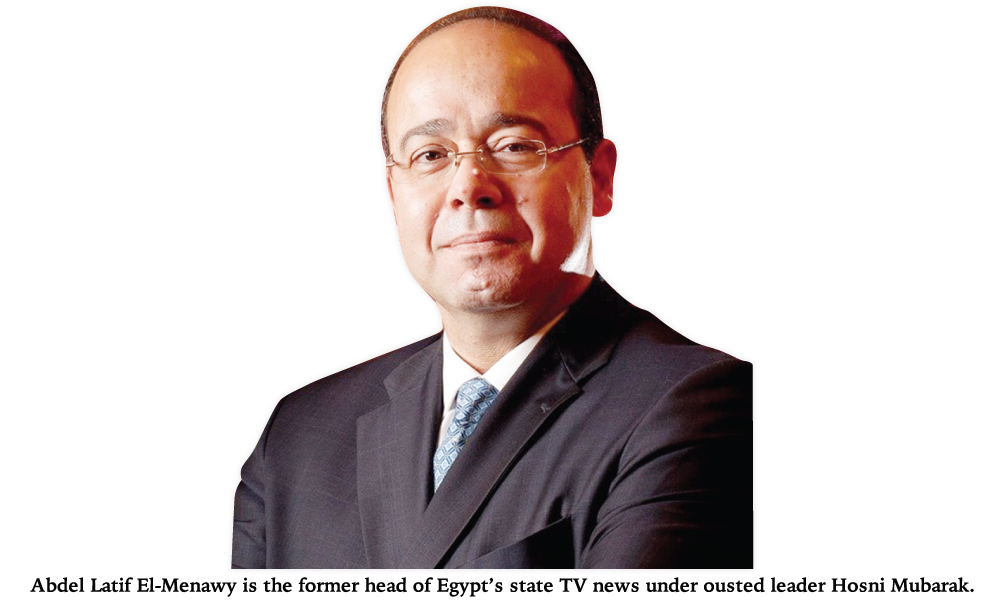
“Some people from Gulf states are upset,” he told Arab News.
The advert was in fact intended to imply Khamenei is “showing off” and that Iran has “an eye” on the Gulf states as “targets”, El-Menawy said.
“I don’t understand how some people understood it in a way like Egypt is supporting Iran,” he said.
“The idea of the billboard (is that Khamenei is) smiling, feeling power, and he is taking a selfie… He’s showing off. And in his back mind, there are also other targets he is considering.”
The journalist referred to the nervousness in the Gulf over the perception of Iran as a threat and Tehran wanting “to control the area”.
El-Menawy, the former head of Egypt’s state TV news under ousted leader Hosni Mubarak, said the adverts were meant as a journalistic statement, rather than a political declaration.
“This campaign doesn’t have anything to do with the state. They didn’t even know about it until they saw it,” he said. “At the end of the day I was doing media, I was not playing politics.”
The wider campaign, which started in mid-October, features around 10 advertisements, with others featuring political figures such as John Kerry, the US Secretary of State, and Sergey Lavrov, Russia’s Minister of Foreign Affairs.
But it was the ads showing Khamenei and Erdogan that proved the most controversial.
The Erdogan billboard was only on public display for a couple of hours — at a site at Tahrir Square in Cairo — before it was removed, said El-Menawy. Other media reports suggest Egyptian security forces removed the billboards.
The advert showed Erdogan sitting on a throne with prisoners in cages in the background, along with a “wanted” sign for his archrival Fethullah Gulen, the US-based cleric.
“(Erdogan) is sitting in this big chair, the sultan’s chair… This is his dream. But the situation, his position, is that Turkey has turned now to be a big prison cell. So this is the idea,” said El-Menawy.
But the timing of the advertisement proved unfortunate given the changing tides in relations between the Gulf states and Turkey.
The pan-Arab news channel Al Ghad Al Arabi is funded by Abu Dhabi authorities and supervised by Mohammad Dahlan, El-Menawy said. Dahlan, a Palestinian political figure, is the former leader of Fatah in Gaza.
El-Menawy said the TV station’s board had approved the billboard campaign before it appeared. But amid the furor over the campaign, he is leaving the channel, with his resignation effective Tuesday.
“I think that this misunderstanding shows that we might not have the same way of thinking,” he said of the Al Ghad management. “So I don’t think this is the right moment to continue.”


