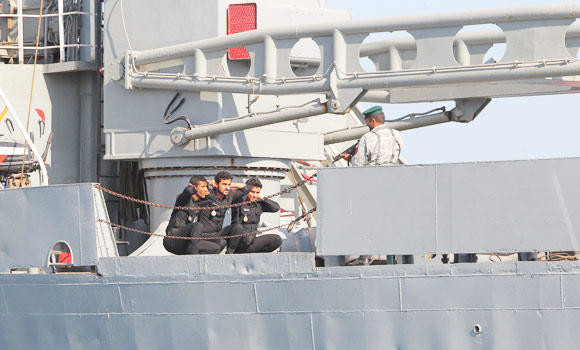
DUBAI: The navies of Iran and Pakistan plan to hold joint military exercises in the eastern part of the Strait of Hormuz on Tuesday, Iran’s state news agency said on Sunday.
Several Pakistani naval vessels, including a warship and a submarine, docked at the Iranian port of Bandar Abbas on Saturday, the IRNA news agency said, citing an Iranian Navy statement.
“The most important activity of the Pakistani fleet during its stay in Bandar Abbas is to launch joint manoeuvres with selected units of Iran’s Navy in eastern waters of the Hormuz Strait,” Iranian Rear Admiral Shahram Irani told IRNA.
Iran’s state news agency said the joint naval exercises were aimed at promoting military cooperation between Tehran and Islamabad but gave no details of the plans.
More than a third of the world’s sea borne oil exports pass through the Strait of Hormuz, a narrow corridor between Iran and Oman. Western navies, led by the United States, patrol the region to ensure their safe passage.
A crude oil tanker was shot at last week as it sailed through the Strait of Hormuz, although such incidents are rare.

Iran, Pakistan navies to hold joint drill in Hormuz strait
Unprecedented gagging order over Afghan data breach should have been avoided, former secretary says
- Ben Wallace tells MPs that he had ordered time-limited injunction to protect lives of Afghan veterans
- Sensitive details of thousands was leaked via email mistake because ‘someone didn’t do their job’
LONDON: The former UK defense secretary has said he would not have proposed a secret gagging order to conceal the catastrophic data breach that threatened the lives of thousands of Afghans.
Ben Wallace told MPs on Tuesday that he had ordered a time-limited injunction to protect the news of the data leak, The Independent reported.
At the time, in mid-2023, the Ministry of Defence had scrambled the learn the source of the leak, which took place when an official accidentally emailed a sensitive spreadsheet containing Afghans’ contact details outside of the ministry.
It led to the publication of the identities of thousands of Afghans who had served alongside British forces during the war against the Taliban, placing them at risk of reprisal.
They were secretly relocated to the UK, and the leak was only revealed to the British public when a High Court judge lifted a superinjunction last year.
It followed a longtime lobbying effort by The Independent and other news organizations to have the details of the leak released.
Wallace told MPs: “We are not covering up our mistakes. The priority is to protect the people in Afghanistan and then open it up to the public. We need to say a certain amount are out of danger.”
On the indefinite injunction, he added: “I didn’t think it was the right thing to do; I didn’t think it was necessary.
“I said, ‘we’re not doing that.’ The only thing we’re going to do, is we need to basically hold off in public until we get to the bottom of the threat these people are under. I said we won’t cover up our mistakes; we’ll talk about them.”
The rules surrounding a superinjunction forbid even mentioning its existence.
Wallace said: “You can have an injunction, I think, without reporting the contents … a superinjunction; my understanding is you can’t even say there’s an injunction. I think I would never have been in that space. Public bodies are accountable. If necessary you could even ring up the journalist and say ‘please hold off, people are at risk.’ Most journalists don’t want to put people at risk.”
The superinjunction was applied by a judge shortly after Wallace had left government.
It came after the MoD applied to the High Court for a regular injunction.
Grant Shapps, the subsequent defense secretary, then maintained the gagging order until the 2024 general election, when the Labour opposition took government.
Wallace blamed the 2022 breach on negligence, adding: “Someone didn’t do their job.”
The former defense secretary had implemented new checking procedures in the ministry after another Afghan data breach, but that “that clearly didn’t happen on this occasion; someone clearly didn’t do their job,” he told MPs.
Wallace said that military and defense spending is not a priority for voters, “partly because they don’t know” the true nature of the threat facing Britain.