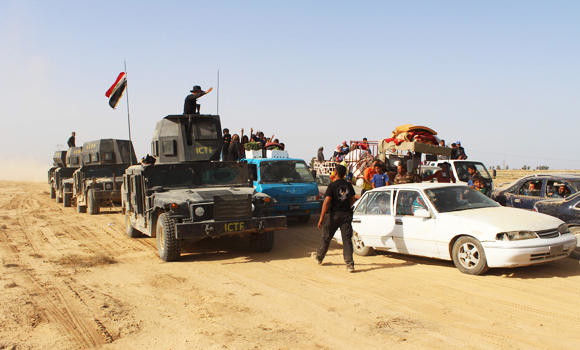
BAGHDAD: Daesh on Sunday pulled its fighters out of Rutba, a desert town in the western Iraqi province of Anbar, an army general and the mayor said.
The pullout, if confirmed, would be a rare case of the terrorists abandoning a position under no massive miliary pressure and suggests a manpower crisis in the organization.
“Daesh has completely pulled out of Rutba and gone toward Al-Qaim,” a major general told AFP, referring to a terrorist bastion on the border with Syria, further north in Anbar.
“Daesh’s armed men started pulling out last night and completed their withdrawal this morning,” the senior officer said. “Rutba is now free of Daesh.”
The mayor of the isolated town, which lies about 390 km west of Baghdad on the road to Jordan, confirmed that IS had withdrawn.
“Daesh has pulled out. They have no armed men there now,” Imad Ahmed said.
“This withdrawal looks real, a consequence of their losses in Anbar, notably the retaking by the security forces of Ramadi, of areas east of Ramadi and the progress toward Hit,” he said.
After launching a final push against IS in the provincial capital Ramadi late last year, Iraq’s security forces established full control over the city last month.
They have since been securing areas east of Ramadi, further isolating the terror stronghold of Fallujah, which lies only 50 km west of Baghdad.
The security forces are also currently working their way up the Euphrates, west of Ramadi, with a view to retaking the town of Hit.
“It cannot be ruled out however that Daesh is pulling out to try to lure out sleeper cells among the population cooperating with the security forces,” the mayor said.
“We have warned the residents that this could be a trick... and asked the Iraqi security forces to come and retake control of the area,” he said.
The major general said any operation in the Rutba needed the approval of Prime Minister Haider Al-Abadi and sufficient time to plan.
Raja Barakat, a member of Anbar provincial council’s security committee, confirmed the Rutba pullout and said Daesh had also been pulling some of its forces from Hit.
“It was not just from Rutba but also from Hit after their fighters shaved their beards to slip out,” he said.
“But in Hit, it’s not a complete pullout, some Daesh fighters remain,” Barakat said.
He said that the Daesh fighters who withdrew from Hit moved through the desert toward Baiji, to the northeast, and toward Al-Qaim, to the northwest.

Daesh terrorists pull out of Anbar town
Iraq’s Kataeb Hezbollah says commander killed in strike
BAGHDAD: The Tehran-backed Iraqi group Kataeb Hezbollah said on Thursday that one of its commanders was killed in a strike in southern Iraq the previous day.
Ahmad Al-Hamidawi, the secretary-general of the armed faction, mourned in a statement the loss of a “great commander,” Ali Hussein Al-Freiji, who had joined the group more than two decades ago.
Two sources from the faction told AFP on Wednesday that a strike hit a vehicle near the group’s main base in southern Iraq, killing two fighters.
The toll then rose to three, including the commander.
One source described the attack as a “Zionist-US strike.”
The group’s Jurf Al-Nasr base was the first Iraqi target of strikes blamed on Israel and the US, which later expanded to other areas.
Since the start of the war, the strikes have killed 15 fighters, mostly from Kataeb Hezbollah.
Iraq, which has recently regained a sense of stability but has long been a proxy battleground between the US and Iran, had said it did not want to be dragged into the war. But it has not been spared.
Several Iran-backed armed groups — known as the Islamic Resistance in Iraq, to which Kataeb Hezbollah also belongs — claim daily drone attacks on US bases.
The Islamic Resistance in Iraq on Thursday warned European countries not to join the war, threatening their “forces and bases in Iraq and the region.”
Earlier on Thursday, the Iraqi News Agency (INA) reported that security forces seized two rockets and a launchpad in the southern Basra province, that were set up to target a neighboring country.
Ahmad Al-Hamidawi, the secretary-general of the armed faction, mourned in a statement the loss of a “great commander,” Ali Hussein Al-Freiji, who had joined the group more than two decades ago.
Two sources from the faction told AFP on Wednesday that a strike hit a vehicle near the group’s main base in southern Iraq, killing two fighters.
The toll then rose to three, including the commander.
One source described the attack as a “Zionist-US strike.”
The group’s Jurf Al-Nasr base was the first Iraqi target of strikes blamed on Israel and the US, which later expanded to other areas.
Since the start of the war, the strikes have killed 15 fighters, mostly from Kataeb Hezbollah.
Iraq, which has recently regained a sense of stability but has long been a proxy battleground between the US and Iran, had said it did not want to be dragged into the war. But it has not been spared.
Several Iran-backed armed groups — known as the Islamic Resistance in Iraq, to which Kataeb Hezbollah also belongs — claim daily drone attacks on US bases.
The Islamic Resistance in Iraq on Thursday warned European countries not to join the war, threatening their “forces and bases in Iraq and the region.”
Earlier on Thursday, the Iraqi News Agency (INA) reported that security forces seized two rockets and a launchpad in the southern Basra province, that were set up to target a neighboring country.
© 2026 SAUDI RESEARCH & PUBLISHING COMPANY, All Rights Reserved And subject to Terms of Use Agreement.