Socially inappropriate behavior such as nail biting among children, as well as some adults, is not uncommon. Etiquette and hygiene are important values to possess at any age and in any socieo-economic situation.
Behaviors that do not adhere to hygienic etiquette, such as nose picking, spitting in public places, dirtying public toilets after using them and other acts that offend the public should be prevented.
Unfortunately, it sometimes gets to the point where it becomes a habit, and so we find a lot of adults and children accustomed to doing what is not commensurate with the ethics of health and hygiene.
Prof. Khoulod Nasser, a lecturer at King Abdulaziz University in Jeddah, sheds some light on public hygiene.
“Our children are a great responsibility that we will be held accountable for, and therefore, this responsibility requires us to set a good example for them and to instill in them the highest values that promote the concept of morality,” she said.
Among the most important things that should be the focus of all parents in the upbringing of their children is public hygiene.
The child’s character is easy to mold at a young age. As such, the child develops into a person according to what he sees of his parents whose behavior will be entrenched in his mind. That is the behavior that he learns and practices in general all his life.
This child is a witty imitator who copies every behavior he sees, and that requires us to be dead serious about what we show him of our actions and behaviors.
If we want to teach our children the principles of hygiene, we should first revise our behavior and strengthen it.
For example, the child learns to wash his hands before eating when he watches his parents doing so. If the child does a certain desired behavior, his parents should encourage him until it becomes a habit.
Parents should take it gradually instead of following an aggressive approach to teach children. It is important that the child is directed through dialogue and discussion so that the child accepts good behavior with an open mind and practices it with conviction.
Also, among the things that will help children to learn hygiene is developing a sense of responsibility i.e. making them believe that they are responsible for their behavior. For example, on a picnic, parents should direct their children to get rid of the garbage after they have finished their meal.
As children we learnt in our English and religion classes that cleanliness if half of faith, but sadly, the implementation of that phrase is not done.
Not only should we tell children that cleanliness is half of faith but we must put it into practice step-by-step and teach them the benefits of hygiene, why it is important and necessary in our lives.
We should begin by teaching them to wash their hands with soap and water both before and after eating to avoid any bacterial infection and diseases due to the germs on the hands.
We should also teach the little ones the importance of bathing, trimming the hair and nails, in addition to teaching them about the hygiene of their surroundings — their house, classroom, school, the streets, city and our society as a whole.
Important tips provided by Prof. Nasser to teach hygiene to your children:
• Instead of criticizing the child sharply, teach him to maintain hygiene, and how to clean his nose, for example.
• You should also explain to him the problem of lack of hygiene and its consequences — diseases and infections.
•Teach him, for example, how to clean his nose with a towel if there is no water, and how to do that in case he was in the house or in a place where there is a toilet.
• Teach him the importance of washing hands after going to the toilet and before and after eating.
• Also teach him the importance of brushing his teeth, and how to do it well.
• Arrange competitions between children to reward the ones with the cleanest teeth, tidiest clothes, etc.
• Make sure that he learns changing his clothes constantly, especially clothes that get dirty easily, such as socks and underwear.
• Also, teach him how to take a bath.
• Make sure to cut his nails every time he takes a shower or at least weekly.
• Make these healthy habits his daily routine from the moment he wakes up in the morning until he goes to bed in the night.
• Start teaching him from the age of a year and a half or two years at the most.
• Encourage him to follow the tips and compliment his performance always.
— [email protected]


![]()
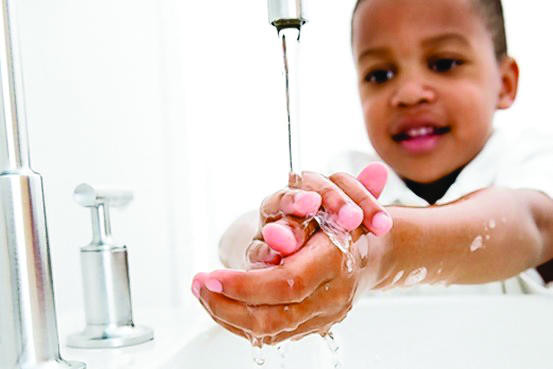
Teaching hygiene and etiquette to children
Teaching hygiene and etiquette to children
Latest updates


Recommended


© 2026 SAUDI RESEARCH & PUBLISHING COMPANY, All Rights Reserved And subject to Terms of Use Agreement.