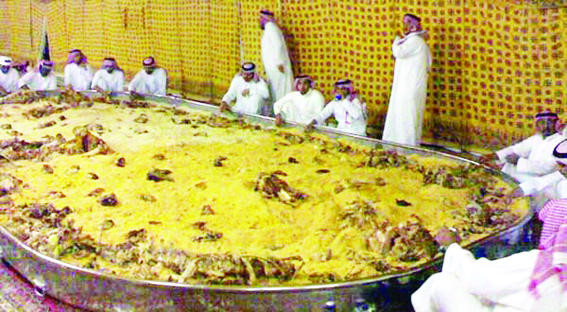
Food wasted in Makkah enough to feed millions going hungry globally

Updated 24 January 2016
Follow

Food wasted in Makkah enough to feed millions going hungry globally

MAKKAH: The food wasted in Makkah could feed 17 percent of hungry children in 18 developing countries, said a press report Friday. There are an estimated 4.8 million
starving children in Africa, Asia and Latin American countries, said Ahmad Al-Matrafi, director general of a charity food project in Makkah.
Al-Matrafi said that food wasted at an average wedding was sufficient to feed at least 250 people. He said that during the mid-year holidays, 24,000 people were fed with food collected at weddings and other social events.
He said that 60 out of 120 halls and resorts in Makkah were approached during the holidays. This revealed that there was food wasted and no information about it. Thirty percent of Makkah’s people do not inform anyone about the availability of surplus food, he said.
The charity was trying to create awareness about the situation so that more needy people can be helped, he said.
Meanwhile, Sheikh Saleh bin Humaid, imam and khateeb of the Grand Mosque in Makkah, said in his Friday sermon that people would become more responsible if they count their blessings.
“If they fail to do so and become ungrateful, Allah may take these good things away from them.” Protecting one’s blessing was a form of worship, he said.


Red Sea Global unveils scientific model for regenerative tourism worldwide

Updated 26 February 2026
Follow

Red Sea Global unveils scientific model for regenerative tourism worldwide

  • The report details the model’s rollout at “The Red Sea” and “AMAALA” destinations, backed by studies covering 8 marine habitats

TABUK: Red Sea Global (RSG) has unveiled a science-based model aimed at achieving a 30 percent net positive conservation benefit across its tourism destinations by 2040. 

The framework is now available for global adoption, according to a statement released by RSG.

Owned by Saudi Arabia’s Public Investment Fund (PIF), Red Sea Global is the multi-project developer behind ambitious regenerative tourism destinations like “The Red Sea” and “AMAALA.” 

As a cornerstone of the Kingdom’s Vision 2030, the company aims to diversify the national economy while setting new global benchmarks for sustainable, nature-positive development.

CEO John Pagano stated that openly sharing this detailed approach will help elevate the global tourism sector and secure a healthier environment for future generations.
 

Map showing the boundaries of the Red Sea Zone. (Graphic from the RSG report)

The cornerstone of this initiative is the proprietary SIIG Model, a four-step framework:
• Survey: Establish biodiversity baselines and monitor long-term changes.
• Identify: Assess risks to priority habitats and species.
• Intervene: Execute evidence-based actions, such as regulating fishing and enhancing natural habitats.
• Gain: Measure and verify biodiversity improvements.

The report details the model’s rollout at “The Red Sea” and “AMAALA” destinations, backed by extensive 2022–2023 environmental baseline studies covering eight marine habitats and priority species groups during 2022 and 2023. 

A major intervention is the 5,015-square-kilometer Fishery Management Area in Al-Wajh Lagoon. The plan reserves 38 percent of the area for priority conservation—protecting 62 percent of local coral reefs—while allocating 61 percent for sustainable fishing.

According to scientific modeling, eliminating fishing in high-protection zones could increase reef fish populations by 113 percent, sharks and rays by 72 percent, and marine mammals by 24 percent. These measures are expected to boost coral resilience, support ecosystem recovery, and protect vulnerable species like sea turtles and seabirds.
Ihab Kindi, RSG’s Red Sea Destination Executive Director, called the data-driven model a practical roadmap for large-scale marine recovery. The complete methodology is available in the new report, “The SIIG Model: A Roadmap Toward Achieving Measurable Conservation Gains.”