AMMAN, Jordan: A video released online Tuesday purportedly shows a Jordanian pilot captured by the Islamic State extremist group in Syria last month being burned to death by his captors following a weeklong drama over a possible prisoner exchange.
The video appeared aimed at testing Jordan’s continuing participation in the US-led coalition attacking the Islamic State group. Jordan’s king, a close Western ally, has portrayed the campaign against the extremists as a battle over values, but the airstrikes against fellow Muslims are not popular in Jordan.
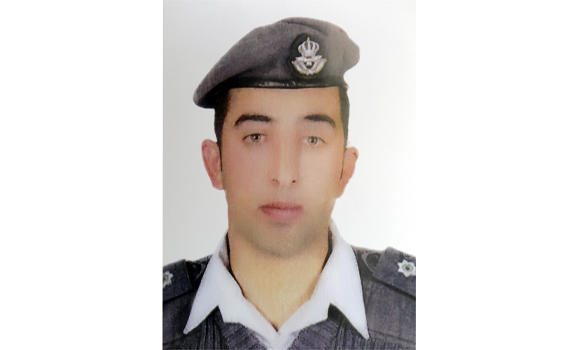
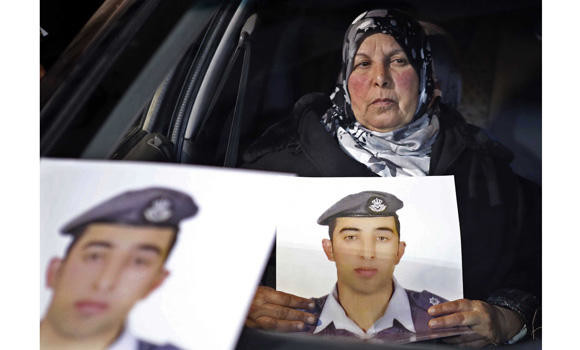
The spokesman for the Jordanian armed forces confirmed the death of the “hero pilot” Lt. Muath Al-Kaseasbeh and vowed revenge.
“While the military forces mourn the martyr, they emphasize his blood will not be shed in vain. Our punishment and revenge will be as huge as the loss of the Jordanians,” Mamdouh Al-Ameri said in a statement read on Jordanian TV.
Al-Kaseasbeh, 26, fell into the hands of the militants in December when his Jordanian F-16 crashed near Raqqa, Syria, the de facto capital of the group’s self-styled caliphate. He is the only pilot from the US-led coalition battling the group to have been captured.
At a tribal meeting place where the pilot’s relatives have waited for weeks for word on his fate, chants against Jordan’s King Abdullah II erupted and some family members wept. An uncle shouted in Arabic: “I received a phone call from the chief of staff saying God bless his soul.”
The pilot’s father, Safi, was surrounded by family members.
Following militant demands, Jordan’s government had said it was willing to trade Sajida Al-Rishawi, an Al-Qaeda prisoner, for the pilot, but that it wanted proof of life first. Al-Rishawi faces death in Jordan for her role in triple 2005 hotel bombings that killed 60 people.
The Associated Press was not immediately able to confirm the authenticity of the video, which was released on militant websites and bore the logo of the extremist group’s Al-Furqan media service. The 20-minute-long video featured the slick production and graphics used in previous Islamic State videos.
The video included purported images of the pilot showing signs of having been beaten, including a black eye. At the end of the video he is purportedly shown wearing an orange jumpsuit and standing in an outdoor cage. A masked militant lights a line of fuel leading to the cage.
The video also threatened other purported Jordanian pilots.
The latest video emerged three days after Japanese journalist Kenji Goto was purportedly beheaded by the militants. The fate of the two captives had been linked but a video of Goto’s purported slaying released Saturday made no mention of the pilot.
An audio message last week, also purportedly from the Islamic State group, said the pilot would be killed if Al-Rishawi was not released Thursday, without actually proposing a swap.
A scroll on Jordan TV said that the pilot was killed on Jan. 3, raising questions over whether any of the hostage negotiations were sincere.
US President Barack Obama said if the video is found to be authentic it would be “just one more indication of the viciousness and barbarity of this organization.”
“It will redouble the vigilance and determination on the part of the global coalition to make sure that they are degraded and ultimately defeated,” he told reporters during an event at the White House.
The Islamic State extremist group, which controls around a third of Syria and neighboring Iraq, has released a series of grisly videos showing the killing of captives, including two American journalists, an American aid worker and two British aid workers. Tuesday’s was the first to show a captive being burned alive.
David L. Phillips, a former State Department adviser on the Middle East, said he believes the brutal killing of the pilot could backfire, antagonizing Sunni Muslims against the Islamic State group, including Sunni tribes in Iraq.
“They need to have a welcome from Sunni Arabs in Anbar Province (in Iraq) to maintain their operations,” said Phillips, director of the Program on Peace-building and Human Rights at Columbia University.
He said the extremist group’s recent military setbacks may have fueled the killings. “They need to compensate for that with increasingly gruesome killings of prisoners,” he said.
Jordan has made clear that the hostage crisis will not prompt it to leave the US-led military coalition against the Islamic State group.
On Sunday, a day after a video emerged of the purported beheading of Goto, Jordanian Foreign Minister Nasser Judeh insisted the kingdom remains “as committed as ever” to the coalition.
Experts are divided over whether Jordan faces a greater threat from extremists outside its borders or from those within. In recent months, there have been signs of greater support for the Islamic State group’s ideas among Jordan’s young and poor. Last year, the government intensified a crackdown on IS sympathizers and the Al-Qaeda branch in Syria.
Currently, about 220 Jordanians are in prison because of alleged ties to such groups, including 30 who are serving terms from three to five years, said Marwan Shehadeh, an expert on militant groups.
___
Laub reported from Jerusalem. Associated Press writers Joseph Krauss in Cairo and Bassem Mroue in Beirut contributed to this report.


Purported IS video shows Jordan pilot burned to death

Purported IS video shows Jordan pilot burned to death

How talks in Riyadh led to the end of harsh US sanctions on Syria
- Congress’ repeal of the Caesar Act caps a Saudi-led diplomatic push to reintegrate a war-weary nation into the global economy
- The end of tough US sanctions opens the door to foreign investment as Damascus reenters the world stage, analysts say
RIYADH: What began as a Saudi-led push to reengage Syria after the fall of Bashar Assad reached a pivotal moment on Dec. 17 when the US Congress voted to permanently repeal the Caesar Syria Civilian Protection Act of 2019.
The long-awaited step has removed a major obstacle to foreign investment and economic recovery in Syria, analysts say, further easing the nation’s global reintegration after years of international isolation.
“Saudi Arabia believed that bringing Syria back into the Arab fold was the right path forward,” Ghassan Ibrahim, a Syria expert and head of the London-based Global Arab Network, told Arab News.
“To achieve this, it required a strong and clear decision to support Syria. One of the main challenges was lifting sanctions and reconnecting Syria with the US, and Saudi Arabia played a major role in accomplishing that.”
Hani Nasira, a regional political analyst, said the decision stemmed from a meeting in Riyadh in May between Saudi Crown Prince Mohammed bin Salman, US President Donald Trump, and Syria’s interim President Ahmad Al-Sharaa.
“Following this decision, Syria will regain its vitality, and the train of development will return to the country,” Nasira told Arab News.
He said Saudi Arabia has emerged as “the foremost driving force and the most important incubator” of Syria’s return to the international community — a role underscored by Washington’s decision to end its strictest sanction.
Trump signaled that intent at the start of his three-day visit to Saudi Arabia on May 13. “After discussing the situation in Syria with the (Saudi) crown prince, I will be ordering the cessation of sanctions against Syria in order to give them a chance at greatness,” he said.
The following day in Riyadh, Trump met Al-Sharaa — who had led the rebel offensive that toppled Assad on Dec. 8, 2024 — marking the first high-level US-Syria meeting in a quarter of a century.
The meeting represented a dramatic turn for a country still adjusting to life after more than five decades of Assad family rule, and for an interim president who until recently had a $10 million bounty on his head.
“The meeting in Riyadh between the three leaders was carefully arranged and reflected a shared desire and need for cooperation between Syria and Saudi Arabia,” Ibrahim said.
“This cooperation laid the groundwork for a new type of coalition — one aimed at bringing greater stability and prosperity to the region.
“The Saudi, American and Syrian leaderships came together around a common vision; that stability is the pathway to prosperity. This vision aligns with Saudi Arabia’s Vision 2030, and all sides shared similar perspectives and objectives.”
Diplomatic momentum quickly followed. On May 23, US Secretary of State Marco Rubio signed a 180-day waiver of the Caesar Act’s secondary sanctions to facilitate humanitarian aid and early recovery efforts.
Nearly a month later, on June 30, Trump issued an executive order terminating the broader US sanctions program on Syria, effective July 1, and instructed the State Department to review whether additional Caesar-mandated sanctions should be suspended.
In November, following Al-Sharaa’s historic visit to the White House — the first Syrian leader to do so — the Caesar Act suspension was temporarily extended for another 180 days before Congress ultimately moved to repeal it.
“When Assad was in power, Syria’s only allies were Iran and Russia,” Ibrahim said. “After his removal, Syria was left with just one uncertain partner: Russia. That made reconnecting with the world essential.
“President Al-Sharaa chose Saudi Arabia as the first gateway to reestablish Syria’s ties with the international community. Saudi Arabia did not hesitate; it supported the new Syria and its new leadership.
“The relationship between the two countries had always existed, but it needed this push to be fully restored.”
First imposed in 2019 during Trump’s first term, the Caesar Act was a cornerstone of US pressure on the former Syrian regime.
Designed to deter foreign entities from doing business with Damascus, the law reportedly exacted a heavy toll on ordinary Syrians already suffering through a civil war that began in 2011.
Although the act formally expired in December last year under its five-year sunset clause, Congress renewed it through the 2025 National Defense Authorization Act, extending its reach into 2029 before reversing course months later.
Assad fled to Russia on Dec. 8, 2024, after Al-Sharaa’s Hayat Tahrir Al-Sham seized Damascus. In the months that followed, and amid appeals from Saudi Arabia and other regional powers, the Trump administration reassessed its Syria policy.
Beyond the symbolic importance of repealing the Caesar Act, Nasira said it will facilitate the release of Syrian assets held abroad, estimated at about $400 million, providing critical funding for economic reforms.
The World Bank estimates that reconstruction will cost between $140 billion and $345 billion, with a “best estimate” of $216 billion — nearly 10 times Syria’s 2024 gross domestic product of $21.4 billion.
In July, Damascus hosted its first Syrian-Saudi Investment Forum, producing more than 40 preliminary agreements worth about $6 billion across sectors including infrastructure, telecoms, tourism and health care.
That same month, Syria signed an $800 million agreement with Dubai Ports World to upgrade port infrastructure.
In August, it reached additional energy deals with Saudi Arabia, while a separate $7 billion energy project involving Turkish, Qatari and US firms promises to boost electricity supply.
Even so, sanctions relief alone, while “necessary,” is “far from sufficient,” said Vittorio Maresca di Serracapriola, lead sanctions expert at Karam Shaar Advisory
“For international capital to enter Syria at scale, deeper conditions must be met; meaningful banking sector reform, upgraded anti-money laundering and combating the financing of terrorism standards, and above all, political and security stability,” he said.
Nevertheless, Ibrahim believes the repeal of the Caesar Act will allow Syria to “move to the next phase; reconstructing the country and ensuring there is no vacuum of authority or power.”
“It gives Syria a real opportunity,” he said. “The next step is strengthening the new leadership, deepening cooperation, attracting investment and restoring Syria as a normal member of the international community.”
Al-Sharaa echoed that message in his first post on X following the repeal, congratulating Syrians and thanking those who helped lift the sanctions.
“Through the will of the Syrians and the support of brothers and friends, a page of suffering has been turned, and a new phase of reconstruction has begun,” he said.
“Hand in hand, we move forward toward a future worthy of our people and our homeland.”


