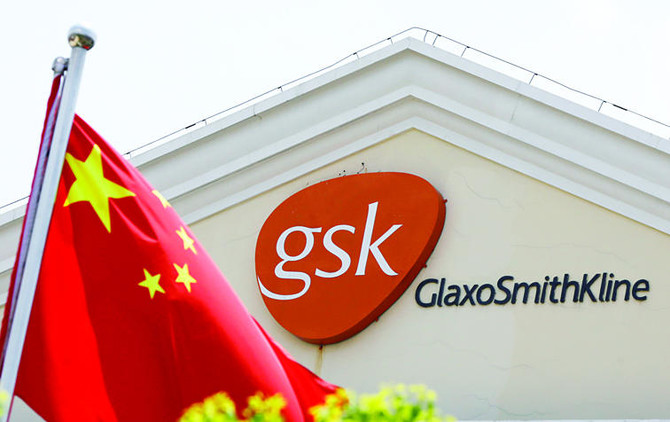
GSK fined $490m in China graft probe

Updated 19 September 2014
Follow

GSK fined $490m in China graft probe

BEIJING: A Chinese court has fined British drugmaker GlaxoSmithKline 3.0 billion yuan ($490 million) following a nearly year-long bribery probe, the company said.
The firm’s former head of China operations, Mark Reilly who would be deported, and four other ex-officials were given suspended sentences of between two and four years in prison, the Xinhua news agency said.
The fine levied by the Changsha Intermediate People’s Court after a closed hearing in central Hunan province was the largest ever handed down by a Chinese court, according to Xinhua.
It equals the precise amount that China’s ministry of public security said last year had been funnelled between GSK and travel agencies since 2007.
Police allege that GSK took kickbacks from travel agencies to organize conferences that never took place.
The company also “resorted to bribery to boost sales of its medical products and sought benefits in an unfair manner,” the court said in a statement, according to Xinhua.
“GSK bribed, in various forms, people working in medical institutions across the country, and the amount of money involved was huge. Five senior executives actively organized, pushed forward and implemented sales with bribery,” the court statement added.
The firm said in a statement that the court had found it guilty of “bribing non-government personnel.”
In an apology posted on its website, GSK said that the illegal activities of the firm’s China arm “are a clear breach of GSK plc’s governance and compliance procedures; and are wholly contrary to the values and standards we expect from our employees.”
The firm “must work hard to regain the trust of the Chinese people,” it added.
According to Xinhua, Reilly was given three years in prison but will receive a four-year reprieve and be “expelled” from China. It did not provide further details.
Three other GSK officials — former human resources director Zhang Guowei, former vice president Liang Hong and former legal affairs director Zhao Hongyan — received sentences and reprieves of two to three years, Xinhua said.
The firm’s former general manager for business development, Huang Hong, was found guilty of “bribing and receiving bribes” and received a sentence of three years, which will be suspended for four years, according to Xinhua.
The court decided to reduce the jail sentences for the five “since they confessed the facts truthfully and were considered to have given themselves up,” Xinhua reported.
After being detained by Chinese authorities last year, Huang was quoted in state media as saying that GSK had set up a special team to handle important clients which had an annual “relations” budget of nearly 10 million yuan ($1.6 million).
Sales growth targets set by the firm as high as 25 percent put pressure on employees, Xinhua quoted Huang as saying.
Neither the statement nor the apology mentioned the sentencing of Reilly or other officials.
The verdict comes more than a year after Chinese police first accused Reilly of ordering employees to bribe hospitals, doctors and health institutions to gain billions of dollars in revenue.
China’s health care sector is widely considered to be riddled with graft, partly the result of an opaque tendering system for drugs, and also due to doctors’ low salaries.
GSK is the most high-profile target of wide-ranging Chinese inquiries into foreign pharmaceutical firms, as Beijing also mounts probes into overseas companies in sectors ranging from cars to baby milk.
The investigations come against the backdrop of an anti-graft campaign backed by President Xi Jinping to root out official corruption.
Reilly is not the only non-Chinese national to have been ensnared in the probe.
Last month, a Shanghai court sentenced British investigator Peter Humphrey and his American wife Yu Yingzeng to two-and-a-half years in jail for breaching privacy laws.
The investigators had been hired by GSK to investigate the source of a lurid sex tape of Reilly shortly before the probe went public.


Saudi Aramco bolsters global oil market stability amid rising regional tensions

Updated 4 sec ago
Follow

Saudi Aramco bolsters global oil market stability amid rising regional tensions

RIYADH: Amid growing logistical challenges facing the energy sector, operational moves by Saudi Aramco are emerging as a stabilizing factor in global oil supply.

The company has offered additional crude shipments on the spot market, a step analysts see as aimed at absorbing supply shocks and ensuring the continued flow of oil through key energy corridors.

The move aligns with Saudi Arabia’s long-standing role as a leading global producer and is intended to limit price volatility and maintain balance between supply and demand at a time of heightened geopolitical uncertainty.

Reuters reported that Aramco has offered more than 4 million barrels of Saudi crude through rare spot tenders, as tensions between the US and Iran disrupt Middle Eastern exports.

Mohammad Al-Sabban, former senior adviser to the Saudi energy minister, said the current surge in oil prices does not necessarily reflect an immediate shortage of supply. Instead, it is largely driven by what energy markets call a “geopolitical risk premium.”

Speaking to Asharq Al-Awsat, Al-Sabban said prices remaining above $100 per barrel reflect global anxiety that the conflict could expand and threaten future supply security.

He noted that higher prices, while boosting short-term revenues and fiscal surpluses for oil-exporting countries, also bring hidden costs. These include increased spending on security measures to protect oil infrastructure — costs that rise in a volatile regional environment where Gulf states face mounting security pressures.

Al-Sabban also pointed out that spot market sales are currently generating greater returns than long-term futures contracts. The uncertainty surrounding the conflict has led buyers to pay premiums for immediate deliveries, making spot transactions more attractive during the current crisis.

Strategic chokepoint

Shipping through the Strait of Hormuz, which carries roughly 20 percent of global oil supply, remains central to the crisis.

Al-Sabban warned that even a temporary closure of the waterway would inevitably reduce available supplies, potentially triggering panic in markets and forcing countries to draw from strategic reserves.

He recalled historical precedents, noting that during the Iran-Iraq war, energy markets became a hub for speculation, with negative economic consequences emerging later.

Asked whether the conflict represents a short-term economic opportunity or a broader risk for regional economies, Al-Sabban said the reality is a mix of both. High prices may offer temporary gains as long as oil remains above $100 a barrel, but a prolonged conflict could ultimately impose heavier economic burdens through rising logistical and security costs.

Flexible response

Financial and economic adviser Hussein Al-Attas said Aramco’s decision to release additional cargoes on the spot market reflects significant flexibility in managing supply and responding quickly to market shifts amid rising demand and concerns about potential shortages.

He told Asharq Al-Awsat that the move sends an important signal to global markets that Saudi Arabia continues to play the role of a swing producer, capable of intervening to maintain market balance and ease fears about supply security.

Al-Attas added that the recent surge in oil prices is largely tied to geopolitical tensions in a region that represents the heart of global energy supply.

While Brent crude could remain above $100 in the short term if supply concerns persist, he noted that history shows price spikes driven by political tensions are often temporary unless they lead to a prolonged disruption in supply.

Higher oil prices naturally increase revenues for exporting countries, potentially strengthening fiscal balances and enabling governments to finance spending and development projects, Al-Attas remarked.

Gulf states, particularly Saudi Arabia and the United Arab Emirates, may therefore benefit financially in the short term.

However, he cautioned that such gains are usually temporary rather than structural. Prolonged high energy prices can slow global economic growth by fueling inflation, which may eventually reduce demand for oil. As a result, the current price surge may represent a temporary financial opportunity rather than a lasting shift in oil revenues.

Ultimately, Al-Attas said the crisis carries two opposing dynamics: Gulf countries may benefit financially in the short term, but any wider regional conflict could pose greater risks to economic and commercial stability.

For that reason, he added, the region’s strategic interest ultimately lies in stable energy markets and uninterrupted oil flows, which are essential for sustaining global demand and supporting long-term economic growth.