In a sprawling industrial city in Inner Mongolia, three rappers surround a microphone, dressed in the baseball caps, baggy trousers and branded trainers favored by hip hop fans the world over.
The sparsely populated region in northeastern China counts mining and milk among its main industries, and locals are more familiar with throat-singing than rapping.
But members of China’s Mongolian ethnic minority, whose ancestors were first united by Genghis Khan, are turning to hip hop to condemn the resources boom they say is wreaking havoc on their traditions and lands — while avoiding the authorities’ attention.
“Herders are bribed with cash, and our land is torn up by machines,” the trio, who go by the English name Poorman, rap in their track “Tears.” “Brothers and sisters, we need to wake up!“ Once an economic backwater, the development of thousands of coal mines to tap Inner Mongolia’s vast mineral reserves has made the region one of China’s fastest-growing.
But while some have prospered from the mining boom, other Mongolians resent being displaced from their land to make room for the mines, which they say scar the steppe and discriminate against them in recruiting.
“There are all these songs about the beauty of Inner Mongolia’s grasslands, but when people come to visit they realize it’s being turned into desert,” said band member Sodmuren, 25, who like many Mongolians uses a single name.
The region’s rappers adopted the genre a decade ago from their ethnic fellows in neighboring Mongolia, an independent country which has had a thriving hip hop scene for more 20 years.
“Hip hop is the most honest kind of music there is,” Sodmuren told AFP in a recording studio in Inner Mongolia’s capital, Hohhot, where swathes of newly built concrete apartment blocks stretch into the grassy countryside.
China’s Mongolians have seen their traditional way of life transformed by government policies encouraging nomadic herders to abandon their grazing lands for flats in the cities.
As a result, most of the region’s rappers grew up in an urban environment. But Sodmuren and his bandmates retain a fascination with nomadic culture, incorporating pastoral imagery into their music. One of Poorman’s videos shows the band sitting outside traditional tents, known as yurts, with one member wearing the deel, a Mongolian gown. “Although we grew up in yurts, after years in the city we’re forgetting our culture,” they sing.
A few minutes’ drive away from their studio, a sprawling Gucci store is testament to the new class of millionaires created by the mining boom, and their splurging on luxury cars and clothing.
But Eregjin, a baseball-capped 27-year-old solo rapper who has been singing under the name MC Bondoo since he was a teenager, said: “We don’t admire luxury culture. We hate materialism, and the worship of expensive things.”
He has the national symbol of independent Mongolia tattooed on his right arm.
Mongolians are one of dozens of minority groups who live along China’s borders and speak Mandarin as a second language, seeing themselves as culturally different from the majority Han Chinese — now 79 percent of Inner Mongolia’s population.
Mandarin is increasingly popular for economic reasons even among Mongolians, and the rappers see their songs as a way to keep their own tongue alive.
“We’re worried about the future of the Mongolian language, because there are fewer and fewer children attending bilingual schools,” Sodmuren said. “The danger is that we’ll lose our Mongolian identity.”
Ethnic identification can be a sensitive topic in China, where the government is anxious to avoid social unrest.
When a Han Chinese coal truck driver ran over a Mongolian herdsman in 2011 it triggered more than a week of protests by hundreds of people in cities and towns across the region.
A rapper known as Syrlig was detained by authorities in 2011 after writing a song called “Stand up, Inner Mongolians!” several singers told AFP. He has since moved to Mongolia, the rappers said.
“There are some lyrics we’d sing in shows, but if we published them we’d be arrested,” MC Bater, a member of one of Inner Mongolia’s most successful hip hop groups, PTS, told AFP.
But the scene’s low profile, combined with a degree of self-censorship — declining to target individuals or the ruling Communist Party by name — allows Mongolian rappers to escape censure from the authorities.
“I complain about government officials in my songs, but I don’t name anyone directly,” Sodmuren said. “I have to be smart.”


China’s Mongolians rap on coal and cash

China’s Mongolians rap on coal and cash
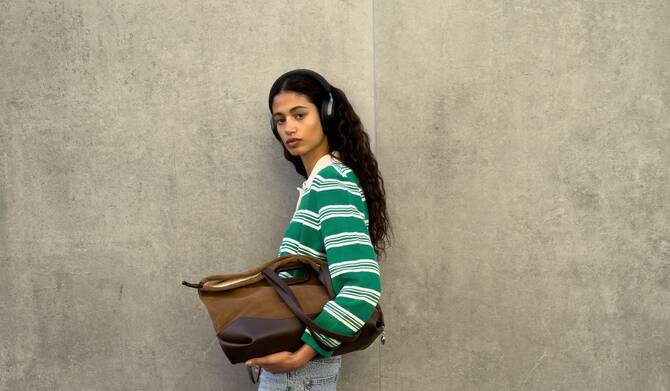
Malika El-Maslouhi ushers in spring in Maje
DUBAI: Moroccan Italian model Malika El-Maslouhi is the embodiment of relaxed in Parisian label Maje’s Spring-Summer 2026 campaign.
The model took to Instagram to share shots from the campaign. Set against a minimalist concrete backdrop, El-Maslouhi is seen wearing a green and white striped knit cardigan paired with wide-leg, speckled denim and chunky black boots, creating a chic contrast between casual comfort and fashion-forward styling. The oversized brown leather bag slung under her arm adds a touch of understated luxury.
She captioned the post, “Spring renaissance.”
Meanwhile, El-Maslouhi ended 2025 on a strong note with a holiday campaign for the French luxury label Guerlain.
In a photo shared on the brand’s Instagram page, the 27-year-old model, who has become a favorite on international runways, wore the limited-edition Rouge G lipstick from Guerlain’s Tale of Wonders Holiday Collection in shade G 877. She was also pictured holding the lipstick alongside the matching limited-edition Rouge G Stellar case.
In August 2025, she was the face of Anthropologie’s 2026 resort-wear campaign. The line blended breezy elegance with playful details, including jewel-toned maxi dresses, sleek black knitted dresses, and form-fitting satin gowns that would be perfect for date night.
El-Maslouhi has previously starred in Anthropologie’s summer campaigns. The catwalk star was photographed posing pool and beachside in pieces from Anthropologie’s summer offering, which included ready-to-wear, swimwear and accessories.
Earlier in the year, El-Maslouhi starred in Saint Levant’s music video for the song “Exile,” directed by Algerian-French filmmaker Lyna Zerrouki. The video, which explores themes of longing, loss and hope, features El-Maslouhi against a striking blue backdrop, seemingly falling through the air.
El-Maslouhi, born in Milan to a Moroccan father and an Italian mother, began her modeling career at the age of 18. She has since appeared on runways for international fashion houses including Dior, Chanel, Valentino and Jacquemus, gracing the catwalks of New York, London, Milan and Paris fashion weeks. Over the years, she has walked for brands such as Ulla Johnson, Prabal Gurung, David Koma, Boss, Missoni, Messika and more.
She has also featured in campaigns for brands such as Calvin Klein, Off-White and Lanvin, expanding her portfolio across both luxury and contemporary fashion.
In 2022, she was awarded the Model of the Year in Italy title.


