RIYADH: Just 16 months after its launch, Saudi Arabia’s Public Investment Fund-owned Humain has begun preparations for a potential public offering, with its CEO publishing an announcement seeking a specialized team for the task.
While the announcement did not provide any update on the potential timetable or size of the offering, it sheds light on a company that has, in a relatively short period, built a broad portfolio of partnerships, investments, and products aimed at helping achieve the objectives for which it was established — building an integrated artificial intelligence ecosystem in the Kingdom, Asharq Bloomberg reported.
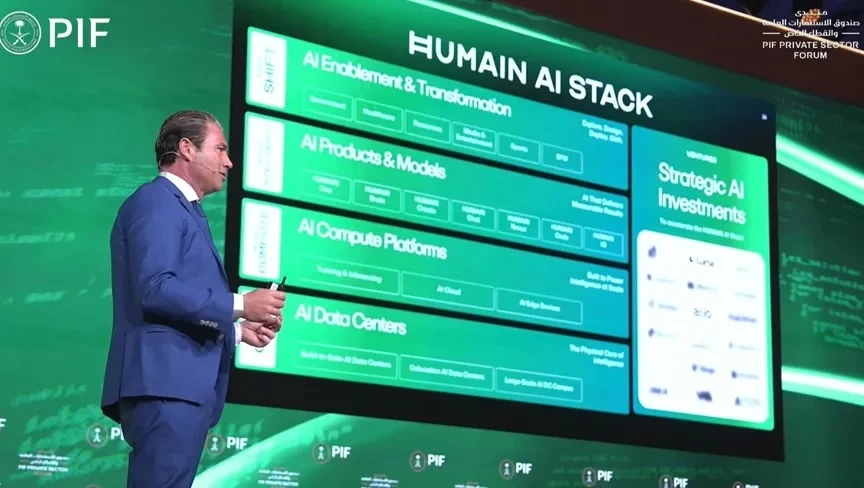
Launch with ambitions spanning the AI value chain
Humain officially began its journey on May 12, 2025, when Saudi Crown Prince Mohammed bin Salman announced the launch of the company to develop, manage, and invest in artificial intelligence solutions and technologies.
The company was established with a vision covering the entire value chain, from data centers and cloud infrastructure to models and applications, with a particular focus on developing a large language model in Arabic.
The following day, the company announced its first major plans with Nvidia, through a project with a capacity of up to 500 megawatts over five years. The company’s CEO, Tareq Amin, also revealed an ambition to reach 1.9 gigawatts by 2030.
On the same day, Amazon Web Services announced a joint investment of more than $5 billion to establish an “AI Zone” in Saudi Arabia. The partnership was expanded in May through the Humain One initiative, which aims to accelerate AI adoption among enterprises globally.
The company then announced its first agreement with Qualcomm on May 14, 2025, to develop advanced data centers and provide hybrid AI services. The cooperation added a pathway connecting cloud computing with devices before the relationship expanded to plans to deploy inference chips and develop enterprise-focused computers.
In December, the company announced the launch of a joint venture with Center3, the digital infrastructure solutions company owned by Saudi telecom group stc, to build AI data centers in the Kingdom.
The partnership aims to develop and operate advanced infrastructure with high operating capacity of up to 1 GW of power required to run data centers, with capacity starting at 250 MW, paving the way for the development of high-capacity, low-latency infrastructure.
Allam opens the way for products
Alongside its infrastructure announcements, Humain began developing its own AI-powered products. In August 2025, the company launched Humain Chat, powered by the Allam 34B model, making Arabic and its cultural contexts a central focus of the product.
The company’s consumer focus was not limited to AI conversations. On Aug. 26, it revealed that it was developing an integrated AI computer before unveiling the Horizon Pro on Sept. 25. The device featured Qualcomm’s Snapdragon X Elite processor and was designed to integrate with Humain One.
The relationship between hardware and software became clearer on Oct. 28, when Humain officially unveiled Humain One, an enterprise operating platform powered by AI agents to execute tasks and manage workflows.
The product portfolio had by then brought together a language model, a computer, and a platform targeting how enterprises operate.
Broader partnerships and xAI investment
Alongside the introduction of products, Humain continued to expand the computing and financial foundations of its business.
On Oct. 28, it also announced a partnership with Blackstone and AirTrunk to develop, finance, and operate data centers in Saudi Arabia, adding companies specializing in investment and infrastructure to its network of technology partners.
During the same month, its cooperation with Qualcomm expanded into a plan to deploy 200 MW of infrastructure starting in 2026, based on its AI200 and AI250 solutions.
In November, the expansion grew significantly, with Amazon and Humain announcing plans to operate up to 150,000 AI accelerators in Riyadh. The series of agreements announced at the time also included a joint venture with AMD and Cisco for data centers, as well as a plan with xAI to develop 500 MW of capacity.
The relationship with xAI evolved from cooperation into an equity investment. On Feb. 18, Humain announced a $3 billion investment as part of a funding round that preceded SpaceX’s acquisition of the company.
The deal gave Humain a significant minority stake, which was later converted into shares in SpaceX, adding investment in technology developers to its operational activities.
Meanwhile, its partnership with Amazon was expanded on May 3, through Humain One, targeting the acceleration of enterprise AI adoption globally.
From platform expansion to operations
Throughout August, the company continued to expand the channels through which its products reach customers. On Aug. 26, it announced a strategic collaboration with Microsoft that includes making Allam available through Microsoft’s AI ecosystem and developing enterprise solutions, after the model began its journey through the company’s own chat application.
Days later, during LEAP 2026, it unveiled the Horizon Ultra computer, designed to run AI models locally while using the cloud when additional computing capabilities are required. The first generation runs on Windows, while Humain plans to introduce a generation operating on its own system in 2027.
The expansion of its product portfolio coincided with an operational milestone on Aug. 31, when the company announced the launch of computing infrastructure developed in cooperation with AMD as part of its partnership with Cisco.
On the same day, Adobe expanded its collaboration with Humain to develop an image model tailored to Saudi culture and provide free tools for one year to more than 27 million eligible people in the Kingdom, with a value exceeding $4 billion.
Throughout the conference, the rollout of new services was accompanied by projects to increase computing capacity, including a 100-MW data center with DataVolt in Neom and a 250-MW project with Together AI.
The scope of applications also expanded into transportation through an agreement with Applied Intuition to deploy autonomous trucks by 2030.
The company had also announced a collaboration with Nvidia to develop an autonomous mobility ecosystem in the Kingdom. The partnership will rely on Nvidia DRIVE Hyperion to develop the infrastructure and operational capabilities required for autonomous transportation.
Expansion beyond the sector
Humain’s expansion is not limited to the AI sector, as Saudi football club Al-Nassr announced a strategic partnership with Humain in July, under which the company would become the club’s official sponsor for the 2026-27 season.
The club said the partnership goes beyond the traditional framework of sports sponsorship and focuses on leveraging AI solutions in several critical areas, including sports data analysis, improving technical performance, and supporting decision-making processes.
Financing lays the groundwork
These expansions brought financing back into focus in early September, with a plan to initially raise $2.5 billion for a fund investing in Saudi data centers.
According to Bloomberg sources, the fund will help finance 250 MW of capacity being developed by Humain with Al-Moammar Information Systems, with the possibility of later increasing it to 1 GW.
At the same time, Reuters reported in May that the company had selected Goldman Sachs to advise on arranging a financing package worth at least SR20 billion ($5.33 billion) to build data centers in the Kingdom.
The agency said the company had recently brought in the US bank to help finance data centers and graphics processing units, or GPUs, with capacity of up to 2 GW – equivalent to about one-third of Humain’s target by 2034.
Against this backdrop, preparations for an initial public offering represent an extension of a trajectory combining infrastructure spending, product development, and the pursuit of financing.
After about 16 months, Humain’s portfolio includes services that have begun operations, products that have been launched, and projects that remain under development.
However, beginning preparations for an IPO does not necessarily mean that a listing is imminent. The company had previously set a timeframe extending to 2029 for listings on the Saudi and New York stock exchanges.
With some projects already operational and others still under development, this timeframe could give the company more time to build a broader operating track record to support its investment case.
The trajectory places what Humain has achieved during its first months in the context of the larger ambition announced by the company from the outset.
In November 2025, Amin told Asharq Bloomberg that the company’s ambition was to make Saudi Arabia the world’s third-largest country in AI infrastructure, after the US and China, adding: “We have achieved a lot in record time. Humain was launched just months ago, and today we have begun putting the Kingdom on the global map.”
From launch to IPO: how Saudi AI firm Humain grew in 16 months