Maronite Patriarch Al-Rahi draws support in resolute stance on Lebanon’s neutrality 

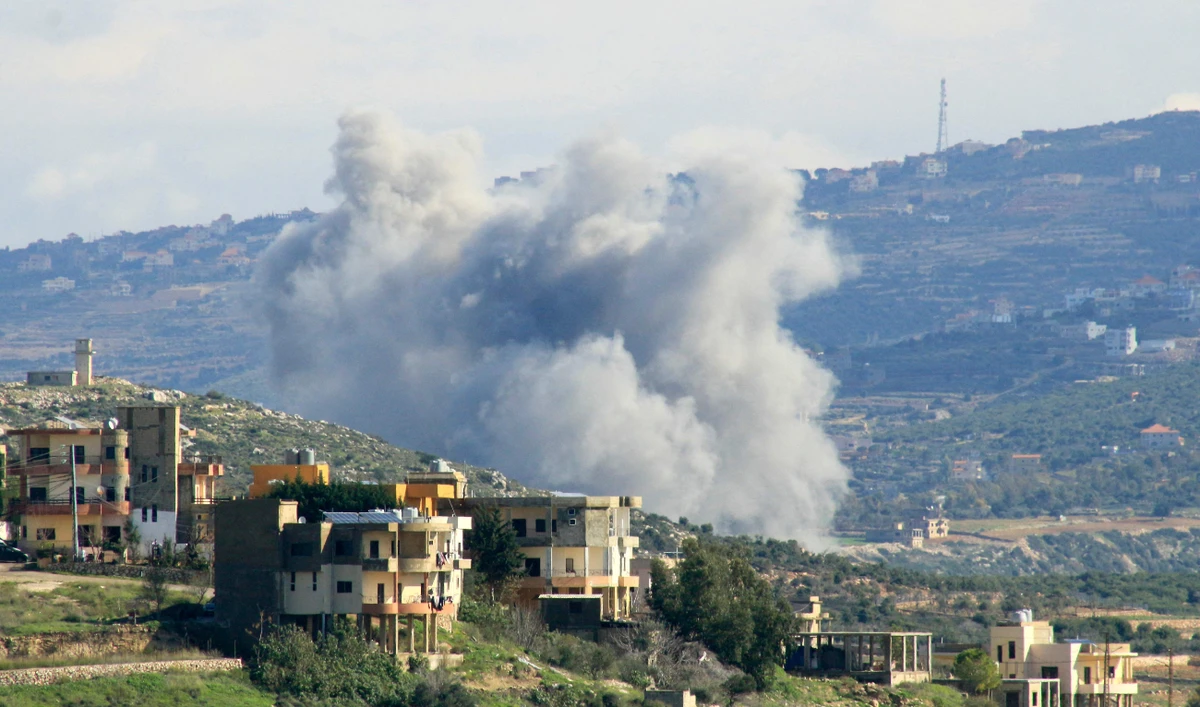
Smoke billows from Lebanon’s southern village of Majdelzoun during an Israeli airstrike. Hezbollah on Monday claimed responsibility for attacks on Israeli army positions near the border, using Falaq-1 rockets. (AFP)
Short Url
Updated 29 January 2024
Follow

Maronite Patriarch Al-Rahi draws support in resolute stance on Lebanon’s neutrality 

  • Hostilities escalate on the southern front amid concern over plight of border villagers 

BEIRUT: A significant portion of Lebanese people have aired their concern over Hezbollah supporters’ stance on ongoing violent clashes in the border region.

The criticism by Maronite Patriarch Bechara Boutros Al-Rahi — who advocates for “Lebanon’s neutrality” regarding operations carried out by Hezbollah toward the Israeli army — triggered angry reactions on Monday.

Hezbollah supporters attacked Al-Rahi on social media as hostilities escalated on the southern front.

The organization introduced a new weapon amid Israeli threats of a wide-scale military operation inside Lebanese territory and talk of training and maneuvers for Golani Brigade soldiers coming from Gaza to the northern border.

In his Sunday sermon, Al-Rahi expressed the views of those opposed to such involvement, criticizing the “excess of power under the headless state.”

He said: “The residents of the border villages in the south have expressed their pain to us about the state abandoning them while they endure the brunt of the imposed and rejected war.

“They consider that Lebanon and the Lebanese have nothing to do with it (the war).”

Al-Rahi conveyed their rejection of being used as “hostages, human shields, and scapegoats for failed Lebanese policies and the culture of death that has brought nothing to our country except imaginary victories and shameful defeats.”

Pro-Hezbollah activists responded, with one saying: “He who gave the sermon needs to be preached to.”

Another said: “Hezbollah’s culture is the culture of triumph over death.”

Al-Rahi’s defenders continued to criticize Hezbollah supporters. One activist requested a stop to “accusations of treason against anyone who rejects Hezbollah’s performance and criticizes its loyalty to Iran.”

Lebanese Forces MP Ghayath Yazbek said: “To those who attack the Maronite Patriarchate, you live in a state whose borders were demarcated with a thread drawn from the robe of a patriarch, and you swing safely on a branch of its blessed cedar. Suppress evil tongues before you bring down Lebanon and regret it.”

Independent MP Neemat Frem said: “The brutal campaign against Patriarch Al-Rahi on social media is shameful and strongly condemned.

“This is not how we communicate with a national authority that carries the people’s pain, stands by legitimate institutions, opposes war, and speaks out on the culture of life. What is happening is very shameful.”

On Sunday evening, Hezbollah revealed its use — for the first time — of Almas anti-tank guided missiles in its attacks against Israeli sites.

A southern security source said: “There has been a gradual increase in Hezbollah’s weapons in recent weeks, from the use of the Burkan missile to the Falaq 1 missile to the Almas missile. Its goal is most likely to maintain the balance of terror.”

Hezbollah media released a video showing the use of an Almas ATGM on the battlefield.

According to a military specialist, this was a “revised edition of the Israeli Spike ATGM system. The modified missile uses a built-in camera to track its target, allowing it to bypass obstacles and strike with precision. It can be operated from a remote location.”

Meanwhile, Israeli strikes ranged from Hezbollah missile launch sites or areas where its members were moving to targeting houses. This eventually impacted businesses, along with water and electricity services, and resulted in extensive destruction.

Hezbollah declared several military actions on Monday. A Falaq 1 missile was used to target a group of Israeli soldiers near the Jal al-Alam site. They also launched Burkan missiles at the Pranit barracks and there were attacks on the Metula site and a gathering of Israeli soldiers at Honin Fort. The Hadab Yarin site was also hit with Burkan missiles, along with the Barkat Risha site. Sirens sounded in Manara, Margaliot, Miskavam and Kiryat Shmona in the Galilee.

Israeli media announced that “Hezbollah used precise missile systems to attack a military target inside Kiryat Shmona.”

Israeli Army Radio reported the wounding of two Israeli soldiers during the Pranit Barracks attack.

Lebanese civilians were injured as a result of the Israeli bombing. It was reported people from Marwahin and Al-Dhahira experienced breathing difficulties and suffocation due to inhaling phosphorus gas.

The Israeli military launched several shells near ruined houses in the town of Al-Dhahira while paramedics were looking for those who were injured. Four people were wounded by the Israeli artillery shelling of Hula.

Hezbollah mourned the loss of three fighters — Sadiq Mohammed Hashem, Ali Jamal Shukr, and Hussein Halawi.
Netanyahu says Israel and Hamas will enter ceasefire’s second phase soon

Updated 08 December 2025
Follow

Netanyahu says Israel and Hamas will enter ceasefire’s second phase soon

  • Says the second phase addresses the disarming of Hamas and withdrawal of Israeli troops from Gaza
  • Second stage also includes the deployment of an international force to secure Gaza and forming a temporary Palestinian government

TEL AVIV, Israel: Israeli Prime Minister Benjamin Netanyahu said Sunday that Israel and Hamas are “very shortly expected to move into the second phase of the ceasefire,” after Hamas returns the remains of the last hostage held in Gaza.
Netanyahu spoke during a news conference with visiting German Chancellor Friedrich Merz and stressed that the second phase, which addresses the disarming of Hamas and the withdrawal of Israeli troops from Gaza, could begin as soon as the end of the month.
Hamas has yet to hand over the remains of Ran Gvili, a 24-year-old police officer who was killed in the Hamas-led Oct. 7, 2023, attack that sparked the war. His body was taken to Gaza.
The ceasefire’s second stage also includes the deployment of an international force to secure Gaza and forming a temporary Palestinian government to run day-to-day affairs under the supervision of an international board led by US President Donald Trump.
A senior Hamas official on Sunday told The Associated Press the group is ready to discuss “freezing or storing or laying down” its weapons as part of the ceasefire in a possible approach to one of the most difficult issues ahead.

Netanyahu says second phase will be challenging
Netanyahu said few people believed the ceasefire’s first stage could be achieved, and the second phase is just as challenging.
“As I mentioned to the chancellor, there’s a third phase, and that is to deradicalize Gaza, something that also people believed was impossible. But it was done in Germany, it was done in Japan, it was done in the Gulf States. It can be done in Gaza, too, but of course Hamas has to be dismantled,” he said.
The return of Gvili’s remains — and Israel’s return of 15 bodies of Palestinians in exchange — would complete the first phase of Trump’s 20-point ceasefire plan.
Hamas says it has not been able to reach all remains because they are buried under rubble left by Israel’s two-year offensive in Gaza. Israel has accused the militants of stalling and threatened to resume military operations or withhold humanitarian aid if all remains are not returned.
A group of families of hostages said in a statement that “we cannot advance to the next phase before Ran Gvili returns home.”
Meanwhile, Israeli military Chief of Staff Lt. Gen. Eyal Zamir on Sunday called the so-called Yellow Line that divides the Israeli-controlled majority of Gaza from the rest of the territory a “new border.”
“We have operational control over extensive parts of the Gaza Strip and we will remain on those defense lines,” Zamir said. “The Yellow Line is a new border line, serving as a forward defensive line for our communities and a line of operational activity.”
Germany says support for Israel is unchanged
Merz said Germany, one of Israel’s closest allies, is assisting with the implementation of the second phase by sending officers and diplomats to a US-led civilian and military coordination center in southern Israel, and by sending humanitarian aid to Gaza.
The chancellor also said Germany still believes that a two-state-solution is the best possible option but that “the German federal government remains of the opinion that recognition of a Palestinian state can only come at the end of such a process, not at the beginning.”
The US-drafted plan for Gaza leaves the door open to Palestinian independence. Netanyahu has long asserted that creating a Palestinian state would reward Hamas and eventually lead to an even larger Hamas-run state on Israel’s borders.
Netanyahu also said that while he would like to visit Germany, he hasn’t planned a diplomatic trip because he is concerned about an arrest warrant issued by the International Criminal Court, the UN’s top war crimes court, last year in connection with the war in Gaza.
Merz said there are currently no plans for a visit but he may invite Netanyahu in the future. He added that he is not aware of future sanctions against Israel from the European Union nor any plans to renew German bans on military exports to Israel.
Germany had a temporary ban on exporting military equipment to Israel, which was lifted after the ceasefire began on Oct. 10.
Israel kills militant in Gaza
The Israeli military said it killed a militant who approached its troops across the Yellow Line.
Gaza’s Health Ministry says Israeli forces have killed more than 370 Palestinians since the start of the ceasefire, and that the bodies of six people killed in attacks had been brought to local hospitals over the past 24 hours.
In the original Hamas-led attack in 2023, the militants killed around 1,200 people and took more than 250 others hostage. Almost all the hostages or their remains have been returned in ceasefires or other deals.
Israel’s offensive in Gaza has killed at least 70,360 Palestinians, according to Gaza’s Health Ministry, which operates under the Hamas-run government. The ministry does not differentiate between civilians and combatants, but says that nearly half the dead have been women and children. The ministry is part of Gaza’s Hamas government and its numbers are considered reliable by the UN and other international bodies.