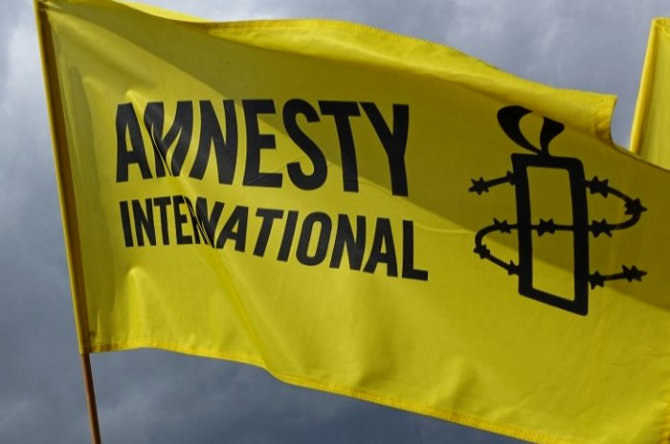
NEW DELHI: India is exploiting recommendations by a global money-laundering watchdog as a “draconian” tool to shutter civil society groups and suppress activists and critics, Amnesty International said Wednesday.
Government critics within civil society organizations and the media have long complained of harassment in the world’s biggest democracy under Prime Minister Narendra Modi’s Hindu-nationalist administration, a charge it strenuously denies.
Amnesty said the recommendations of the Paris-based Financial Action Task Force (FATF) were being abused to bring in “draconian laws to stifle the non-profit sector” and block organizations from funding.
The 39-nation FATF, of which India has been a member since 2010, is mandated to tackle global money laundering and terrorist financing.
Critics say Modi’s government has sought to pressure rights groups by heavily scrutinizing their finances and clamping down on foreign funding.
“Under the guise of combatting terrorism, the Indian government has leveraged the Financial Action Task Force’s recommendations to tighten its arsenal of financial and counter-terrorism laws which are routinely misused to target and silence critics,” Amnesty International India chair Aakar Patel said in a statement.
In the last 10 years, India has canceled the licenses of more than 20,600 non-governmental organizations, with nearly 6,000 of these taking place since 2022, the report said.
In 2020, Amnesty International had to suspend its Indian operations after its bank accounts were frozen.
The Indian government defended its move, accusing Amnesty of “illegal practices” involving the transfer of “large amounts of money” from Amnesty UK to India.
Journalists critical of the government also complain of increased harassment, both on social media — where Modi’s ruling party has a powerful presence — and in the real world.


India using anti-money laundering rules to ‘silence critics’: Amnesty
https://arab.news/r8u9e
India using anti-money laundering rules to ‘silence critics’: Amnesty

- Critics say Modi’s government has sought to pressure rights groups by heavily scrutinizing their finances


Philippines builds defense partnerships amid growing China aggression
- Island country forged new pacts with Japan, the UAE, Canada, Germany in past year
- Manila sees China’s maritime expansion as ‘quintessential security threat,’ expert says
MANILA: The Philippines and Japan have signed a new defense pact, adding to a growing list of security cooperation Manila has been forging with partner countries as it faces a growing Chinese presence in the disputed South China Sea.
Philippine-Japan security ties have strengthened in recent years over shared concerns in the region, with the two countries signing a landmark military pact in 2024, allowing the deployment of their forces on each other’s soil for joint military drills. It was Japan’s first such pact in Asia.
The new defense agreement — signed by Philippine Foreign Secretary Theresa Lazaro and Japanese Foreign Minister Toshimitsu Motegi in Manila on Thursday — is a follow-up to their 2024 pact, and would allow tax-free, reciprocal provision of ammunition, fuel, food and other necessities when their forces conduct joint training and disaster relief operations.
The security partnership is aimed at boosting deterrence against China, experts say.
“The latest defense pact with Japan is not only significant but also existential (as) a strong deterrence to China’s growing military size and ambition in the string of islands of the first island chain that includes Japan and the Philippines,” Chester Cabalza, founding president of the International Development and Security Cooperation think tank, told Arab News.
The Philippines, China and several other countries have overlapping claims in the disputed South China Sea, a strategic waterway through which billions of dollars worth of goods pass each year.
Beijing has maintained its expansive claims of the area, despite a 2016 international tribunal ruling that China’s historical assertion to it had no basis.
Japan has a longstanding territorial dispute with China over islands in the East China Sea, while Chinese and Philippine coast guard and navy ships have been involved in a series of tense incidents in the South China Sea in recent years.
“The imminent threat to maintain a status quo of peaceful co-existence in the region brings a shared responsibility for Manila and Tokyo to elevate strategic partnership to achieve this strategic equilibrium,” he said.
Motegi said he and Lazaro “concurred on continuing to oppose unilateral attempts to change the status quo by force or coercion in the East and South China seas,” in a clear rebuke of Beijing’s increasing assertiveness, without naming China.
The Philippines sees China’s maritime expansion as “the quintessential security threat,” said international studies expert Prof. Renato De Castro.
“So, of course, we rely on our efforts to build up our armed forces in terms of the comprehensive archipelagic defense operation,” he told Arab News.
The Philippines has a mutual defense treaty with the US, which the allies signed in 1951. While both governments have continued to deepen defense cooperation in recent years, Manila has also been building security partnerships with other countries.
The Philippines has signed two defense deals this month alone, including a Memorandum of Understanding on Defense Cooperation with the UAE, its first such deal with a Gulf country.
Last year, Manila signed military pacts with New Zealand and Canada, which sets the legal framework to allow military engagements, including joint drills, in each other’s territory. Both agreements still need to be ratified by the Philippine Senate to take effect.
The Philippines also signed a defense cooperation arrangement with Germany in May, aimed at boosting joint activities.


